
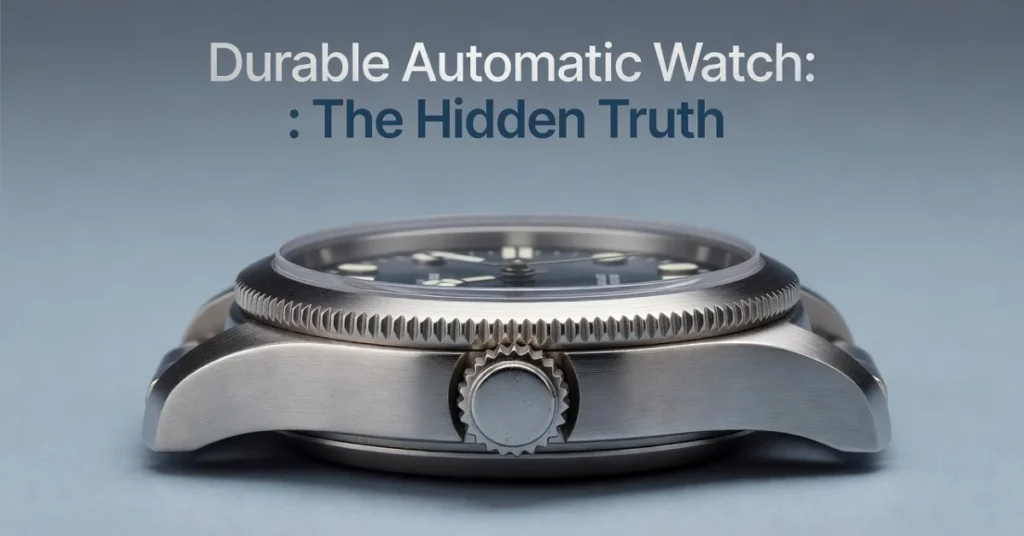
Most watch shoppers assume “automatic” and “durable” mean the same thing. They don’t, and that gap has ruined more than a few wrists over the years.
A durable automatic watch is a mechanical timepiece, powered by the motion of your wrist rather than a battery, built with case materials, movement construction, and water sealing strong enough to handle daily knocks, moisture, and years of wear without needing constant repair. That’s the exact keyword phrase this article is built around, and it matters because plenty of watches marketed as “automatic” are anything but tough.
Anyone who has actually worn a mechanical watch through years of daily use knows the difference shows up fast. A cheap automatic movement can lose accuracy within months. A well-built one, housed in the right case, can outlast the person wearing it.
What Makes a Durable Automatic Watch Different From a Regular One
Not every self-winding watch deserves the label “tough.” The mechanism inside, called the automatic or self-winding movement, uses a rotor that spins with wrist motion to wind the mainspring. That part is common across nearly all automatic watches, cheap or expensive.
What separates a genuinely tough piece from a fragile one comes down to three things: case construction, crystal material, and water resistance rating. Stainless steel and titanium cases resist dents and corrosion far better than plated alloys. Sapphire crystal resists scratches that would cloud a mineral glass face within a year of daily wear. And a screw-down crown paired with a real water resistance rating, not just a number printed on the dial, keeps moisture out of the movement.
Anyone who has managed a watch collection for more than a few years knows that movement quality alone won’t save a watch with a weak case. The two have to work together.
Real Examples of a Durable Automatic Watch People Actually Wear
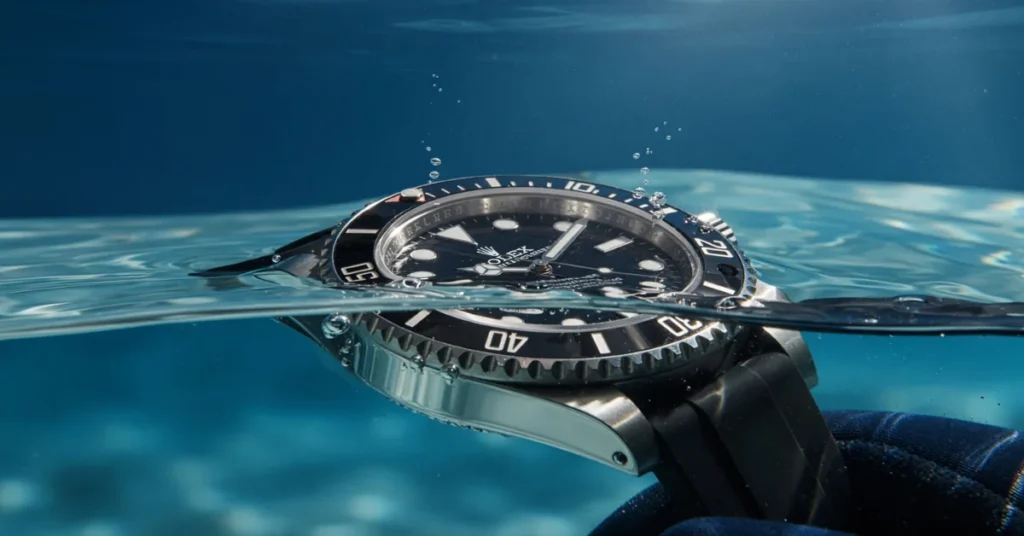
Field watches built for military use set the standard here. Cases built to shrug off knocks, straightforward dials that stay legible in bad light, and movements chosen for reliability over decoration. Divers follow the same logic, with unidirectional bezels and screw-down casebacks designed to survive actual submersion, not just a splash at the sink.
Seiko’s workhorse automatic movements, found across its dive and field lines, have built a reputation among tool-watch owners specifically because they keep running after years of rough handling. Citizen’s mechanical range leans on slim, magnetism-resistant case designs that hold up against the phones and laptops most people carry daily. On the higher end, Rolex’s Oyster case and Tudor’s Black Bay series get cited constantly by collectors as benchmarks for a durable automatic watch that survives decades of ownership, not just a warranty period.
None of this means expensive automatically equals durable. A $200 field watch with a hardened mineral crystal and a screw-down crown can outlast a $2,000 dress watch with a delicate case built for looks rather than abuse.
Case hardening treatments matter more than most buyers realize. Seiko applies a proprietary hardening coating on several of its steel cases that raises scratch resistance well beyond untreated stainless steel, while some German tool-watch makers use a nitrogen-based surface treatment for the same purpose. These coatings don’t touch the metal underneath, but they add a layer of scratch protection that shows up after years of daily contact with desks, doorframes, and tool belts.
Formal testing standards back a lot of this up too. Dive watches marketed as truly rugged usually carry ISO 6425 certification, which requires actual pressure and shock testing rather than a manufacturer’s own claim. Anti-magnetic resistance follows ISO 764, and shock resistance follows ISO 1413. A watch that lists these certifications has been tested against a fixed standard, not just described as tough in marketing copy.
Specific movement numbers back up the durability reputation too. Seiko’s widely used NH35 caliber runs at 21,600 vibrations per hour with a 41-hour power reserve, and it’s the same movement found inside Seiko’s own dive watches. ISO-certified divers built around the Miyota 8204 typically come with a 42-hour reserve paired with 200-meter water resistance and a screw-down crown. Those aren’t marketing numbers pulled from a brochure; they’re the documented specs that tool-watch buyers actually check before purchasing.
Pros and Cons Worth Weighing Before You Buy
There’s real upside to a durable automatic watch, and real tradeoffs too.
On the plus side: no battery to replace, a self-winding mechanism that keeps running as long as you wear it regularly, and materials that age well instead of degrading. Many owners also value the mechanical craftsmanship, the visible movement through an exhibition caseback, and the fact that a well-built piece can genuinely be passed down.
On the downside: automatic movements need servicing every five to seven years, which costs money most quartz owners never pay. They’re also less accurate than quartz movements by design, typically drifting a few seconds a day even in well-regulated pieces. And if you don’t wear the watch daily, it stops and needs manual winding or a watch winder to stay accurate.
Anyone shopping in this category has to weigh those tradeoffs honestly. It isn’t the right category for someone who wants zero maintenance and perfect accuracy.
What the Research Shows
Trade data from the watch industry paints a clear picture of where demand sits right now. Swiss watch export figures for 2025 put total value at roughly CHF 25.5 billion, a modest dip from the prior year, caused mostly by falling unit volume rather than falling interest in mechanical craftsmanship. Steel cases, the material most associated with everyday durability, remained one of the stronger-performing segments even as the broader export numbers softened.
That pattern lines up with what collectors and industry watchers have been noting through 2025 and into 2026: buyers are gravitating toward pieces built for daily wear over showpieces that stay in a drawer. Interest in tool-style automatic watches, the kind built specifically for durability, has held up even while luxury spending in some regions has cooled.
Professionals who service and sell watches for a living consistently report the same thing. Buyers are asking fewer questions about complications and more questions about water resistance, crystal type, and how well a piece handles daily abuse.
How to Choose One That Actually Lasts
Start with the case material. Stainless steel or titanium beats plated metals every time for long-term wear. Check the crystal next, since sapphire resists scratches that mineral glass simply can’t handle over years of use.
Look at the water resistance rating and confirm it’s backed by a screw-down crown, not just a number stamped on the dial for marketing. A 100-meter rating with a screw-down crown means far more than a 200-meter rating without one.
Finally, check the movement’s reputation. Trusted calibers from Seiko, Miyota, ETA, and in-house Swiss movements all have long track records. Newer or unnamed movements from unfamiliar brands carry more risk, even if the specs on paper look identical.
A quick comparison helps:
- Case: stainless steel or titanium over plated alloys
- Crystal: sapphire over mineral glass
- Water resistance: screw-down crown plus a tested rating, not just a printed number
- Movement: a caliber with a documented, long service history
- Price tier: durability exists at every price point, from $200 field watches to five-figure dive watches
| Feature | Budget durability | Mid-range durability | Premium durability |
|---|---|---|---|
| Case | Stainless steel | Steel or titanium | Titanium or hardened steel |
| Crystal | Hardened mineral | Sapphire | Sapphire with anti-reflective coating |
| Water resistance | 30–100m | 100–200m | 200–300m |
| Movement | Miyota/Seiko NH35 | ETA or Sellita | In-house Swiss caliber |
| Typical service cost | $100–150 | $150–300 | $400–800+ |
The bracelet or strap matters just as much as the case, and it’s the part most buying guides skip entirely. A solid-link steel bracelet resists wear and stretches far less over years of daily use than a hollow-link bracelet, even when both look identical on a shelf. Leather straps age well with proper care but weaken faster around water exposure and sweat, while rubber or fluoroelastomer straps hold up better for anyone who swims, dives, or works outdoors. Anyone buying a durable automatic watch for daily, active wear should weigh the strap or bracelet choice with the same seriousness as the case material.
It’s also worth understanding what a printed water resistance rating actually means. That number comes from a static pressure test performed once, on a new watch, in laboratory conditions. It doesn’t account for gasket wear, temperature swings, or years of crown use, which is exactly why watchmakers re-test water resistance during routine service. A five-year-old watch rated for 200 meters isn’t automatically still safe at that depth without a gasket check, even though the case and movement remain otherwise sound.
Keeping It Durable: What Ongoing Care Actually Looks Like
Buying the right piece is only half the job. Anyone who has kept a mechanical watch running for a decade or more knows that basic habits matter as much as the specs on paper.
Rinse the case and bracelet after exposure to saltwater or sweat, since both speed up corrosion around case seams over time. Avoid winding the crown while it’s still screwed down, since forcing it can strip the threads that keep water out in the first place. And don’t assume a high water resistance number means the watch can handle hot showers or diving without the crown properly secured first.
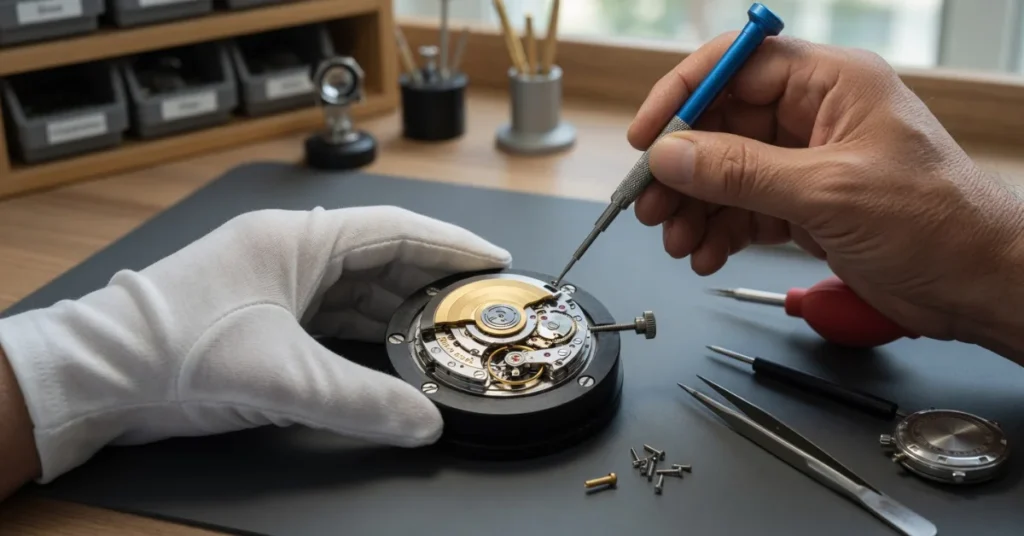
First-time buyers often skip the service interval entirely, assuming a mechanical watch runs forever without attention. It doesn’t. Skipping service for ten or fifteen years typically costs more in the end, since dried-out lubricant can damage components that would have been a simple, cheap fix if caught early.
Buyers who travel often should also know that automatic movements can be sensitive to strong magnetic fields from laptop speakers, phone cases with magnetic closures, and some induction chargers. Most modern movements resist everyday exposure fine, but a watch that suddenly starts running fast or slow is often a magnetism problem, not a mechanical failure, and it’s usually an easy fix at a watchmaker.
Who Should Actually Buy One
A durable automatic watch makes sense for people who wear one watch daily and want it to survive years of real use, not a display case. It’s a strong fit for anyone working outdoors, traveling frequently, or simply tired of replacing batteries and cheap quartz movements every couple of years.
It’s a weaker fit for collectors who rotate through several watches and won’t wear any single piece often enough to keep it wound, or for buyers who prioritize split-second accuracy over mechanical craftsmanship.
Conclusion
A durable automatic watch isn’t just about price or a brand name. It comes down to case material, crystal quality, water sealing, and a movement with a real track record. Get those basics right, and a mechanical watch can genuinely outlast the person who bought it, riding out decades of daily wear the way a well-built tool should.
FAQs
Is an automatic watch automatically more durable than a quartz watch?
No. Durability comes from case material, crystal type, and water sealing, not from the movement type alone. A well-built quartz watch can outlast a poorly built automatic.
How often does a durable automatic watch need servicing?
Most manufacturers recommend service every five to seven years to keep the movement running accurately and to replace worn lubricants.
Can a durable automatic watch survive daily bumps and drops?
Watches built with hardened steel or titanium cases and screw-down crowns are designed to handle daily knocks far better than dress watches built primarily for looks.
Is an affordable automatic watch actually durable?
Yes. Several models under $300 use proven movements and solid steel cases that match or exceed the toughness of far more expensive pieces.
What’s the biggest mistake buyers make when choosing one?
Focusing on brand name over specifications. A durable automatic watch depends on case material, crystal, and water resistance far more than the logo on the dial.