
You feel it first in the steering wheel. A light buzz around 55 mph that turns into a full-body rumble by 70. If you’re asking why does my car shake at high speeds, you’re dealing with one of the most common complaints mechanics hear, and the good news is that the cause is almost always traceable.
Anyone who has spent time under a car on a lift knows the culprit is rarely mysterious once you know where to look. A shake that builds with speed points to something spinning out of balance. A shake tied to braking points somewhere else entirely. This guide walks through the real reasons your car shakes at high speeds, how to tell them apart, and what a fix typically costs.
Why Does My Car Shake at High Speeds? The Short Answer
In most cases, why does my car shake at high speeds comes down to one of several things: unbalanced tires, a bent wheel, worn suspension parts, a warped brake rotor, a wheel bearing, an engine or mount issue, or a failing driveline component. Each of these creates vibration through a different mechanism, but they share one trait. The faster the wheels spin, the more the imperfection gets amplified.
Think of a washing machine with an uneven load. At low spin speeds it barely wobbles. Crank up the cycle and the whole machine starts walking across the floor. Your car’s wheels work the same way. A tiny imbalance that’s invisible at 20 mph becomes impossible to ignore at 65.
Quick Symptom Checker
Before digging into each specific cause behind why does my car shake at high speeds, here’s a fast way to narrow things down based on where you feel it and when it happens.
| Where You Feel It | When It Happens | Likely Cause |
|---|---|---|
| Steering wheel | Builds steadily from 45-65 mph | Unbalanced or damaged front tire |
| Seat or floor | Builds steadily from 45-65 mph | Unbalanced or damaged rear tire |
| Steering wheel + pedal pulse | Only when braking | Warped brake rotor |
| Whole car, humming that grows | Gradual, worsens with speed | Failing wheel bearing |
| Steering wheel + wandering feel | Highway speed, worse over bumps | Worn ball joint, tie rod, or suspension bushing |
| Whole car, shudder in waves | Under acceleration or climbing a grade | Worn CV joint, axle, or driveshaft |
| Whole car, feels like rumble strips | Fairly constant, not speed-dependent | Failing motor mount |
| Steering wheel, mild and constant | Any speed, doesn’t build or fade | Under-inflated or unevenly inflated tire |
This table won’t replace a proper inspection, but it gives you a starting point before you call a shop.
Unbalanced or Damaged Tires
Tire imbalance is the single most common reason drivers notice shaking on the highway. Every tire has small weight variations built in during manufacturing, which is why shops attach small lead or zinc weights to the rim during a balance.
Over time, those weights can fall off after hitting a pothole or curb. Tires also wear unevenly, develop flat spots from sitting parked for weeks, or suffer an internal belt separation that no amount of rebalancing will fix.
- Vibration usually starts between 45 and 60 mph
- It’s often felt in the steering wheel if the front tires are the issue
- It shows up in the seat or floor if a rear tire is out of balance
A quick way to narrow this down is a visual check for uneven tread wear, cupping, or a bulge in the sidewall. If you spot any of those, a tire shop visit should move to the top of your list.
Two smaller tire issues get overlooked often. Under-inflated or unevenly inflated tires can produce a mild, constant vibration that doesn’t build with speed the way an imbalance does, and it’s the cheapest possible fix since a pressure check takes two minutes at any gas station. And even brand-new tires can cause a shake if they weren’t mounted and balanced correctly at installation, so a fresh set that starts vibrating right away points back to the shop that installed them, not to the tires themselves.
Bent Wheels and Rim Damage
A pothole hit hard enough can bend a wheel rim without leaving a visible dent. Aluminum alloy wheels, which make up most modern cars, are lighter but less forgiving than old steel rims when it comes to impact damage.
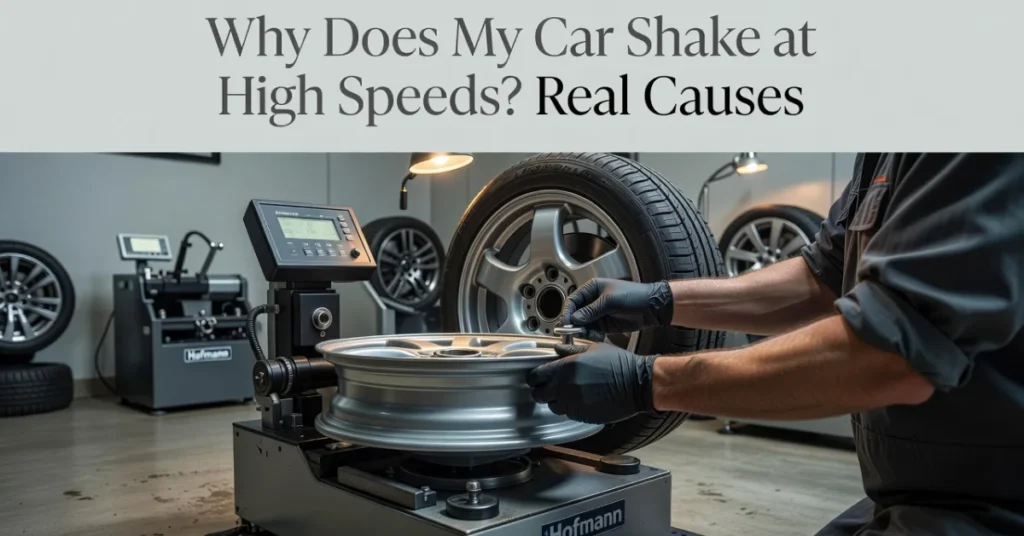
A bent wheel throws off the entire rotating assembly, and no amount of rebalancing solves it. Shops check for this with a dial indicator on a wheel balancer, and in most cases the wheel needs to be replaced rather than repaired.
Worn Suspension and Steering Components
This is where the answer to why does my car shake at high speeds gets a little more involved. Ball joints, tie rod ends, control arm bushings, and sway bar links all wear out over tens of thousands of miles, and any one of them going loose can introduce vibration.
Professionals in this field will tell you the tell-tale sign here is a shake paired with a wandering feeling in the steering wheel, or a clunk over bumps. If the front end feels vague rather than sharp on the highway, worn suspension parts are worth checking before you spend money on a new set of tires.
Struts and shock absorbers matter too. Once they lose their damping ability, the wheel keeps bouncing slightly after every road imperfection instead of settling, and that constant micro-bounce turns into a shake at speed.
A Failing Wheel Bearing
A wheel bearing deserves its own mention because its symptom pattern is genuinely different from the others. Instead of a sharp buzz, it usually starts as a low hum or growl that grows into a grinding sound as the bearing wears further, and that noise gets louder the faster you drive.
Anyone who has replaced a bearing knows the vibration tends to show up gradually over weeks or months rather than appearing suddenly after hitting a pothole. A simple check is to have someone listen from outside the car while you drive slowly in a straight line and then gently weave; a wheel bearing issue often gets louder when weight shifts onto the affected side. Left alone long enough, a bearing can seize entirely, so this isn’t one to put off.
Engine Misfires and Motor Mounts
Not every shake comes from the rotating assembly. If the vibration shows up mainly while accelerating rather than at a steady cruise, a bad spark plug, a failing ignition coil, or a fuel delivery problem could be misfiring the engine and shaking the whole car through the frame.
A related but separate issue is a failing motor mount. Mounts are rubber-and-metal brackets that hold the engine in place and absorb its natural vibration. Once a mount cracks or collapses, that vibration transfers directly into the cabin instead of being absorbed, and drivers often describe the feeling as similar to rolling over rumble strips, even on smooth pavement. Unlike tire or wheel issues, this type of shake doesn’t necessarily build with road speed since it’s tied more to engine load than wheel rotation.
Why Does My Car Shake at High Speeds When Braking?
If the shaking only shows up, or gets noticeably worse, when you press the brake pedal, the rotors are the likely source. Repeated hard stops or driving through deep water right after hard braking can cause uneven heat buildup on the rotor surface, leaving high and low spots.
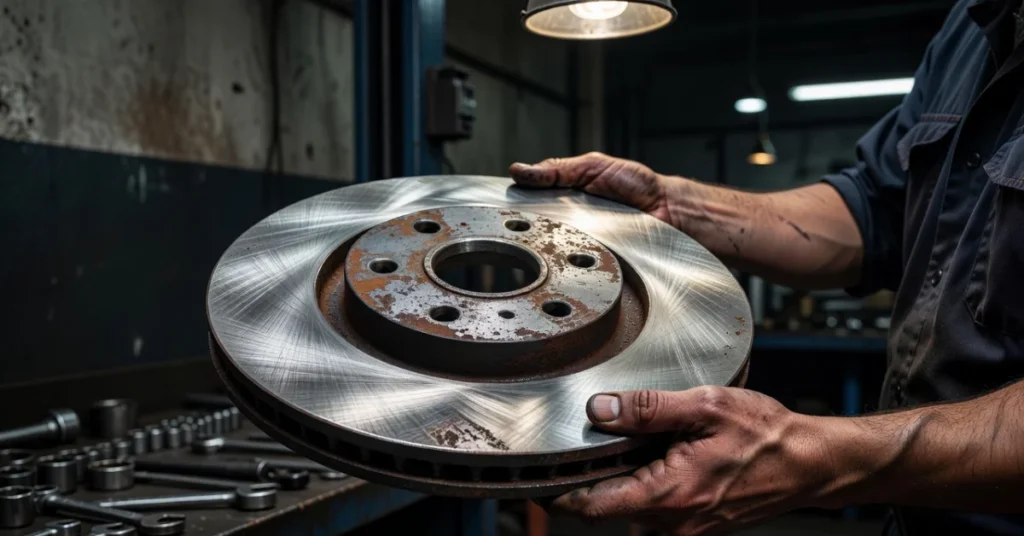
That uneven surface is what you feel as pulsing through the pedal or a shake through the steering wheel during braking. Resurfacing the rotor can sometimes fix mild cases, but a rotor with more pronounced warping usually needs full replacement along with fresh pads.
Driveline and Axle Problems
On front-wheel-drive and all-wheel-drive vehicles, a worn CV joint or a damaged axle can create a shake that gets worse as you accelerate through highway speeds. A clicking sound during turns is often the first warning sign before the vibration sets in.
Rear-wheel-drive vehicles can develop a similar issue in the driveshaft, particularly at the U-joints. A driveline vibration tends to feel different from a tire imbalance. It’s often described as a shudder that comes in waves rather than a steady buzz, and it typically gets worse under load, like climbing a hill at highway speed.
What the Research Shows
Detailed analysis from major automotive service networks consistently points to the same pattern. Tire and wheel balance issues account for the largest share of high-speed vibration complaints brought into repair shops, followed by suspension wear and brake rotor problems. Government road safety data has also long identified worn tires and suspension components among the contributing factors in loss-of-control crashes on highways, which is one reason regulators continue to push for regular vehicle inspections.
Interest in do-it-yourself vehicle diagnostics has grown noticeably through 2025 and into 2026, with more drivers turning to online resources before booking a shop visit. Mechanics report that customers now arrive with a much clearer idea of what might be wrong, even if the final diagnosis still requires a hands-on inspection.
How Mechanics Actually Diagnose It
A shop won’t just guess. The typical process starts with a road test to note the speed range where the shake appears and whether braking, acceleration, or turning changes it. From there, a technician will spin each wheel on a balancer, check for bent rims, inspect suspension bushings and ball joints by hand, and measure rotor thickness variation with a dial gauge.
Anyone who has managed a repair shop knows that skipping this diagnostic order is how customers end up paying for four new tires when the real issue was a forty-dollar wheel weight that fell off. A proper diagnosis usually takes less than an hour and saves money down the line.
Is It Safe to Keep Driving?
A mild vibration that only shows up above 65 mph is rarely an emergency, but it’s not something to put off indefinitely either. A worn CV joint or a badly warped rotor can fail without much warning, and a bent wheel under enough stress can crack. If the shake is severe, paired with a burning smell, a grinding noise, or a dashboard warning light, treat it as urgent and have the car looked at before your next long drive.
Cost to Fix a Car That Shakes at High Speeds
Once you know what’s behind why does my car shake at high speeds, cost is usually the next question. Prices vary by region and vehicle, but here’s a general range shops quote for the most common repairs:
- Tire balancing: usually under $75 for a full set
- Wheel alignment: typically $100 to $200
- Replacing a bent wheel: $150 to $500 depending on material
- Brake rotor replacement: $150 to $300 per axle
- CV axle replacement: $200 to $450 per side
- Wheel bearing replacement: $150 to $400 per wheel
- Motor mount replacement: $150 to $300 per mount
Catching the problem early almost always costs less than waiting. A wheel bearing that’s ignored can eventually take out a hub assembly, turning a moderate repair into a much bigger one.
For Drivers Without a Mechanical Background
Not every driver who asks why does my car shake at high speeds has a mechanical background, and that’s fine. If you’ve never popped a hood before, don’t worry. You don’t need to diagnose the exact part to take the right first step. Note the speed the shake starts at, whether it changes under braking, and whether it’s felt in the wheel, the seat, or the whole car. That single description, handed to a service advisor, cuts diagnostic time dramatically and helps you avoid paying for guesswork.

Conclusion
So, why does my car shake at high speeds? Nine times out of ten, it traces back to tires, wheels, suspension, bearings, engine mounts, brakes, or the driveline, and each of those has a distinct symptom pattern once you know what to look for. Ignoring a highway vibration rarely makes it go away on its own, and in 2026, with tire and part prices what they are, an early fifty-dollar balance job still beats a late five-hundred-dollar repair. Get it checked, get the answer, and get back to a smooth ride.
FAQs
Why does my car shake at high speeds but not at low speeds?
Rotating imbalances like an unbalanced tire or a bent wheel create vibration that grows with speed, so it can be unnoticeable under 40 mph and obvious by 65.
Can bad alignment cause my car to shake at high speeds?
Alignment issues usually cause pulling to one side or uneven tire wear more than shaking, so a shake alone points more toward balance, brakes, bearings, or suspension.
Is it dangerous to keep driving if my car shakes at high speeds?
A mild shake can often wait for a scheduled appointment, but a severe or worsening shake, especially with noise or a warning light, should be checked right away.
How much does it cost to fix a car that shakes at highway speed?
Simple fixes like tire balancing run under $75, while bigger repairs like axle, bearing, or rotor replacement can run $150 to $450 depending on the part and vehicle.
Will new tires fix a car that shakes at high speeds?
Only if worn or damaged tires are the actual cause. If the real problem is a bent wheel, worn suspension, a bearing, or a driveline part, new tires alone won’t solve it.