

Stepping on the gas pedal shouldn’t feel like a small jolt through the whole car, but for a lot of drivers, that’s exactly what happens. If you’ve been asking yourself why does my car jerk when I accelerate, you’re dealing with one of the most common complaints mechanics hear. The good news? It’s rarely a mystery once you know where to look.
That jerking motion usually comes down to one of three systems fighting for control: fuel delivery, ignition, or the transmission. Sometimes it’s a fifteen-dollar part. Other times it’s a warning sign you shouldn’t ignore.
Why Does My Car Jerk When I Accelerate? The Short Answer
In most cases, your engine isn’t getting a clean, steady supply of fuel and air, or the spark that ignites that mixture is weak or inconsistent. Either problem causes what’s called a misfire — the engine briefly stumbles, then catches up, and you feel that as a jerk or buck.
Anyone who’s driven an older car with a few hundred thousand miles on it knows this feeling well. It’s not random. It builds up over time as parts wear down or get dirty.
Before going deeper, here’s a quick reference table matching what you’re feeling to what’s likely going on underneath:
| When It Happens | Likely Cause | Typical DIY Fix? |
|---|---|---|
| At idle and low speed | Dirty fuel injectors, vacuum leak | Sometimes — injector cleaner is DIY-friendly |
| During hard acceleration or uphill | Clogged catalytic converter, worn spark plugs | Spark plugs yes, converter usually no |
| Right at gear changes | Low transmission fluid, worn clutch | Fluid top-up yes, clutch no |
| Only when cold | Vacuum leak, dirty throttle body | Throttle body cleaning yes |
| Constant, at every speed | Failing ignition coil, mass airflow sensor | Sensor cleaning yes, coil replacement usually a shop job |
Use this as a starting point, not a final diagnosis. A code reader will narrow things down further, which we’ll get to below.
Common Reasons Your Engine Hesitates and Jerks
Here’s a breakdown of the usual suspects, starting with the most frequent offenders mechanics actually see on the lift.
Dirty or Failing Fuel Injectors
Fuel injectors spray a precise mist of gasoline into each cylinder. Over tens of thousands of miles, they collect grime and start spraying unevenly. When you press the gas, the engine suddenly needs more fuel, and a dirty injector can’t keep up. That’s a jerk or hesitation right as you accelerate.
A fuel system cleaning treatment or a professional injector cleaning service often solves this without needing new parts. It’s usually the first, cheapest thing worth trying.
Worn Spark Plugs and Ignition Coils
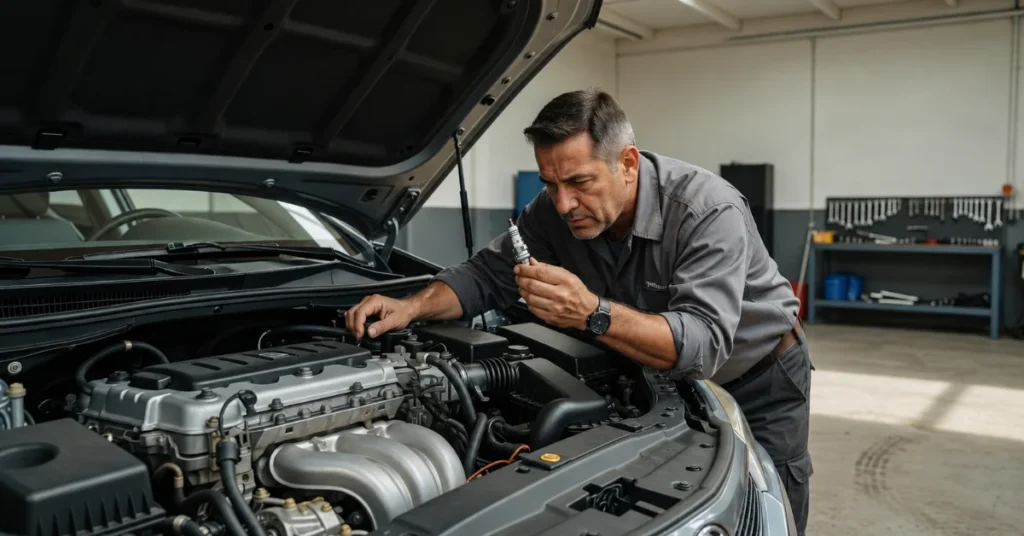
Spark plugs ignite the fuel-air mixture in each cylinder, thousands of times a minute. Once they wear down or get fouled with carbon, the spark weakens and combustion becomes incomplete. Ignition coils — which boost battery voltage into the spark plugs — fail the same way, often one cylinder at a time.
Drivers describe this as a rough idle at stoplights that turns into a noticeable jerk once they press down on the pedal. Replacing spark plugs is one of the cheapest fixes on this whole list, and most shops can do it in under an hour.
Clogged Catalytic Converter
This one surprises a lot of people. The catalytic converter cleans up exhaust gases before they leave the tailpipe, and when it clogs, exhaust can’t flow out properly. That backpressure chokes the engine right when it’s trying to breathe hardest — during acceleration.
Symptoms usually include a sulfur or rotten-egg smell, sluggish power, and a check engine light. A clogged converter is often the real reason behind why does my car jerk when I accelerate on hills or highway on-ramps specifically, where the engine is working hardest.
Dirty Air Filter or Mass Airflow Sensor
The mass airflow sensor measures how much air enters the engine so the computer knows how much fuel to add. If it’s coated in dust or oil residue, it sends bad readings, and the fuel mixture goes off balance. A clogged air filter causes a similar problem by starving the engine of clean air.
Both are cheap parts, and both are worth checking before spending money on anything bigger.
Vacuum Leaks
A vacuum leak lets unmeasured air into the engine, past the sensors that are supposed to track it. The computer ends up adding the wrong amount of fuel for the air it thinks is coming in, and the result is a rough idle that turns into a jerk under acceleration. Cracked hoses and brittle intake gaskets are the usual culprits, especially on cars past the 80,000-mile mark.
This one gets missed a lot because it doesn’t throw an obvious symptom at idle. A mechanic will usually spray a bit of carb cleaner around suspect hoses and listen for a change in idle speed to track it down.
Dirty Throttle Body
The throttle body controls exactly how much air enters the engine when you press the pedal. Carbon deposits build up on the internal walls over time, especially in stop-and-go city driving, and that buildup makes the throttle plate stick or respond unevenly.
Drivers usually notice this as a delay right when they press the gas, followed by a jerk once the engine catches up. A throttle body cleaning is inexpensive and something a confident DIYer can handle in under an hour with the right cleaner and a rag.
Transmission Trouble
If the jerking happens specifically around gear changes rather than steady acceleration, look at the transmission instead of the engine. Low or dirty transmission fluid causes slipping and hesitation. In manual cars, a worn clutch produces the same jerky sensation as it struggles to engage smoothly.
Transmission issues tend to get worse fast, so this is one area where waiting rarely pays off.
Why Does My Car Jerk When I Accelerate in an Automatic vs a Manual?
The distinction matters more than most drivers realize. In an automatic, jerking during acceleration often points to transmission fluid problems, a failing torque converter, or a solenoid that’s stuck. In a manual, it’s more likely clutch wear, a stretched cable, or the driver riding the clutch without realizing it.
Mechanics who work on both types will tell you the diagnostic path splits early. That’s why describing exactly when the jerk happens — at low speed, high speed, during gear shifts, or constantly — makes a real difference to whoever ends up looking under the hood.
What About Electric and Hybrid Cars?
Most advice on this topic assumes a gas engine, but EV and hybrid owners feel jerky acceleration too, and the causes are different. There’s no spark plug or catalytic converter to blame here.
In EVs, jerking usually comes from aggressive regenerative braking settings that fight against your foot on the pedal, or from a software throttle-mapping glitch that a manufacturer update can fix. In hybrids, the jerk often happens right at the handoff point between the electric motor and the gas engine kicking in, which can point to a weakening 12-volt battery or a transmission control module that needs a firmware update.
If you drive an EV or hybrid and none of the fuel or ignition causes above apply to you, start with your manufacturer’s app or dealer for a software check before assuming something’s mechanically broken.
Common OBD-II Codes Linked to Jerky Acceleration
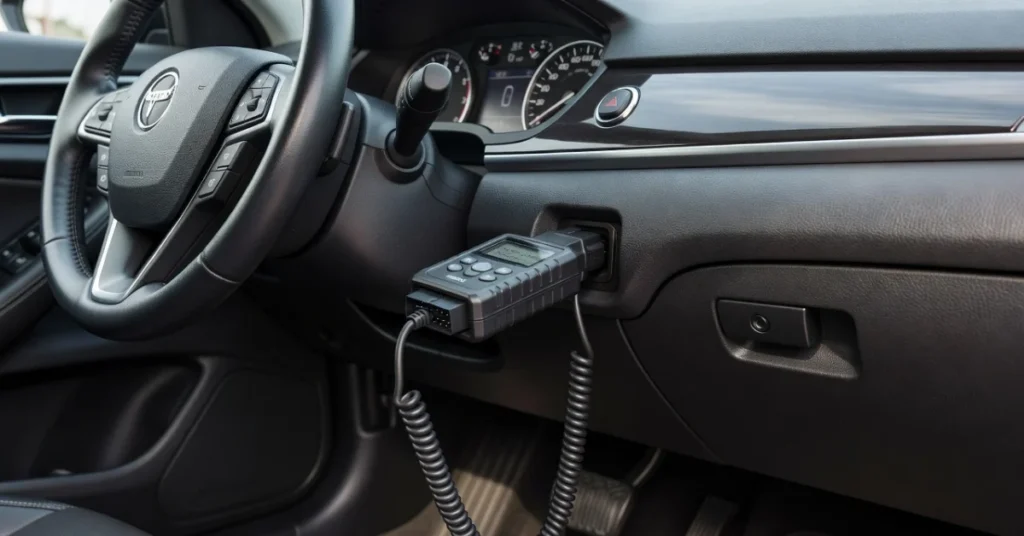
If your check engine light is on, a scan tool will usually point you toward one of these code families:
- P0300–P0308 — engine misfire, often tied to spark plugs or ignition coils
- P0171 / P0174 — fuel system running lean, a common vacuum leak or MAF sensor signal
- P0420 / P0430 — catalytic converter efficiency below threshold
- P0700 series — transmission control system fault
None of these codes tell you the exact part to replace on their own. Think of them as a starting point that narrows down which of the systems above needs a closer look.
What the Research Shows
Detailed breakdowns from automotive diagnostic sources consistently point to the same top three causes: fuel delivery problems, ignition misfires, and exhaust restriction from a failing catalytic converter. Multiple repair-shop write-ups from 2025 and into 2026 rank dirty fuel injectors and worn spark plugs as the single most frequent cause reported by drivers experiencing this exact symptom.
Shops also note a pattern worth mentioning: cars that skip routine maintenance, oil changes, filter swaps, fluid checks, tend to develop jerking symptoms months or years before a comparable, well-maintained vehicle does. That’s not a coincidence. Small deferred problems compound into bigger, more expensive ones.
When to See a Mechanic vs When to DIY
A few checks anyone can do at home:
- Check the air filter — pull it out and hold it up to light. If you can’t see through it, replace it.
- Check transmission fluid level and color, using the dipstick if your vehicle has one.
- Listen for a check engine light and pull the code with a basic OBD-II scanner, which costs less than a tank of gas.
Anything involving fuel injectors, ignition coils, or a catalytic converter replacement is best left to a professional. These parts require specific tools and, in the case of the catalytic converter, often legal disposal requirements tied to emissions regulations.
How to Prevent Jerking Before It Starts
Regular maintenance beats reactive repairs every time. Swap spark plugs on the schedule your manufacturer recommends, usually somewhere between 30,000 and 100,000 miles depending on the plug type. Change the fuel filter and air filter on schedule. Use a mid-grade or top-tier gasoline brand, since cheaper fuel leaves more deposits behind in the injectors and converter over time.
None of this is complicated, and none of it is expensive compared to a transmission rebuild or a new catalytic converter.
Conclusion
So, why does my car jerk when I accelerate? Nine times out of ten, it traces back to fuel delivery, a weak spark, or a restricted exhaust system, all of which show up as the same rough, jerky feeling under the pedal. Catch it early with a scan tool and a look at the basics, and most fixes stay cheap. Ignore it, and you risk turning a fifteen-dollar spark plug into a much bigger repair bill down the road.
FAQs
Is it safe to keep driving if my car jerks when accelerating?
Short trips are usually fine, but don’t put it off for long. A misfire or clogged converter left unaddressed can damage the engine or exhaust system further.
Can bad gas cause my car to jerk when I accelerate?
Yes. Low-quality fuel leaves deposits in the injectors and can even trigger a temporary rough patch that clears up after a tank or two of good gasoline.
Why does my car jerk only when accelerating uphill?
Uphill driving demands more power, which exposes weaknesses like a clogged catalytic converter or worn spark plugs that might not show up during flat, steady driving.
Does a transmission fluid change fix jerky acceleration?
Sometimes, if low or degraded fluid was the cause. It won’t help if the real problem is with the engine’s fuel or ignition system instead.
How much does it cost to fix a car that jerks when accelerating?
It varies widely — spark plugs might run under $150 installed, while a catalytic converter replacement can run several hundred to a couple thousand dollars depending on the vehicle.