
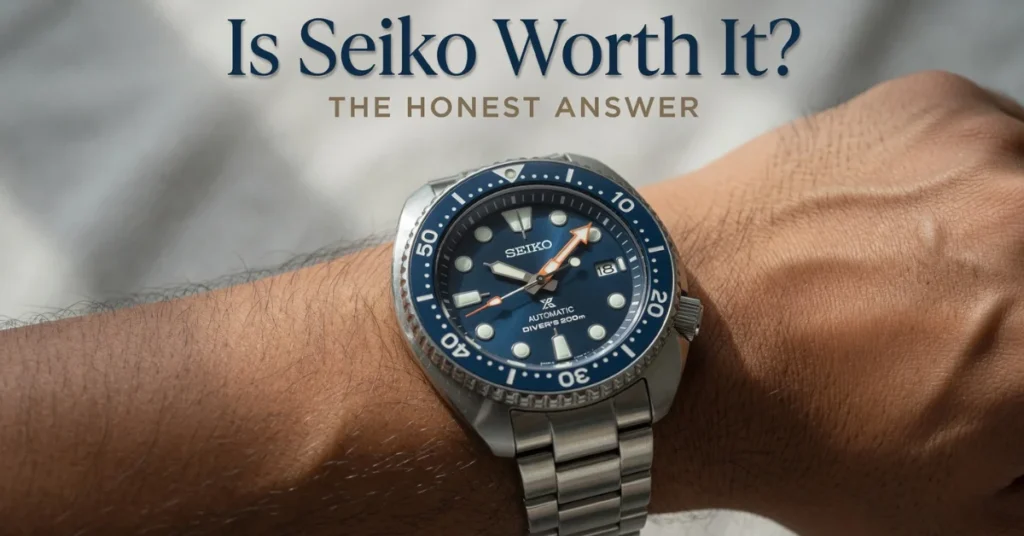
Walk into any watch forum and someone, somewhere, is asking the same question: is Seiko a good watch brand, or is that reputation just internet hype? It’s a fair question. Seiko doesn’t spend Swiss-luxury money on marketing, and it sells watches at prices that make some buyers suspicious of the quality behind them.
Here’s the short version. Yes, Seiko is a good watch brand, and it’s earned that standing the hard way, through more than a century of engineering rather than clever branding. But the full answer depends on which Seiko you’re actually looking at, because the company spans everything from $60 quartz field watches to Grand Seiko pieces that rival anything coming out of Switzerland.
Is Seiko A Good Watch Brand? Start With the History
Seiko traces back to 1881, when a young Tokyo shopkeeper named Kintaro Hattori started repairing clocks and watches out of a small storefront. That shop grew into a company that would go on to reshape the entire watch industry less than a century later.
In 1969, Seiko released the Quartz Astron, the world’s first quartz wristwatch. It wasn’t a minor product launch. It triggered what the industry still calls the Quartz Crisis, a period where Swiss mechanical watchmakers scrambled to survive as battery-powered movements proved cheaper, more accurate, and far easier to mass produce. Anyone who has studied twentieth-century watchmaking knows that single release changed how the world thinks about timekeeping.
That history matters when you’re weighing is Seiko a good watch brand as a purchase decision. This isn’t a company that got lucky with one viral product. It’s one of the few watchmakers on the planet that designs, manufactures, and assembles its own movements in-house, a level of vertical control that most brands, including several well-known Swiss names, simply don’t have.
The Full Seiko Lineup, Explained
New buyers often don’t realize how wide the Seiko catalog actually is. It’s not one brand with one identity. It’s closer to seven distinct product families under a single name.
| Collection | Typical Price Range | Positioning | Best For |
|---|---|---|---|
| Seiko 5 Sports | $70–$300 | Entry automatic | First-time buyers |
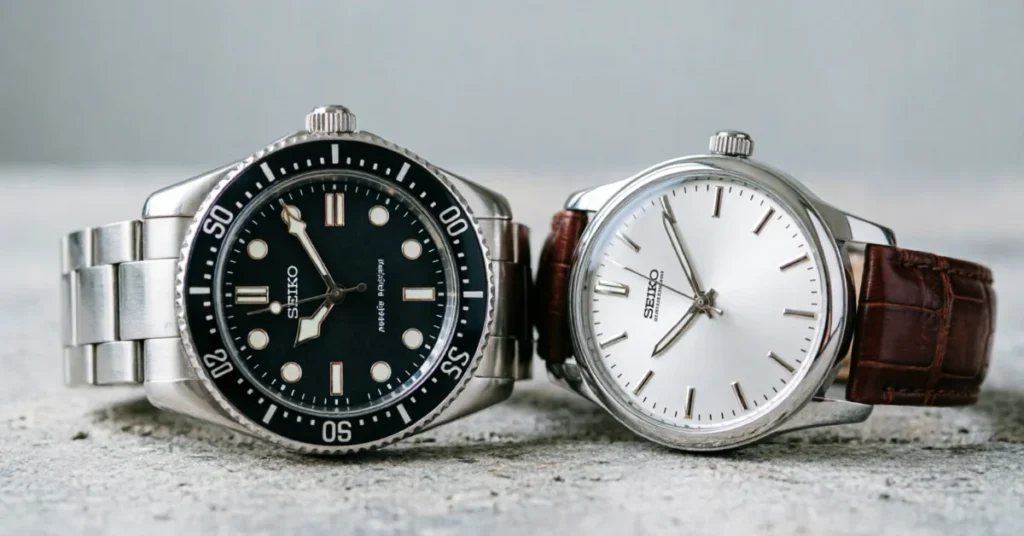
| Presage | $250–$900 | Dress and craft dials | Everyday elegance |
| Prospex | $300–$3,000 | Dive and sport tool watches | Outdoor and diving use |
| Astron | $1,000–$3,500 | GPS solar hybrid | Frequent travelers |
| King Seiko | $2,000–$5,000 | Precision dress heritage | Collectors wanting refinement |
| Premier | $500–$1,500 | Formal, slim dress pieces | Business and formal wear |
| LX Line | $2,500–$6,000 | Premium sport-luxury | High-end everyday wear |
Popular entry points like the Seiko 5 Sports SRPG37 field watch and the SSK005 GMT sit at the accessible end, while the Presage Cocktail Time has built a reputation among dress-watch buyers, carrying well over a thousand customer reviews and a rating hovering around 4.7 stars, one of the highest averages anywhere in the Seiko catalog. On the tool-watch side, the Prospex King Samurai and SPB149 diver deliver sapphire crystal, ceramic bezels, and genuine dive-rated water resistance rather than decorative specs.
What Actually Makes a Watch Brand “Good”
Before judging Seiko, it helps to define the yardstick. Watch collectors typically weigh a brand against a handful of criteria:
- Movement quality and in-house engineering
- Case and bracelet construction
- Long-term reliability and accuracy
- Value relative to price
- Design consistency and heritage
- After-sales service and parts availability
Seiko performs strongly across nearly every one of those categories, though not uniformly. A $70 Seiko 5 field watch and a $6,000 King Seiko share a brand name and factory heritage, but they’re built to different standards. Judging the whole brand off one entry-level piece would be like judging Toyota purely by the cheapest trim of a Corolla.
Seiko Movement Calibers: The Numbers Behind the Reputation
This is the part most articles skip, and it’s exactly where the real answer to is Seiko a good watch brand lives. Movement specs tell you more than marketing copy ever will.
| Caliber | Vibrations/Hour | Power Reserve | Factory Accuracy | Found In |
|---|---|---|---|---|
| 4R35 / 4R36 | 21,600 bph | 40–41 hours | +45/-35 sec/day | Seiko 5 Sports, entry Prospex |
| 6R35 | 21,600 bph | 70 hours | +25/-15 sec/day | Presage, Prospex SPB, King Seiko |
| Spring Drive | Quartz-regulated | 72+ hours | ±1 sec/day | Grand Seiko, LX Line |
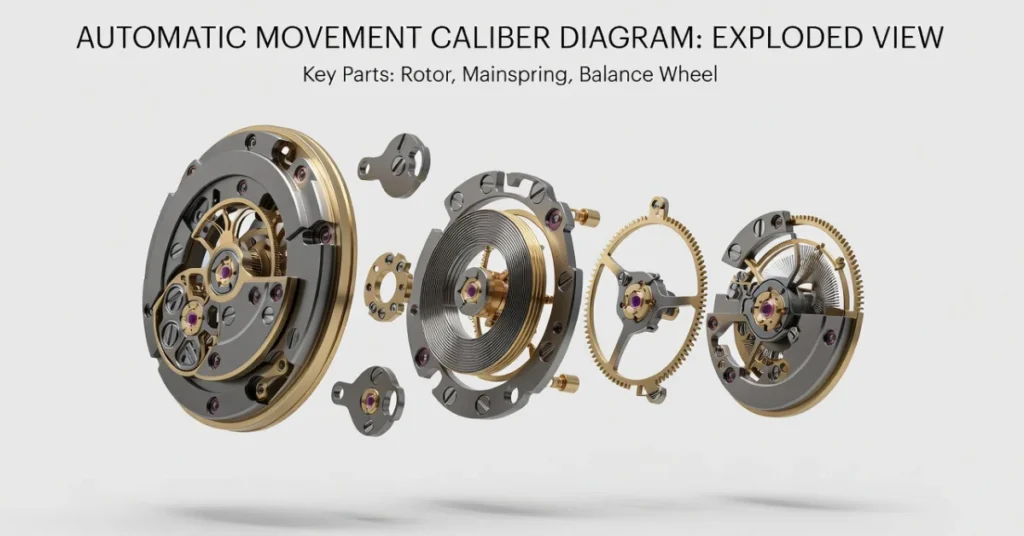
The jump from the 4R-series to the 6R35 is significant. A watch removed on a Friday evening and running on a 4R36 will likely stop by Sunday. The same watch on a 6R35 will still be ticking Monday morning, a genuinely useful difference for anyone rotating between multiple watches. Reviewers testing the Prospex line under real conditions have measured accuracy landing close to eight seconds fast per day on 4R-series watches, comfortably inside the factory tolerance and well within what most daily wearers would ever notice.
Build Quality: Where Seiko Genuinely Shines
People who have owned a Seiko for years tend to describe the same thing: watches that keep running long after cheaper competitors have died. That’s not marketing spin, it’s a function of the components.
Seiko controls every part of production for its core calibers instead of outsourcing to third-party movement makers the way most microbrands do. Seiko’s Lumibrite lume also deserves a mention. Anyone who’s worn a Prospex diver at night knows the lume stays visible for hours, not minutes, which matters if you plan to actually use the watch for diving or low-light work rather than just wearing it for looks.
Even at entry-level price points, cases tend to feel solid rather than hollow. The unidirectional bezel on Prospex divers clicks firmly into place with no play, which is exactly what a dive watch needs to be trustworthy underwater.
Where Seiko Falls Short
No honest assessment skips the weak spots, and Seiko has a few.
Entry-level bracelets, particularly on older Seiko 5 models, have a reputation for feeling stamped and lightweight compared to the cases they’re attached to. Regulation on 4R-series movements can also run toward the wider end of that +45/-35 second window out of the box, occasionally needing a watchmaker’s adjustment for buyers chasing tighter accuracy. Seiko’s dial printing on select lower-tier models has drawn criticism for alignment inconsistencies that a Swiss brand at the same price point might catch before shipping.
None of this changes the overall answer to is Seiko a good watch brand, but it does mean shoppers should choose the specific collection carefully rather than assuming every Seiko performs identically.
How Seiko Stacks Up Against Swiss Brands
This comparison comes up constantly, and it’s worth separating perception from reality. Swiss brands like Tissot or Hamilton often source movements from ETA or Sellita rather than building them from scratch. Seiko builds nearly everything itself, from the movement to the case to the dial.
That doesn’t automatically make Seiko “better.” Swiss finishing, case polishing, and dial work at the mid-range often edge out Seiko’s equivalent price bracket. But dollar for dollar, Seiko frequently delivers more mechanical engineering for less money, which is exactly why so many collectors treat a Seiko 5 or Prospex as a gateway watch before moving into pricier territory.
At the top end, Grand Seiko changes the conversation entirely. It’s a separate brand under the same parent company, and it competes directly with Swiss luxury houses on finishing, accuracy, and price, sometimes beating them outright on technical specs like the Spring Drive movement’s near-silent sweeping hand.
What the Research Shows
Analysis of long-term ownership reports and enthusiast communities points to a consistent pattern: Seiko owners report fewer service issues over five-plus years compared to similarly priced watches from smaller, less established brands. Reviewers testing multiple collections side by side, including Seiko 5 Sports, Presage, and Prospex, note that build consistency has measurably improved in recent product cycles, particularly in bezel action and case tolerances.
Industry watchers also point to Seiko’s unusual position of selling in nearly every price bracket at once, from sub-$100 quartz pieces to five-figure Grand Seiko limited editions, something almost no other watchmaker attempts under one roof.
Buying for Different Types of Users
Not every Seiko shopper wants the same thing, so it’s worth breaking this down by use case rather than treating buyers as one group.
Beginners and first watches: Start with the Seiko 5 Sports line. The SSK019 GMT, in a wearable 39.4mm case, gives new buyers a real GMT complication without the price of a premium brand.
Divers and outdoor users: The Prospex King Samurai and SPB series deliver sapphire crystal, ceramic bezels, and genuine dive-rated water resistance built for actual use, not just looks.
Dress watch buyers: The Presage Cocktail Time and Premier line focus on dial artistry, using techniques like Arita porcelain and enamel work that punch well above their price bracket.
Travelers: The Astron GPS Solar collection auto-adjusts to time zones using satellite signals, solving a problem few competitors address at a similar price.
Collectors and upgraders: King Seiko and the LX Line, both running the 6R35 or Spring Drive, are where Seiko’s engineering gets genuinely competitive with Swiss mid-luxury pricing.
Who Should Actually Buy a Seiko
- First-time watch buyers wanting a real automatic movement without a steep price
- Divers and outdoor users who need genuine water resistance and legible lume
- Collectors building a rotation without spending Swiss-luxury money
- Anyone who values in-house engineering over brand prestige alone
- Buyers who want a watch they can wear daily without babying it
Who Might Look Elsewhere
Buyers chasing pure prestige, resale hype, or ultra-fine hand-finishing at entry-level prices may find Seiko’s mainstream lineup underwhelming next to a dressed-up Swiss name, even if the actual engineering underneath tells a different story.
The Verdict
So, is Seiko a good watch brand? Based on more than a century of in-house engineering, a track record that includes literally inventing the modern quartz watch, and consistent real-world durability across price tiers backed by verifiable movement specs, the answer holds up. It’s not flawless, and the cheapest models show it. But few watchmakers anywhere offer this much genuine mechanical substance per dollar spent, and that’s exactly why Seiko keeps earning new fans heading into 2026.
This article is for informational purposes only and reflects general industry observation, not a guarantee of individual product performance.
FAQs
Is Seiko considered a luxury watch brand?
Not in the traditional sense. Most Seiko collections sit in the affordable-to-mid-range category, though King Seiko, LX Line, and Grand Seiko, a related but separate brand, compete in true luxury territory.
Are Seiko watches worth the money?
For the price, yes. Seiko builds its own movements in-house, which is rare at these price points, and that engineering shows up in long-term reliability.
How long do Seiko watches typically last?
With basic maintenance, including periodic servicing every few years, Seiko automatics regularly run for decades. Many collectors still wear Seiko pieces from the 1970s and 1980s today.
What’s the difference between the 4R35 and 6R35 movements?
The 6R35 offers a 70-hour power reserve and tighter +25/-15 second daily accuracy, compared to the 4R35’s 40-hour reserve and wider +45/-35 second range.
Does Seiko hold its value on the resale market?
Select models, particularly limited editions and vintage Seiko 5 or Prospex divers, hold value well. Entry-level quartz pieces generally don’t appreciate the way Swiss counterparts might.