
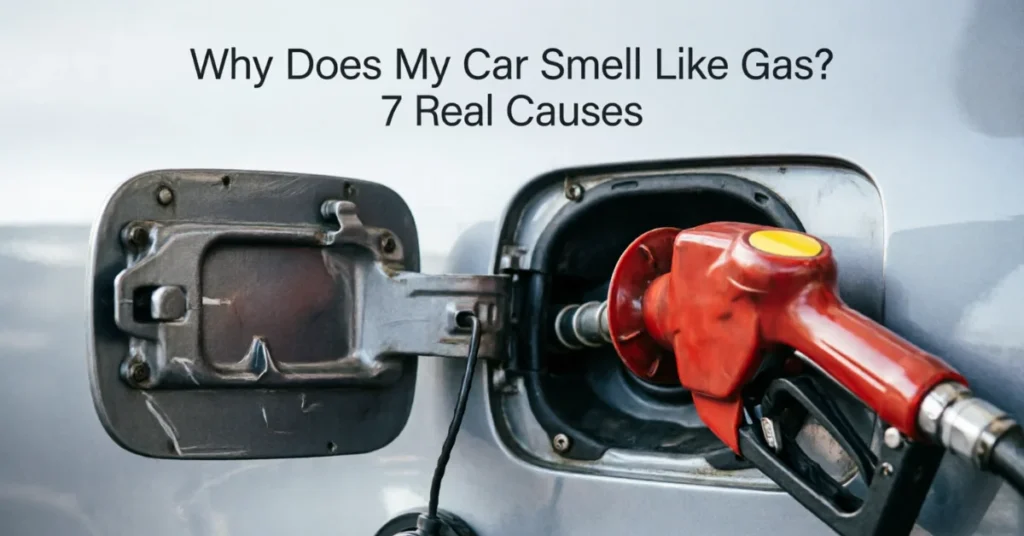
You just got in, turned the key, and there it is: that sharp, unmistakable whiff of gasoline. So why does my car smell like gas? It’s one of the most common questions drivers type into a search bar, usually while standing in a driveway wondering if it’s safe to go anywhere. The short answer is that it could be something as harmless as a splash on your shoe, or it could be a fuel leak that needs attention right now.
This guide breaks down the real reasons behind the smell, how to tell them apart, and what to do next. No guesswork, no scare tactics, just a clear path from “something smells off” to “here’s what’s going on.”
The Short Answer: Why Does My Car Smell Like Gas?
In most cases, a gas smell traces back to one of three things: a loose or damaged gas cap, a leak somewhere in the fuel delivery system, or fumes escaping through the evaporative emissions (EVAP) system. Less often, it’s an exhaust problem or a fuel mixture issue caused by a failing sensor.
Anyone who has popped the hood after smelling gas knows the drill: check the obvious stuff first, then work outward. That’s exactly the approach worth taking here, because not every gas smell means the same level of danger.
Is It Actually Gasoline, or Something Else?
Not every odd smell from under the hood is raw fuel, and mixing them up sends people chasing the wrong fix. Raw gasoline has a sharp, sweet, chemical smell that hits fast and fades slowly. Exhaust fumes smell more like a smoky, sulfur-tinged burn, and they usually come with a hint of soot rather than that sweet edge. Coolant, by contrast, smells sweet in a syrupy way, almost like maple, and it’s often paired with steam or a puddle of orange, green, or pink liquid.
A quick way to tell them apart: gasoline evaporates fast off your fingers and leaves almost no residue, while coolant feels slick and doesn’t dry the same way. If what you’re smelling is closer to burnt toast than gas station pump, the exhaust system is a more likely suspect than a fuel leak.
Why Does My Car Smell Like Gas Right After Filling Up?
This one’s usually the easy fix. A few things happen at the pump that can leave a lingering odor:
- A loose or missing gas cap. The cap does more than block rain. It seals vapor pressure inside the tank as part of the EVAP system. A cracked seal or a cap that never clicked into place lets vapor escape, and that smell can hang around the car for a while.
- Overfilling the tank. Topping off past the automatic shutoff can push liquid fuel into the vent lines meant only for vapor, overwhelming the system.
- A minor spill. Gas on your shoe, your hand, or the side panel travels with you, and it fades within a few minutes of driving with the windows cracked.
If the smell shows up only after refueling and clears up within ten or fifteen minutes, there’s a decent chance it’s one of these three. Tighten the cap until it clicks, check for cracks in the rubber gasket, and keep an eye on it over the next few days.
Why Does My Car Smell Like Gas While Driving?
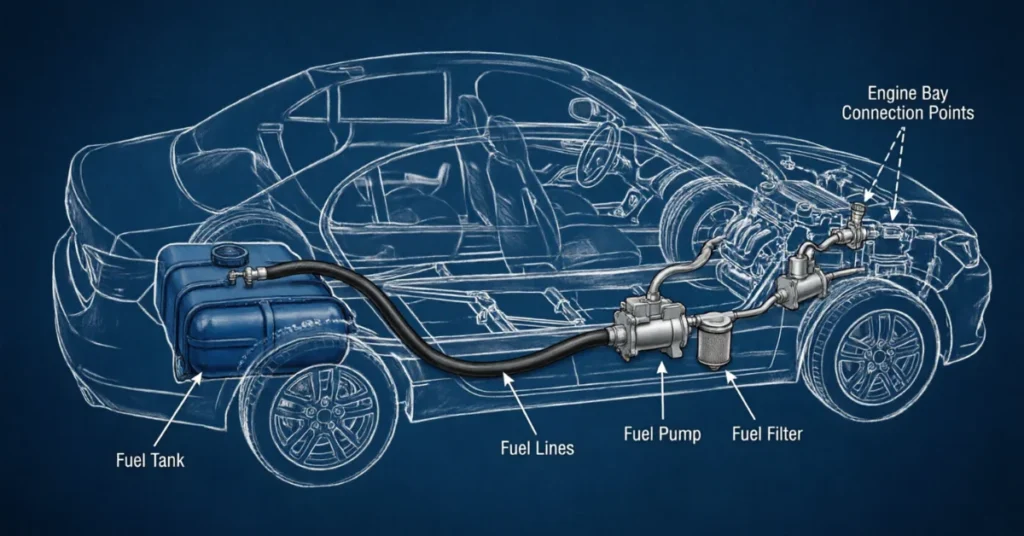
This is where things get more serious. If the odor shows up on the road, especially through the vents, it’s worth pulling over in a safe spot.
Fuel travels from the tank to the engine through pressurized lines, and any breach in that line, whether from corrosion, a rock strike, or worn rubber, can spray fuel onto hot engine parts. That’s a fire risk, not just a nuisance. A cracked fuel injector, a failing pressure regulator, or a torn line near the engine bay can all cause this. Mechanics who deal with fuel systems regularly describe this smell as sharper and more persistent than the post-fueling version, and it often gets stronger as the engine warms up.
A rich fuel mixture is another possibility. When an oxygen sensor misreads or an air filter clogs badly enough, the engine burns more fuel than it should, and some of that unburned gas escapes through the exhaust. It’s less dangerous than a direct leak, but it still points to a repair that shouldn’t wait.
Why Does My Car Smell Like Gas When It’s Parked?
A gas smell that only shows up once the engine is off and sitting still has its own pattern. With no airflow moving through the engine bay, fumes that would normally disperse while driving just sit there and collect instead.
This often points to the EVAP system’s charcoal canister, which stores fuel vapor until the engine is ready to burn it off. A cracked canister or a stuck purge valve lets vapor seep out instead of holding it. A slow fuel line leak can behave the same way, releasing fumes gradually rather than in one obvious burst. Anyone parking in an attached garage should treat this seriously, since fumes indoors are a real health and fire concern.
Heat plays a bigger part than most drivers realize. Gasoline vapor pressure climbs as temperatures rise, so a marginal cap seal or a slightly worn canister that stays quiet all winter can suddenly become noticeable on a hot summer afternoon. If the smell tends to show up more in July than in January, rising vapor pressure is often the missing piece, not a brand new problem.
What Do the Check Engine Codes Actually Mean?
A gas smell paired with the check engine light usually isn’t a coincidence. The EVAP system runs its own self-check by sealing the tank and monitoring pressure, and when that pressure doesn’t hold steady, it stores a trouble code. The most common ones tied to a fuel odor are P0440, P0442, and P0455, which point to a general, small, or large EVAP leak. A loose gas cap is the single most frequent trigger for these codes, so that’s worth ruling out before assuming a bigger repair is needed.
There’s a consumer angle here too that’s easy to miss: a car with an active EVAP fault will fail a state emissions inspection in most areas that require one. That means an unresolved gas smell isn’t just a comfort issue, it can also stand between a driver and vehicle registration renewal.
Quick Reference: Gas Smell Diagnostic Table
For a fast overview, here’s how the most common causes stack up by timing, risk, and typical U.S. repair cost. These are general shop estimates, and the real number depends on region, vehicle make, and labor rates.
| Cause | When You’ll Notice It | Danger Level | Typical Fix | Rough Cost |
|---|---|---|---|---|
| Loose or missing gas cap | Right after fueling | Low | Tighten or replace cap | $10–$25 |
| Overfilled tank | Right after fueling | Low | Let vapors settle | $0 |
| Fuel line leak | While driving | High | Line inspection or replacement | $150–$530 |
| Leaking fuel injector | While driving | High | Injector replacement | $300–$900 |
| Failing pressure regulator | While driving, lingers | Medium | Regulator replacement | $200–$900 |
| EVAP canister or purge valve | Mostly when parked | Medium | Canister or valve replacement | $150–$850 |
| Exhaust leak or bad O2 sensor | While driving, near exhaust | Medium | Sensor or exhaust repair | $150–$500 |
What About Hybrid and Electric Vehicle Owners?
This one catches people off guard. Hybrid drivers sometimes notice a gas smell even though their car barely touches the gas station, and it’s not usually a malfunction. Because a hybrid’s gasoline engine runs far less often than a standard car’s, fuel can sit in the tank and lines for weeks or months at a stretch, and stale gasoline develops a stronger, sourer odor over time. Some hybrids also use a sealed fuel system with a special pump just to relieve tank pressure periodically, and that process can release a brief whiff of fumes.
Fully electric vehicles, on the other hand, have no gas tank at all, so a persistent fuel-like smell in an EV points somewhere else entirely, most often a plastic or electrical component overheating rather than gasoline. Anyone driving an EV who smells something like gas should treat it as an electrical concern and have it checked promptly.
What the Research Shows
Detailed analysis of federal crash and fire data gives some useful context here. A federal evaluation of motor vehicle safety standards found that fires occur in roughly three out of every 1,000 police-reported crashes, and the rate climbs noticeably higher in crashes that turn fatal. Older vehicles show up more often in that data too, largely because fuel lines, gaskets, and seals degrade with age and mileage.
That data covers crash-related fires specifically, not everyday fuel leaks. But it reinforces a simple point: fuel system integrity matters, and it tends to matter more as a car gets older. A ten-year-old sedan with original fuel lines carries a different risk profile than a car fresh off the lot, and that’s worth factoring in when deciding how quickly to act on a gas smell.
Is It Safe to Keep Driving?
Short version: if the smell is strong, sudden, or coming from inside the cabin, don’t risk it. Pull over somewhere away from traffic, shut off the engine, and get out. Gasoline vapor is flammable enough that a hot exhaust pipe or a stray spark is all it takes.
If the smell is faint, only shows up right after fueling, and fades quickly, it’s generally fine to keep driving while you plan an inspection. That said, anyone with even a bit of doubt is better off calling for a tow than testing their luck on the highway.
How to Track Down the Smell Yourself
Before booking a shop visit, a quick walk-around can narrow things down:
- Check the gas cap first. Make sure it clicks and the rubber seal looks intact.
- Look underneath the car for wet spots, drips, or a rainbow-tinted puddle near the tank or engine.
- Pop the hood and look for fuel residue along the lines and near the injectors.
- Note when the smell shows up: right after fueling, while driving, or only when parked. Timing tells you a lot.
- Check your tire treads and floor mats in case you tracked fuel in from the pump.
This won’t replace a professional diagnosis, but it gives a mechanic a head start and can save a diagnostic fee if the fix turns out to be as simple as a new gas cap.
When to Handle It Yourself vs Call a Mechanic
A loose gas cap is a fair DIY fix; most auto parts stores will even test the seal for free. Beyond that, fuel system work gets riskier fast. Fuel lines run under real pressure, and working on them without the right tools or training is asking for trouble.
Think of it the way you’d think of a gas leak in a house: tightening a stovetop knob is fine to do yourself, but re-routing a gas line is a job for someone licensed to do it. The same logic applies under the hood.
Final Thoughts
So, why does my car smell like gas? Nine times out of ten, it comes down to a gas cap, a fuel system leak, or an EVAP issue, and the timing of the smell usually points you toward which one. Faint and fading fast after a fill-up isn’t much to worry about. Sharp, persistent, or noticeable inside the cabin means it’s time to pull over and get it looked at. Trust your nose here. It’s usually right.
This article is for informational purposes only. Always consult a qualified mechanic for a full diagnosis of your specific vehicle.

FAQs
Is it normal for a car to smell like gas after filling the tank?
A faint smell for a few minutes is common, especially in warm weather. If it lingers past 20 minutes or comes back repeatedly, check the gas cap seal.
Can a bad gas smell damage my engine?
The smell itself doesn’t cause damage, but whatever’s causing it, whether a leak or a rich fuel mixture, can lead to bigger problems if it’s ignored for too long.
Why does my car smell like gas but I don’t see any leaks?
Not every leak drips. Vapor leaks from the EVAP system or a failing pressure regulator often produce a strong smell with nothing visible underneath the car.
Is it dangerous to keep driving if my car smells like gas?
A strong, sudden, or cabin-level smell is a real fire risk and shouldn’t be driven through. A faint smell after fueling is generally low-risk short term.
How much does it typically cost to fix a fuel leak?
Costs vary widely depending on the source, from a low-cost gas cap replacement to a more involved fuel line or pump repair, so a proper inspection is the only way to know for sure.