

You strap on a watch, move your wrist through a normal day, and somehow it never runs out of power. No battery, no charging cable, no app. So what is an automatic watch, exactly, and how does it manage to keep running on nothing but your own motion?
The short answer: it’s a mechanical watch that winds itself using the natural swing of your arm. A small weighted rotor spins inside the case every time you move, and that spinning slowly tightens a coiled spring that powers the whole thing. No electronics involved, no battery to swap out every couple of years. Just gears, springs, and physics doing what they’ve done since the late 1700s.
That simple idea has quietly stayed relevant for nearly 250 years. Here’s what’s actually happening inside the case, why watchmakers still bother with something so old fashioned, and whether one belongs on your wrist in 2026.
What Is an Automatic Watch?
An automatic watch is a mechanical timepiece that winds its own mainspring using the wearer’s everyday wrist movement. Watchmakers also call it a self-winding watch, and the two terms mean exactly the same thing.
It sits in contrast to two other watch types. A manual watch also runs on a coiled mainspring, but you have to wind it yourself by turning the crown every day or two. A quartz watch skips springs entirely and runs on a battery that vibrates a tiny quartz crystal to keep time.
Inside an automatic, a half-moon shaped weight called a rotor pivots freely on its own axis. Gravity pulls on it constantly, and any time you lift a cup, type, or just walk, the rotor swings and turns a set of gears connected to the mainspring. Wind that spring tight enough, and it stores mechanical energy the way a stretched rubber band does, then releases it slowly through the movement to drive the hands.
Anyone who’s opened up a case back and watched this happen understands why watchmakers describe it as a living machine rather than a static object. It’s constantly in motion, even when the hands appear to move at a steady, silent sweep.
How the Self-Winding Mechanism Actually Works
The rotor gets the credit, but it’s really a team of small parts working together. Breaking it down helps explain why the mechanism has survived this long without a serious redesign.
The rotor. This weighted disc, often made from a dense metal, swings with wrist motion. Some designs only capture energy when it spins one direction. More advanced bidirectional systems wind the spring no matter which way the rotor turns, which is more efficient for people who don’t move around much during the day.
The mainspring. A tightly coiled ribbon of spring steel sits inside a small drum called the barrel. As the rotor turns the gear train, it winds this spring tighter. The tension stored here is what actually powers the watch once it’s released.
The gear train. A sequence of small wheels transfers energy from the barrel toward the escapement, gradually stepping down the force so it can be released in controlled, tiny amounts rather than all at once.
The escapement and balance wheel. This is the part that turns stored tension into steady timekeeping. The escapement lets the gear train release energy in short, regular bursts, while the balance wheel oscillates back and forth at a fixed rate, acting like the heartbeat of the entire movement. That back and forth motion is what produces the smooth sweeping second hand instead of a ticking jump.
Jewels. Tiny synthetic rubies sit at the pivot points throughout the movement, reducing friction between metal parts so the gears don’t wear down over years of constant motion.
Micro-rotor vs. full rotor. Most automatics use a full-size rotor that sits on top of the movement, which is why many automatic watches sit slightly thicker than manual ones. Some higher-end pieces instead use a micro-rotor, a smaller weight fitted into the same plane as the movement itself rather than stacked above it. That design keeps the watch noticeably thinner, though it usually costs more to manufacture since the parts have to be engineered more precisely to fit the tighter space.
Put together, this is what actually answers the question of what is an automatic watch on a mechanical level, dozens of interdependent parts, some smaller than a grain of rice, converting arm motion into measured time.
How Long Does Power Reserve Last?
A fully wound automatic typically holds enough stored energy to keep running for around two days without being worn, though some modern movements extend that reserve well past 70 hours. Take it off on a Friday night and it may still be ticking Sunday morning.
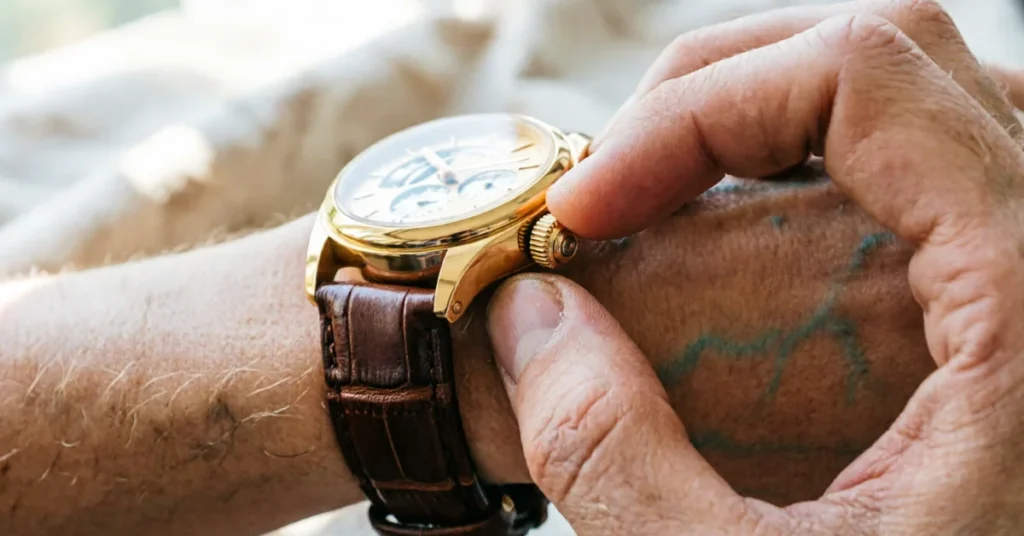
Leave it sitting in a drawer longer than that, though, and it stops. There’s no shame in that; it’s simply how the mechanism is built. Restarting it just means giving the crown a manual twist, usually 20 to 30 turns, before putting it back on so the rotor can take over again.
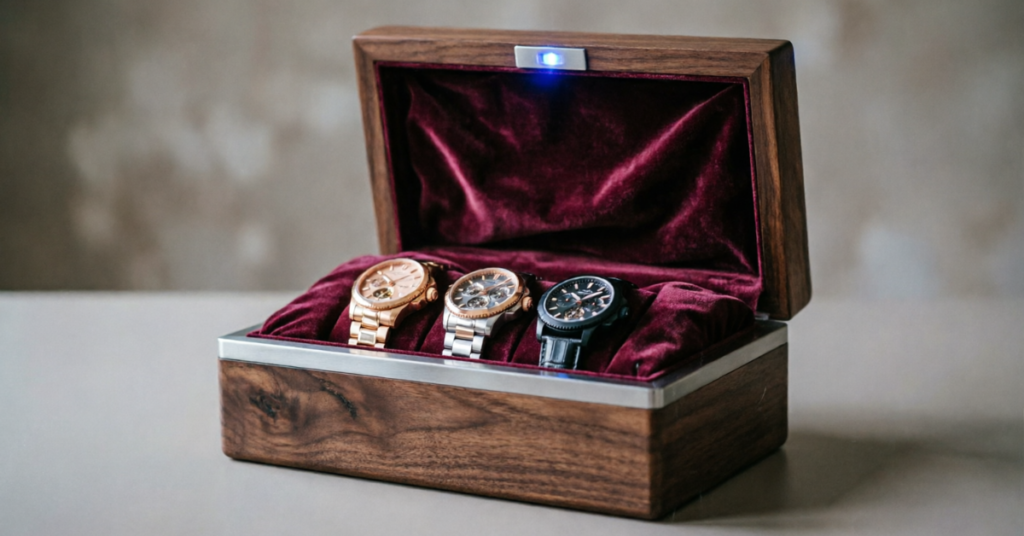
Watch winders exist for exactly this reason. These small motorized boxes gently rotate a stored watch to simulate wrist motion, which is handy for people who rotate between several pieces and don’t want to reset the time and date on each one constantly.
Automatic vs. Manual vs. Quartz: Where It Fits
People searching for what is an automatic watch are often comparing it against the two alternatives, so it’s worth laying the differences out plainly.
- Automatic vs. manual: Both rely on a mainspring and neither needs a battery. The difference is entirely in how that spring gets wound, automatically through motion, or manually through the crown. Manual watches tend to be simpler and sometimes thinner, since they skip the rotor assembly.
- Automatic vs. quartz: This is a bigger split. Quartz watches use battery power to vibrate a crystal at a fixed frequency, which is why they’re typically far more accurate day to day, often within a few seconds a month. Automatics gain or lose closer to 15 to 25 seconds over a couple of days, depending on the movement’s quality. What automatics offer instead is mechanical craftsmanship and the appeal of a machine that never needs disposable power.
Watch enthusiasts who’ve worn both will usually say the appeal of an automatic isn’t precision. It’s the sense of owning something built from moving parts rather than circuitry, something that reflects the mechanical watchmaking tradition rather than replacing it.
Automatic vs. Smartwatch: A Different Kind of Accuracy
Most people searching for a new watch today are also weighing a smartwatch, so it’s worth addressing that gap directly. A smartwatch tracks steps, heart rate, and notifications, and it syncs to satellite time, meaning it never drifts even a second. An automatic can’t compete on that ground and isn’t trying to.
What an automatic offers instead is longevity without dependence on software updates or a charging cable every night. A well-maintained mechanical movement can outlive several generations of smartwatch hardware, since there’s no chipset to become obsolete. People who wear both often keep the smartwatch for the gym and the automatic for everything else, treating them as separate categories rather than competitors.
Is Your Automatic Watch Actually Accurate? The Chronometer Standard
Accuracy claims for automatics aren’t just marketing language; there’s an actual testing body behind the better ones. The Contrôle Officiel Suisse des Chronomètres, known as COSC, is the independent Swiss institute responsible for certifying mechanical watch accuracy. To earn the “chronometer” designation, a movement has to pass 15 days of testing across five positions and three temperatures, and it must hold an average daily rate between -4 and +6 seconds, according to COSC’s own certification criteria.
That tolerance sounds generous next to a smartwatch, but it’s genuinely difficult for a purely mechanical device to hit consistently. Rolex submits over a million movements to COSC annually, followed by Omega, Tudor, Breitling, Mido, and Tissot, and not every automatic on the market bothers with certification at all, since it’s optional and adds cost.
What’s genuinely new here, and something most articles on this topic haven’t caught up with yet, is that COSC introduced a second, stricter tier in 2026 called the Excellence Chronometer. Instead of testing just the loose movement, this standard tests the fully cased watch after it’s been mounted on a robotic wrist for 24 hours to simulate real wear, then checks it against a tightened accuracy window of -2 to +4 seconds per day and exposure to a 200 Gauss magnetic field. The first watches carrying this certification are expected to reach retailers around October 2026.
Magnetism deserves its own mention here too. Everyday electronics, phone speakers, laptop lids, magnetic clasps on bags, can throw off a balance wheel’s rhythm without the owner ever noticing why their watch suddenly runs fast. Manufacturers have responded by building movements with silicon hairsprings and non-magnetic alloys, which resist these fields far better than older steel components did. It’s a quiet upgrade, but a meaningful one for anyone who works around laptops and phones all day, which is essentially everyone now.
Benefits and Trade-Offs Worth Knowing
No watch type is perfect for every situation, and being upfront about the downsides matters here.
Benefits:
- No battery replacements or e-waste from disposable cells
- Smooth, continuous second-hand movement rather than a tick
- Long mechanical lifespan when serviced properly, sometimes decades
- Considered a craft object by collectors, with visible engineering through display case backs
Trade-offs:
- Less accurate than quartz, typically drifting by seconds every few days
- Needs regular wrist motion or a winder to stay powered
- Requires professional servicing roughly every three to five years
- Usually costs more upfront than an equivalent quartz model
Weighing those points against your own habits is really the whole decision. Someone who wears one watch daily gets the self-winding benefit automatically. Someone who rotates through five watches a week may find the power reserve runs out before they get back to it.
What the Research Shows
Detailed analysis of the current watch industry backs up how relevant mechanical timekeeping still is despite the rise of digital alternatives. According to Statista Market Insights, the global watches market generated approximately $135.63 billion in revenue in 2026, with an expected annual growth rate near 5.62% through 2031. That’s not a shrinking category by any measure.
Zooming into the mechanical segment specifically, industry data from IMARC Group shows mechanical watches growing at approximately 4.3% CAGR, one of the fastest-growing categories within the broader watch industry, even as quartz continues to dominate by unit volume. Examining this closely suggests buyers aren’t choosing automatics for raw accuracy. They’re choosing them for the craftsmanship story that quartz and smartwatches simply can’t replicate.
This pattern shows up consistently among collectors and first-time buyers alike: interest in mechanical watchmaking has held steady into 2026, driven partly by younger buyers discovering the category through social platforms and secondhand marketplaces rather than traditional boutique visits.
Who Should Actually Wear One
An automatic makes the most sense for someone who wears it most days, values the mechanical engineering behind it, and doesn’t mind a small margin of daily time drift. It’s a poor fit for someone who wants set-it-and-forget-it precision or swaps watches constantly without a winder on hand.
First-time buyers often start with an entry-level automatic in the $200 to $600 range to get a feel for the mechanism before moving toward higher-end pieces. Collectors, meanwhile, tend to view the movement itself, visible through a sapphire case back, as part of the appeal rather than a hidden technical detail.
Caring for an Automatic Watch
A few habits keep the mechanism healthy over the long run:
- Wear it regularly, or use a winder if it sits unused for more than two days
- Avoid manually winding while it’s already running near full power reserve, since forcing it can strain the spring
- Keep it away from strong magnets, which can throw off the balance wheel’s rhythm
- Get it serviced every three to five years by a qualified watchmaker
- Avoid abrupt shocks, like impacts against hard surfaces, which can knock the escapement out of alignment
Skipping servicing is the most common mistake new owners make. The oils inside dry out over years, and running a dry movement accelerates wear on parts that are genuinely difficult to replace.
So, What Is an Automatic Watch Actually Worth Buying in 2026?
Given everything above, an automatic is worth buying if you want a daily-wear piece with real mechanical engineering behind it and you’re comfortable with a small accuracy trade-off. It’s less worth it if raw precision or zero maintenance is the priority, since a quartz or smartwatch will beat it on both counts without effort. The rise of stricter certification standards like the new Excellence Chronometer suggests the industry itself is working to close that accuracy gap, which is worth watching if precision matters to you but you still want the mechanical appeal.
Conclusion
So, what is an automatic watch when you strip away the marketing language? It’s a small, self-sustaining machine that turns your own movement into stored energy, then spends that energy keeping time through a chain of gears, springs, and a steadily oscillating balance wheel. It won’t outpace a quartz watch on accuracy, and it needs a bit more attention over its lifetime. What it offers instead is something increasingly rare: a mechanical object you can watch work, built on an idea that hasn’t fundamentally changed since the 1700s and still holds up in 2026.
FAQs
Does an automatic watch need a battery?
No. It runs entirely on mechanical energy stored in the mainspring, which gets wound by wrist motion rather than electricity.
How accurate is an automatic watch compared to quartz?
Automatics typically gain or lose around 15 to 25 seconds every couple of days, while quartz movements usually stay accurate within a few seconds per month.
What happens if I stop wearing my automatic watch?
It will run down and stop, generally within two to three days, since the mainspring loses its stored tension without regular motion. A manual wind or a watch winder restarts it.
What does COSC chronometer certification actually mean?
It means the movement passed independent Swiss testing and holds an average daily rate between -4 and +6 seconds. Not every automatic is certified, since it’s optional and adds cost for the manufacturer.
How often should an automatic watch be serviced?
Most watchmakers recommend servicing every three to five years to replace dried lubricants and check the movement for wear.