

A luxury 3 row SUV promises everything: leather-wrapped comfort, third-row seating for the whole crew, and a driving experience that feels worlds away from your neighbor’s minivan. But here’s the catch nobody at the dealership mentions upfront. The gap between the sticker price and the real cost of ownership can be enormous, and the model that looks perfect in a showroom photo might feel cramped once actual humans climb into that back row.
This isn’t a spec sheet dump. It’s a straight look at what a luxury 3 row SUV actually delivers in 2026, who it’s really built for, and where buyers commonly get burned.
Why Families and Executives Keep Choosing a Luxury 3 Row SUV
Anyone who has shopped this segment knows the appeal isn’t just about space. It’s about not having to choose between hauling kids to practice and showing up to a client dinner looking sharp.
The three-row layout solves a real logistics problem. You get flexible seating for six or seven, a cargo hold that swallows strollers and golf bags alike, and a ride height that makes merging onto a packed freeway feel less like a gamble. Add heated massaging seats, adaptive suspension, and cabin materials that rival a boutique hotel room, and it’s easy to see why this class keeps growing.
Body-on-frame models like the Lexus GX lean into rugged capability, packing a turbocharged 3.4-liter V6 good for 349 horsepower, 479 lb-ft of torque, and a towing figure north of 9,000 pounds. On the other end, unibody crossovers like the Lexus TX prioritize hushed, car-like manners with cargo space that expands from about 20.2 cubic feet behind the third row to nearly 97 cubic feet with every seat folded flat.
That split matters. It’s the difference between a vehicle built to tow a boat through the mountains and one built to glide through a school pickup line without a single rattle.
Top Luxury 3 Row SUV Picks Worth Cross-Shopping in 2026
Automotive reviewers who track this category closely tend to circle back to a handful of names, but each one plays a different role.
| Model | Powertrain | Horsepower | Cargo (behind 3rd row) | Fuel Economy |
|---|---|---|---|---|
| Mercedes-Benz GLS | Inline-6 to AMG V8 | 375–603 hp | Up to 84.7 cu ft (max) | Varies by trim |
| BMW X7 | Turbo inline-6 base | Varies | Sliding 2nd row | 16–21 mpg city |
| Infiniti QX80 | Twin-turbo V6 | 450 hp | ~22 cu ft | 16 mpg city / 19 hwy |
| Lincoln Aviator | Twin-turbo V6 | 400 hp | Generous, adaptable | Varies by trim |
| Acura MDX | V6 | Varies | 16.3 cu ft | 19 mpg city / 25 hwy |
| Cadillac Vistiq | Dual-motor EV | 615 hp | Usable, family-sized | 93 MPGe city |
None of these are wrong choices. They just serve different priorities: towing power, back-seat legroom, tech, or straight-line performance. Test-driving two or three back to back is the fastest way to figure out which trade-offs actually bother you.
Luxury 3 Row SUV Price Ranges by Segment
Sticker shock hits different depending on where you’re shopping. A luxury 3 row SUV in 2026 spans roughly $57,000 for an entry-level midsize trim to well over $170,000 for a fully loaded performance flagship.
| Segment | Example Models | Starting Price |
|---|---|---|
| Entry midsize | Acura MDX, Lexus TX 350 | ~$57,000–$70,000 |
| Mainstream luxury midsize | Lincoln Aviator, Infiniti QX60 | ~$58,000–$85,000 |
| Off-road capable midsize | Lexus GX | ~$84,300 (Luxury+ trim) |
| Full-size flagship | BMW X7, Mercedes-Benz GLS, Infiniti QX80 | ~$85,000–$135,000 |
| High-performance full-size | Cadillac Escalade-V | ~$174,000 |
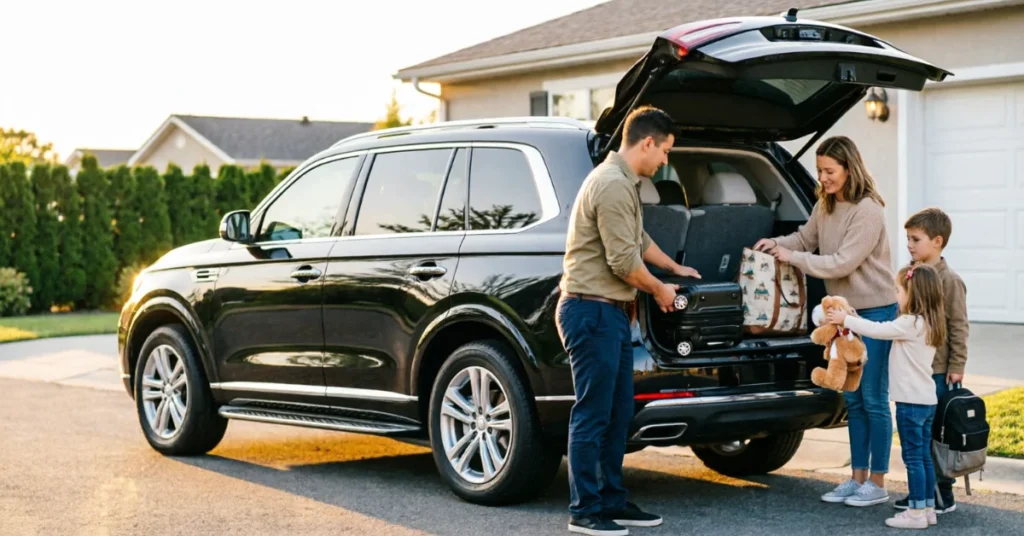
Financing terms swing these numbers further. A 72-month loan on a $90,000 SUV at a typical luxury-tier interest rate adds thousands in interest that never shows up in the window sticker. It’s worth running actual amortization numbers before falling in love with a specific trim.
Fuel Efficiency and the Electrified Shift in This Segment
Gas-only V8 models still exist, but the center of gravity in this class has moved toward hybrids and full EVs. The hybrid Lexus TX posts figures around 27 mpg city and 28 mpg highway, making it one of the more efficient gas-electric options with a third row. Meanwhile the Cadillac Vistiq, an all-electric entry, is rated near 93 MPGe city and 78 MPGe highway.
Professionals who work in vehicle sales consistently report that electrified three-row luxury models are the fastest-growing part of their inventory requests, even among buyers who once swore they’d never give up a V8. Range anxiety hasn’t disappeared, but it’s shrinking as charging networks mature and EPA-rated ranges climb past 400 miles on flagship electric models.
What the Research Shows
Detailed analysis of the broader SUV category backs up what dealers are seeing on their lots. The global SUV market, which includes the luxury three-row tier, is projected to grow from roughly $1.4 trillion in 2026 to more than $3.1 trillion by 2034. That growth isn’t evenly spread. Full-size and mid-size luxury models with third-row seating are capturing an outsized share of that expansion, driven by buyers who want the space of a minivan without the minivan image.
Examining this closely, the pattern lines up with what shoppers already sense in showrooms: waitlists for certain electrified trims, rising demand for hands-free driving features, and a growing willingness among affluent buyers to pay a premium for a third row that’s actually usable by adults, not just kids on short trips.
Business Owners: The Tax Angle Most Buyers Miss
Here’s the deal. Almost nobody covers this part, and it can change the entire math of a purchase.
If a luxury 3 row SUV has a manufacturer gross vehicle weight rating (GVWR) between 6,001 and 14,000 pounds, and it’s used more than 50% for business, it may qualify for the IRS’s “heavy SUV” Section 179 deduction. For the 2026 tax year, that cap sits in the neighborhood of $31,000 to $32,000, depending on final IRS inflation adjustments, with the remaining cost potentially eligible for 100% bonus depreciation under current rules. Several full-size models in this class, including the BMW X7, Cadillac Escalade, Infiniti QX80, and Lexus GX, commonly clear that 6,000-pound threshold, though the exact GVWR always depends on trim and configuration.
Practically, that means a business owner who buys an $85,000 full-size luxury SUV and uses it almost entirely for work could potentially write off a meaningful share of the purchase in the very first tax year, rather than spreading the deduction across five or six years of standard depreciation.
A few things to check before assuming this applies:
- Confirm GVWR on the driver’s door jamb, not from a spec sheet online. Trim level and options can push a vehicle above or below the 6,000-pound line.
- Business use must exceed 50%, and the IRS expects a contemporaneous mileage log, not one reconstructed at tax time.
- Dropping below that threshold in later years can trigger recapture, clawing back part of the deduction as taxable income.
This isn’t tax advice, and the exact numbers shift with IRS guidance each year. Anyone considering this route should talk to a qualified tax professional before signing paperwork, but it’s a real, verifiable factor that changes the effective price of several models on this list.
Second Row Configuration: A Detail That Trips Up Families
Most buying guides skip straight from “seats seven” to horsepower numbers, but the second-row layout matters just as much as the badge on the hood.
Bench seats fit three across and generally make third-row access easier for kids climbing over. Captain’s chairs, which some trims offer as an option, feel more premium and give rear passengers their own space, but they cap second-row capacity at two and can make loading three car seats side by side impossible. The Audi Q7, for example, is often singled out by parents specifically because its bench-style second row is wide enough to fit three car seats without a squeeze, something several rivals with narrower captain’s-chair layouts can’t match.
Before choosing a trim, it’s worth sitting an actual car seat, or an actual teenager, in the row you’ll use daily. Photos rarely tell that story.
Who Else Searches for a Luxury 3 Row SUV
Most articles on this topic write only for the two-income suburban family. That leaves out groups who search this exact term just as often.
Empty-nesters and retirees often want the third row folded flat most of the year, prioritizing cargo space and ride comfort over raw seating capacity. A vehicle like the Lexus GX, with its 97 cubic feet of maximum cargo room, fits this use case better than a seven-seat sedan-on-stilts.
Small business owners frequently cross-shop this segment for client transport, and, as covered above, for the tax treatment on heavier trims. Cabin quietness and rear-seat tech tend to matter as much as the deduction itself.
First-time luxury buyers should know that a new luxury SUV typically loses around 20% of its value in the first year alone, one of the steepest depreciation curves in the industry. Certified pre-owned models in this class, typically three to five years old, have already absorbed that steepest hit. A well-maintained used Audi Q7 or BMW X7 can deliver nearly the same experience as new for a fraction of the price, provided the maintenance history checks out.
How to Choose the Right Luxury 3 Row SUV for Your Life
A few practical questions cut through the marketing noise fast:
- Who actually sits in the third row? If it’s adults on a regular basis, prioritize models with a sliding second row and genuine adult-sized legroom, not just a seat that technically folds down.
- Bench or captain’s chairs? Families installing multiple car seats side by side should lean toward a wide bench-style second row rather than a captain’s-chair layout.
- Do you tow anything? Body-on-frame options like the Lexus GX or Land Rover Defender handle real towing loads far better than unibody crossovers.
- What’s your realistic annual mileage? Heavy commuters may save more with a hybrid or EV trim than the sticker price difference suggests.
- How long will you keep it, and is it for business? Buyers planning to trade in within three years should weigh resale value as heavily as first-year comfort, while business buyers should factor the Section 179 math in before choosing a trim.
Anyone who has managed a fleet of company vehicles knows the cheapest option upfront rarely stays the cheapest option over five years. The same logic applies to a personal purchase, just with higher emotional stakes.

Conclusion
A luxury 3 row SUV isn’t just a bigger, fancier version of a family crossover. It’s a genuinely different ownership experience, one that rewards buyers who take the time to match powertrain, cargo layout, seating configuration, and price bracket to how they actually live, not how a showroom brochure imagines they live. Test drive more than one, run the real financing numbers, sit in the actual second and third rows, and, if it’s a business purchase, ask about GVWR before you fall for a trim. That’s where most buyers discover whether the SUV they wanted is actually the right fit.
This article discusses general vehicle market and tax trends; individual pricing, incentives, and eligibility vary by region, dealer, and tax situation. Always confirm current figures with a manufacturer, dealership, or qualified tax professional.
FAQs
What is considered a luxury 3 row SUV?
It’s a premium SUV, typically from a brand like Lexus, BMW, Mercedes-Benz, Audi, Infiniti, or Cadillac, that seats six to eight passengers across three rows and includes upscale materials, advanced tech, and a starting price generally above $55,000.
Are luxury 3 row SUVs good for towing?
Body-on-frame models like the Lexus GX handle towing well, with capacities over 9,000 pounds in some trims. Unibody crossovers built primarily for on-road comfort typically tow less, often in the 5,000-pound range.
Can I write off a luxury 3 row SUV for business use?
Certain full-size models with a GVWR between 6,001 and 14,000 pounds may qualify for the IRS Section 179 heavy SUV deduction, generally capped around $31,000 to $32,000 for 2026, plus possible bonus depreciation. Business use must exceed 50%, and a tax professional should confirm eligibility for your specific vehicle and situation.
Bench seats or captain’s chairs in the second row, which is better?
Bench seats fit three across and work better for families installing multiple car seats. Captain’s chairs offer more individual comfort and easier third-row access but cap second-row capacity at two.
How much does a luxury 3 row SUV cost in 2026?
Prices generally start around $57,000 for entry midsize trims and climb past $170,000 for high-performance full-size flagships, before factoring in options and financing costs.