

A watch that winds itself sounds like a small magic trick, and that’s basically what citizen automatic watches have been selling for decades. No battery, no charging cable, just a rotor spinning inside the case every time your wrist moves. As of 2026, Citizen has quietly pushed out one of its busiest release calendars in years, and the mechanical side of the brand is getting more attention than it has in a long while.
This piece looks at what citizen automatic watches actually are, how the current lineup breaks down, what they cost, and who should genuinely think about buying one over a quartz or solar-powered option.
What Makes Citizen Automatic Watches Different
Citizen is better known worldwide for Eco-Drive, its light-powered quartz technology. Automatic watches sit in a separate lane entirely. They run on a mechanical movement wound by a weighted rotor that spins as the wearer moves, storing energy in a mainspring instead of a battery or a solar cell.
The company built its first automatic caliber back in 1958, inside the Citizen Deluxe, a model that went on to sell more than 100 million units over its production run. That history matters here. Citizen isn’t a fashion brand that outsourced a movement to look credible. It makes its own mechanical calibers in-house, including the workhorse 8200 and 8210 families found across most of today’s entry-level automatics.
Anyone who has handled one of these watches on a counter knows the appeal instantly. There’s a small window on most models, usually at 6 o’clock, where you can watch the rotor and balance wheel move. It’s a tactile, slightly hypnotic detail that a quartz dial simply doesn’t have.
The Current Lineup, Piece by Piece
Citizen kicked off 2026 with a set of budget-friendly automatics that reset expectations for the category. The NJ0210 dress series and NJ022 diver series arrived at under 250 euros each, built around the calibre 8210 running at 3Hz with roughly 40 hours of power reserve and 100 metres of water resistance.
A short list of specs makes the lineup clear:
- NJ0210 dress models: 38.5mm steel case, mineral crystal, leather or steel bracelet, priced from EUR 239 to EUR 249
- NJ022 diver-style models: same movement family, rotating bezel styling, similar price band
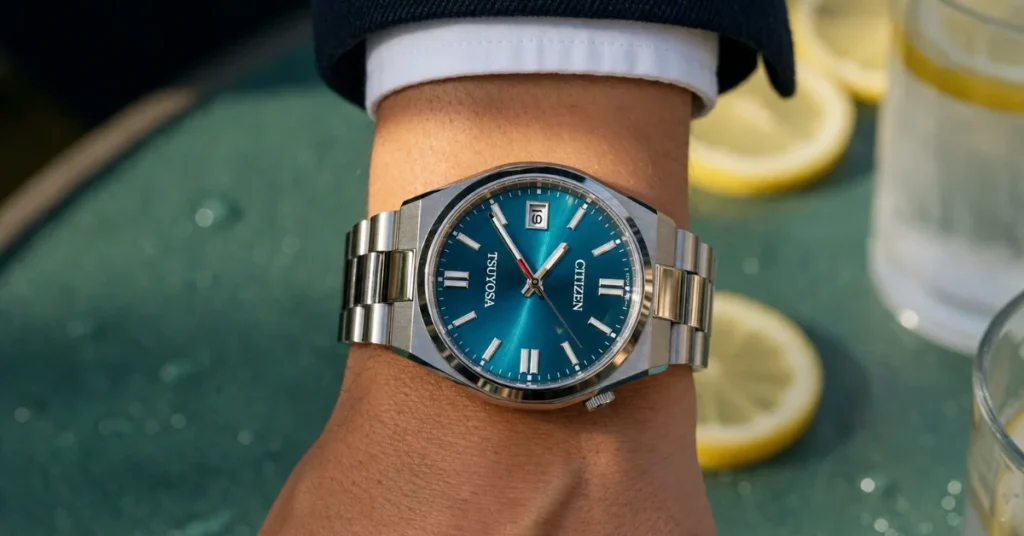
- Tsuyosa Shore automatics: integrated bracelet design, colourful summer dials, starting around $495
- Series 8 slim mechanicals: cases under 40mm, Calibre 9051, a Tokyo skyline motif worked into the dial
At the top end sits the anniversary-driven work, like the limited Tsuyosa reference built around the calibre 8210 with a red-moon dial tied to a lunar eclipse visible from Japan in March 2026, priced above one million yen. That’s an outlier, not the norm, but it shows the range citizen automatic watches now cover.
Real Examples From Recent Releases
The Tsuyosa line is probably the clearest case study here. It first came out a few years back as a compact, integrated-bracelet sports watch and has since grown a rotating bezel option and even a limited collaboration with the French horological artist known as seconde/seconde/, where the minute hand visually slices through each hour marker.
Reviewers who’ve spent real time with the Shore variants describe them as lighter and more playful than earlier Tsuyosa colorways, which sometimes felt stuck between sporty and formal. That’s a fair read. The bright dials and compact 38-40mm cases suit smaller wrists just as well as larger ones, which is part of why the line keeps growing rather than getting quietly discontinued.
Series 8, on the other hand, aims at buyers who want something dressier without stepping up to a Swiss price tag. The slim case, five-piece polished construction, and Calibre 9051 give it a different personality entirely from the tool-watch feel of Promaster.
Citizen Automatic Watches vs Eco-Drive: How to Choose
This is the question that trips up most first-time buyers browsing the Citizen catalogue. Eco-Drive uses a solar cell hidden under the dial to keep a rechargeable cell topped up, and it holds far tighter daily accuracy than any mechanical movement, automatic or otherwise.
Citizen automatic watches trade that accuracy for something else entirely: a visible, moving mechanism with no cell to eventually replace and no dependence on ambient light. Someone who wears a watch daily and likes the idea of a small machine ticking away on their wrist will lean automatic. Someone who wants to set it once and forget it for months will lean Eco-Drive.
Buyers outside Japan, the US, and Western Europe should also know pricing and availability differ by region. Southeast Asian and Middle Eastern retailers often carry different reference numbers for the same case and movement, so it’s worth checking the exact caliber, 8200 versus 8210, rather than relying on the model name alone when comparing listings across countries.
Smaller-wristed buyers, meanwhile, have more room to shop than they might expect. The NJ0210 dress series and the newer Series 8 cases both sit under 39mm, which is a meaningfully different fit than the 40mm-plus Promaster tool watches that dominated Citizen’s automatic range for years.
Pros and Cons Worth Knowing Before You Buy
No watch category is without trade-offs, and citizen automatic watches are no exception.
Pros:
- No battery replacement, ever, as long as it’s worn or wound regularly
- In-house movements at price points most Swiss brands can’t match
- Wide range, from sub-$300 dress pieces to five-figure limited runs
- Visible mechanical detail through display case backs on most models
Cons:
- Accuracy sits around -20/+40 seconds a day on entry calibers, noticeably looser than Eco-Drive quartz
- Needs regular wrist time or a watch winder, or it stops and needs resetting
- Servicing a mechanical movement eventually costs more than replacing a battery
- Entry-level calibers use simpler day-date complications, not chronometer-grade tuning
Anyone who has managed a small watch collection knows that trade-off well. You’re not buying citizen automatic watches for lab-grade accuracy. You’re buying the mechanism itself, and the ritual of winding or wearing it enough to keep it running.
What the Research Shows
Citizen doesn’t publish unit sales for automatics specifically, but the sheer volume of new automatic references that arrived in 2026, across Tsuyosa, Series 8, and the entry NJ series, points to a company reading real demand and responding with volume rather than a single flagship. Watch retailers covering this category have called Citizen’s 2026 calendar one of its busiest in years, with most of it built around genuine mechanical upgrades rather than repeated colorway releases.
Who Should Actually Buy One
- First-time mechanical watch buyers: the NJ0210 and NJ022 series are about as low-risk an entry point as exists right now
- Collectors wanting a beater: the Promaster automatic line takes daily knocks without the anxiety of a Swiss piece
- Dress watch shoppers on a budget: Series 8 covers that slim, formal look under $600 in most markets
- Gift buyers: the sub-$350 four-model set released early in 2026 was built specifically for this kind of purchase
People who aren’t interested in winding a watch, setting it after it stops, or accepting looser daily accuracy are probably better served by Citizen’s own Eco-Drive lineup instead. That’s not a knock on either technology, just a matter of matching the watch to how someone actually lives.
The Bottom Line
Citizen automatic watches aren’t trying to beat Switzerland at its own game, and they don’t need to. The brand has built genuine in-house mechanical movements into watches that start under $300, grew a playful integrated-bracelet line with Tsuyosa, and slimmed down Series 8 for buyers who want something dressier. Whether it’s a first mechanical watch or an addition to a growing collection, the current lineup gives a reason to look past the Eco-Drive shelf.
FAQs
Are citizen automatic watches accurate?
Entry-level calibers like the 8200 and 8210 typically run within -20 to +40 seconds a day, which is normal for mass-produced mechanical movements and noticeably looser than quartz or Eco-Drive.
Do citizen automatic watches need a battery?
No. They run on a mainspring wound by a rotor that moves with the wearer’s wrist, so there’s nothing to charge or replace unless the movement itself eventually needs servicing.
What’s the difference between Citizen automatic and Eco-Drive models?
Automatic watches use a purely mechanical movement powered by motion, while Eco-Drive relies on a solar cell under the dial to charge a rechargeable cell, which gives tighter accuracy but no visible mechanical movement.
How much do Citizen automatic watches cost?
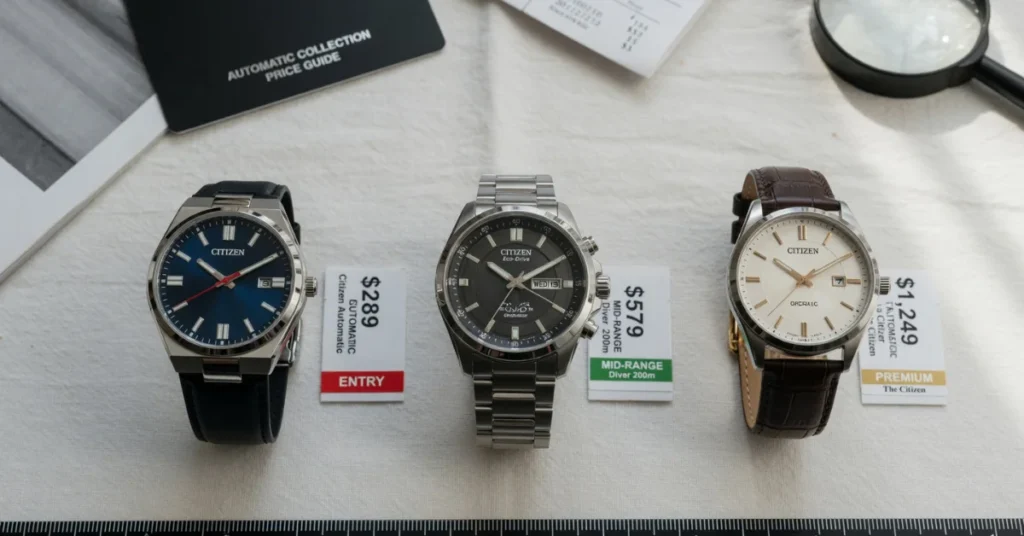
Entry models like the NJ0210 and NJ022 start under 250 euros, mid-range Tsuyosa and Series 8 pieces run from roughly $400 to $700, and limited anniversary editions can climb well past $1,000.
How long will an automatic watch run without being worn?
Most current Citizen calibers store about 40 to 42 hours of power reserve, so a watch left off the wrist for two days will typically stop and need resetting.