
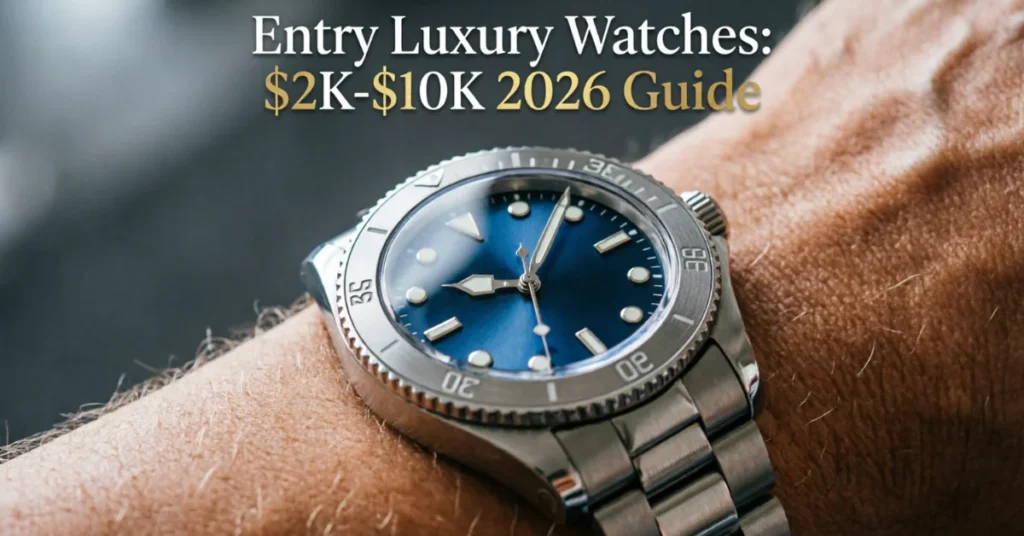
Entry level luxury watches used to mean one thing: a Tudor or an Omega, bought new, full stop. That definition has cracked wide open. Walk into any watch forum right now and you’ll see the same argument playing out — is a $700 Hamilton “luxury,” or does that title only kick in once you cross $5,000? There’s no single right answer, and that’s exactly why so many first-time buyers freeze before they spend a dollar.
Here’s the honest starting point. Entry level luxury watches, as the term gets used across dealers, collectors, and manufacturers in 2026, generally sit between $2,000 and $10,000. Below that, you’re mostly in fashion-watch or Swatch Group territory. Above it, you’re closer to mid-tier collecting than a “first” purchase. Everything in between is where the real decisions get made.
What Actually Counts as Entry Level Luxury Watches
Price alone doesn’t decide this. A $400 fashion watch and a $4,000 Tudor aren’t built to the same standard, even though both sit on a wrist and tell time.
What separates the two comes down to a handful of concrete markers: in-house or co-developed automatic movements, sapphire crystal instead of mineral glass, solid stainless steel or precious-metal cases, and — often overlooked — a service network that still exists in ten years. A watch you can get repaired in 2036 is worth more than one that quietly becomes disposable.
Anyone who has shopped this category for a while knows the $2,000–$10,000 band isn’t arbitrary either. It’s the zone where brands with genuine watchmaking history — Longines, Tudor, Omega, Cartier, Tissot’s higher lines — start selling pieces with real mechanical depth, without the six-figure price tags attached to Patek Philippe or Richard Mille. That’s the practical definition most dealers and collectors work from today.
Where the Money Actually Goes
A first-time buyer’s biggest surprise usually isn’t the price tag. It’s realizing how little of that price sits in the metal itself.
Here’s a rough breakdown of what you’re paying for on a $4,000–$6,000 entry level luxury watch:
- The movement (roughly 25–35% of retail): Swiss automatic calibres, often COSC-certified for accuracy
- Case and bracelet finishing (20–25%): polished versus brushed transitions, bevels, lug shaping
- Brand and R&D overhead (20–30%): design history, marketing, retail experience
- Distribution and dealer margin (15–20%): authorized dealer networks, warranty support
This is where new versus pre-owned makes the biggest financial difference. A watch bought new carries full retail markup the moment it leaves the boutique. The same reference, two years later on the pre-owned market, often trades 15–30% below original retail — sometimes more for pieces that saw heavy production runs.
The Brands Worth Knowing in 2026
A few names come up again and again once you start comparing entry level luxury watches, and each occupies a slightly different lane.
Tudor remains the default recommendation for buyers who want heritage without the Rolex waitlist. The Black Bay Fifty-Eight, built around a manufacture calibre with a long power reserve, channels 1950s dive-watch design into something that reads as both vintage and current.
Omega’s Seamaster Aqua Terra and Diver 300M sit close behind, backed by co-axial escapement movements and a service network that spans nearly every major city on earth. That last point matters more than it sounds — a watch you can’t get serviced locally becomes a liability, not an asset.
Longines Spirit and Spirit Zulu Time pieces deliver Swiss in-house movement quality at a noticeably lower price point than Tudor or Omega, which makes them a common first purchase for buyers watching their budget closely.
Cartier Santos and Tank models take the category in a completely different direction — dress-first, design-led, and increasingly popular with younger buyers who want a watch that reads as jewelry as much as instrument.
For buyers who want to stretch further down, Hamilton, Certina, and Mido deliver Swiss automatic movements starting well under $2,000, which pushes the practical floor of “real watchmaking” lower than most people assume.
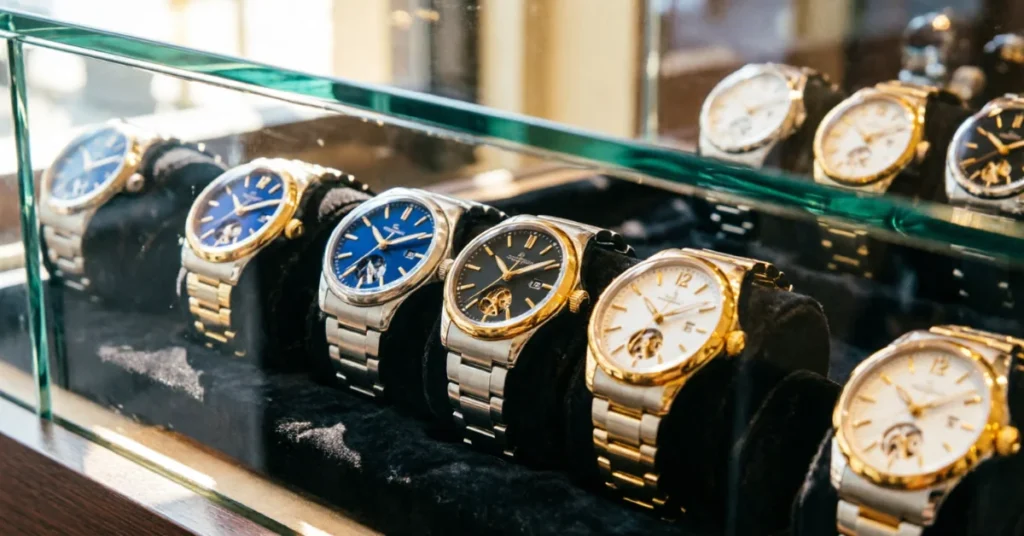
Quick Brand Comparison
| Brand | Starting Price (2026) | Movement Type | Best For |
|---|---|---|---|
| Hamilton | ~$700 | Swiss automatic (ETA-based) | First-time buyers on a tight budget |
| Certina | ~$900 | Swiss automatic, ISO-certified diver | Everyday sport wear |
| Mido | ~$1,100 | Swiss automatic, in-house case tech | Vintage-inspired dress/sport |
| Longines | ~$2,200–2,600 | Swiss in-house calibre | Aviation-style, mid-budget buyers |
| Tudor | ~$3,800–4,700 | Manufacture automatic calibre | Heritage dive/tool watches |
| Omega | ~$5,900+ | Co-axial escapement | Global service network, resale confidence |
| Cartier | ~$7,000–9,300 | Manufacture/quartz options | Dress-first, design-led buyers |
What the Research Shows
Industry export data for the first half of 2026 tells a clearer story than most marketing copy does. Watches priced between roughly $220 and $550 saw a sharp jump in export value, up more than 50% year over year, while pieces priced above $3,300 grew a healthy double-digit amount over the same stretch. The segment that actually struggled sat in the middle — the $550 to $3,300 range, where mid-tier fashion watches compete directly against genuine entry level luxury.
That pattern lines up with what dealers describe anecdotally: buyers are either trading up decisively into real horology or staying disciplined at accessible price points, with less appetite for the in-between. Analysts covering the sector describe this as a bifurcation — value-conscious buying at the bottom, confident spending at the top, and a squeezed middle everywhere else.
For anyone shopping entry level luxury watches specifically, that data point matters. It suggests the $2,000–$10,000 window isn’t shrinking; if anything, demand at the upper end of that range has held firmer than the broader watch market through a genuinely uneven year.
Why US Buyers Are Seeing Different Pricing in 2026
Here’s a piece most buying guides skip entirely, and it matters if you’re shopping from the United States. New import tariffs introduced in 2025 hit the US watch market hard through the first half of 2026 — Swiss watch exports to the US actually fell nearly 15% over that period, even while exports to markets like the UK, Japan, and the UAE kept climbing.
What that means in practice: some boutiques have quietly adjusted US retail pricing upward on new pieces, while the pre-owned and grey market have absorbed a chunk of the difference, since resale inventory already exists inside the country and isn’t re-crossing a border. Buyers comparing US retail to UK or EU pricing right now may notice a wider gap than usual — that’s not a pricing error, it’s the tariff working through the supply chain. Shopping pre-owned or certified pre-owned domestically has become a genuinely more attractive path for US buyers specifically because of this.
New vs Pre-Owned: The Smarter Entry Point
Anyone who has managed a first watch purchase on a fixed budget eventually runs into this fork in the road. New watches come with full warranty coverage, zero prior wear, and the boutique experience — but you pay full retail the second you walk out the door.
Pre-owned, bought through a certified dealer rather than a random online listing, typically saves 15–30% on the exact same reference. The catch is authentication. Counterfeit and Frankenwatch risk (genuine parts assembled into a fake configuration) is real enough that buying from an unverified seller can wipe out any savings the moment resale comes up.
One term worth understanding here is the grey market. It doesn’t mean fake or illegal — grey market watches are genuine pieces sold outside a brand’s official authorized dealer network, often imported from a country with lower retail pricing. They’re real watches, just without the manufacturer’s direct warranty backing, which is why grey market prices sit noticeably below boutique retail.
Before buying pre-owned, run through this quick authentication check:
- Match the serial and reference numbers on the case, movement, and any papers against the brand’s official format
- Ask for the original box and papers, and confirm the purchase date lines up with the watch’s known production window
- Inspect the caseback engraving under magnification — laser engraving on a genuine piece looks crisp and uniform, not shallow or uneven
- Request a recent service history or movement photo from the seller before wiring any money
- Buy through a dealer offering an independent authentication guarantee, not just a “trust me” listing
A practical middle ground exists too: certified pre-owned programs run directly by brands like Omega and IWC, which combine secondary-market pricing with a fresh warranty. It’s a newer option, and it’s growing fast for exactly that reason.
New vs Pre-Owned at a Glance
| Factor | New (Authorized Dealer) | Pre-Owned (Certified Dealer) | Certified Pre-Owned (Brand Program) |
|---|---|---|---|
| Typical Savings | 0% (full retail) | 15–30% below retail | 10–20% below retail |
| Warranty | Full manufacturer warranty | Dealer warranty, varies (6–24 months) | Fresh manufacturer-backed warranty |
| Authentication Risk | None | Moderate — dealer-dependent | Low — brand-verified |
| Wait Times | Can involve boutique waitlists | Usually immediate | Usually immediate |
Who Should Actually Buy Entry Level Luxury Watches Right Now
Not everyone needs to rush in. Someone who wears a watch daily, cares about mechanical craftsmanship, and plans to keep the piece for a decade or more gets the clearest return on entry level luxury watches — both in enjoyment and in resale value if priorities change later.
Buyers chasing pure investment upside should temper expectations. Most entry level luxury watches hold value reasonably well if the brand and reference are chosen carefully, but they aren’t a guaranteed appreciating asset the way a handful of ultra-scarce Rolex or Patek references are. Treating a first purchase as “the watch I’ll wear,” not “the watch I’ll flip,” tends to produce the most satisfied owners.
International buyers face a slightly different calculation. US buyers currently see stronger dealer availability and competitive grey-market pricing, while UK and EU buyers often find better pre-owned selection but higher VAT-inclusive new pricing. Anyone buying across borders should factor in import duty and warranty validity by region before finalizing a purchase — a warranty registered in one country doesn’t always transfer cleanly to another.
Insurance is worth a mention here too, since it rarely comes up in buying guides. A standard homeowner’s or renter’s policy often caps jewelry and watch coverage at a low flat amount, sometimes as little as $1,500 total, regardless of what the watch actually cost. Once you’re past that threshold, a specialty jeweler’s insurance rider — typically a small annual percentage of the watch’s value — covers theft, loss, and accidental damage properly. It’s a detail worth sorting out in the same week as the purchase, not months later.
Mistakes First-Time Buyers Make
A few patterns show up again and again among people buying their first entry level luxury watches, and most are avoidable with a bit of planning.
Sizing gets overlooked constantly. A 41mm case that looks perfect in a product photo can wear enormous on a smaller wrist, and most authorized dealers won’t take a return once a watch has left the store worn. Trying a reference on in person, even a similar-sized model from a different brand, beats guessing from a spec sheet.
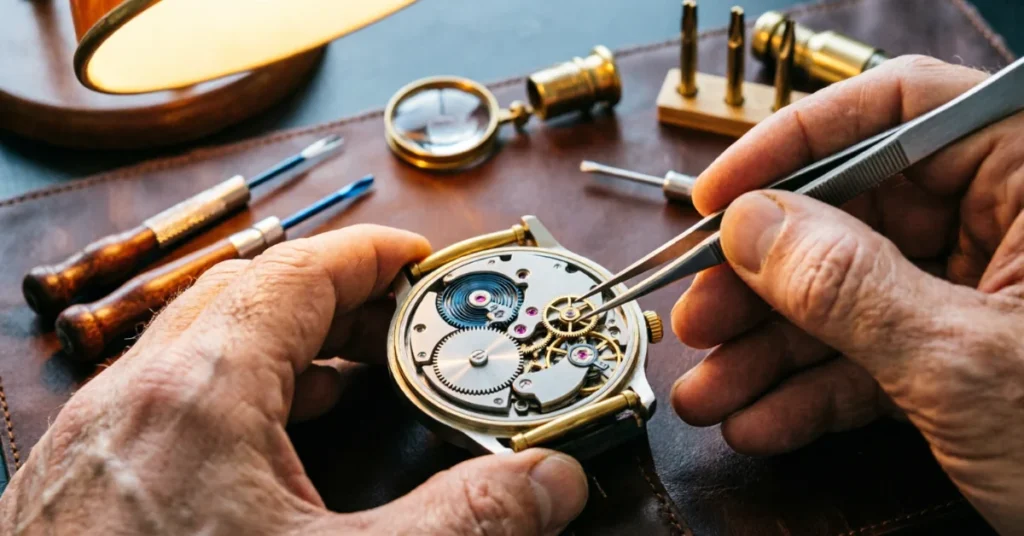
Skipping the servicing conversation is another common one. Mechanical watches typically need service every five to seven years, and that cost — often $300 to $800 depending on the brand — should factor into the real cost of ownership from day one, not come as a surprise later.
Buying based purely on brand recognition, without checking movement specs, water resistance, or bracelet quality, rounds out the list. Two watches from equally respected brands can differ enormously in day-to-day durability once you look past the dial.
Conclusion
Entry level luxury watches in 2026 cover more ground than the phrase suggests — from $700 Hamiltons with real Swiss movements up through $9,000 Cartier Santos pieces that double as design statements. The $2,000–$10,000 range remains the most useful working definition, and within it, the smartest buyers are the ones who separate genuine mechanical value from brand name alone before they spend. Whether that first purchase is a Tudor Black Bay, a Longines Spirit, or something quieter from Certina or Mido, the same rule holds: buy the watch you’ll actually wear, check the service network before the dial color, and treat resale value as a bonus, not the point.
FAQs
What is considered an entry level luxury watch in 2026?
Most dealers and collectors place entry level luxury watches in the $2,000–$10,000 range, defined less by price and more by in-house or co-developed automatic movements, sapphire crystal, and a functioning global service network.
What’s the cheapest real luxury watch brand to start with?
Hamilton, Certina, and Mido offer genuine Swiss automatic movements starting under $1,500, making them the most accessible entry points before stepping up into Tudor, Longines, or Omega territory.
Is buying pre-owned safe for a first luxury watch?
Yes, as long as the purchase goes through a certified dealer or a brand’s own certified pre-owned program, and the buyer runs a basic authentication check on serial numbers, papers, and caseback engraving. Buying from unverified private sellers carries real counterfeit and mismatched-parts risk.
Do entry level luxury watches hold their value?
Most hold value reasonably well if the brand and specific reference are chosen carefully, but they shouldn’t be treated as a guaranteed investment the way a small number of ultra-scarce Rolex or Patek Philippe references are.
How often do luxury watches need servicing?
Mechanical watches typically need servicing every five to seven years, with costs generally running $300 to $800 depending on brand and movement complexity — a cost worth budgeting for before buying, not after.