
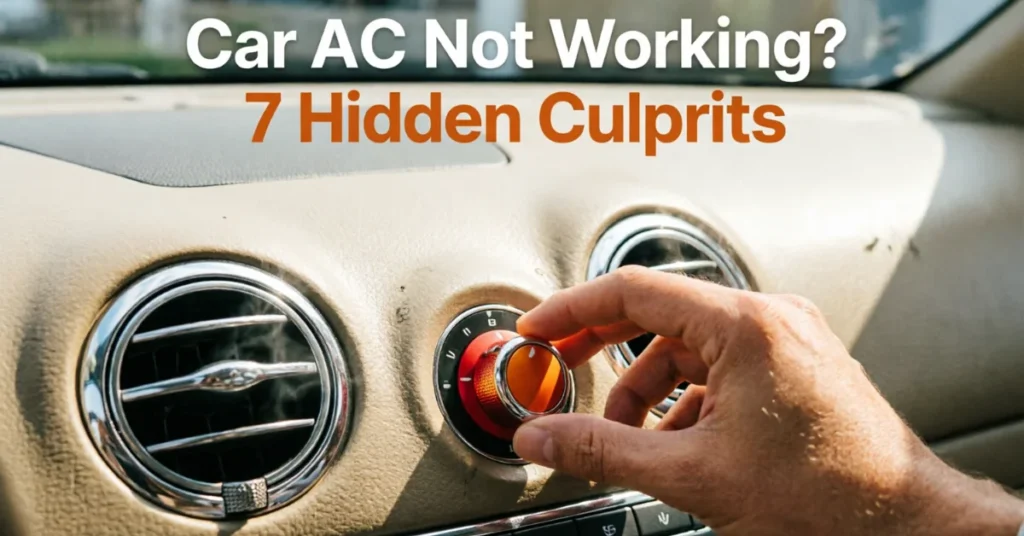
You crank the dial to max cold, point every vent at your face, and get nothing but warm air rolling out. If you’re asking why does my car AC not work, you’re not alone this time of year, and the honest answer is that it’s almost never one single thing. It’s usually one of a handful of predictable failures, and most of them give off warning signs before the system quits completely.
This guide walks through the actual mechanical and electrical reasons why your car AC not working and what a technician checks first, what a technician checks first, and which fixes are worth doing yourself versus leaving to a shop.
Why Does My Car AC Not Work? The Short Answer
In the vast majority of cases, a dead or weak car AC traces back to one of three things: a slow refrigerant leak, a failed compressor, or an electrical fault somewhere in the control circuit. Airflow problems and clogged cabin filters cause the rest.
Technicians who spend their summers under hoods will tell you the same thing: skipping a proper diagnosis and just adding refrigerant is the fastest way to waste money without fixing anything. A recharge on a system that’s leaking buys you a few days of cold air at best.
Quick Troubleshooting Guide
Use this table to quickly match your symptom with the most likely cause and the right next step.
| Symptom (What you notice) | Most Likely Cause | DIY Fix or Shop Visit? |
|---|---|---|
| Air is blowing, but it’s warm | Low refrigerant (leak) or bad compressor | Shop (Needs leak test & gauge) |
| Airflow is very weak/faint | Clogged cabin air filter or failing blower | DIY (Replace filter in 5 mins) |
| AC clicks on and off rapidly | Low refrigerant pressure switch tripping | Shop (Needs recharge & leak fix) |
| No air coming from vents at all | Blower motor failure or bad resistor | DIY or Shop (Motor replacement) |
| AC works while driving, warm at idle | Dirty/blocked condenser or bad cooling fan | DIY (Clean condenser) or Shop |
1. The Most Common Reason: Low Refrigerant From a Slow Leak
Refrigerant doesn’t get “used up” the way gasoline does. A sealed AC system that’s low on charge has a leak somewhere, even if it’s too small to see or hear. When drivers ask why does my car ac not work, low refrigerant from an undetected leak is usually the #1 culprit technicians find.
Typical warning signs include:
- Warm or barely-cool air even on max settings
- A faint hissing noise near the engine bay
- Oily residue around fittings, hoses, or the compressor
Seals and rubber hoses dry out during the off-season. Anyone who has run a shop through a cold winter and a hot spring knows this pattern well — cars that cooled fine in October show up in April blowing warm, because months of sitting idle let small leaks widen. A dye test or electronic leak detector is how a shop pinpoints the exact spot before recharging anything.
2. Compressor Failure: The Expensive Culprit
The compressor is the pump that pressurizes refrigerant and pushes it through the whole loop. When it seizes, fails to turn on, or wears out internally, the entire system stops cooling regardless of refrigerant level.
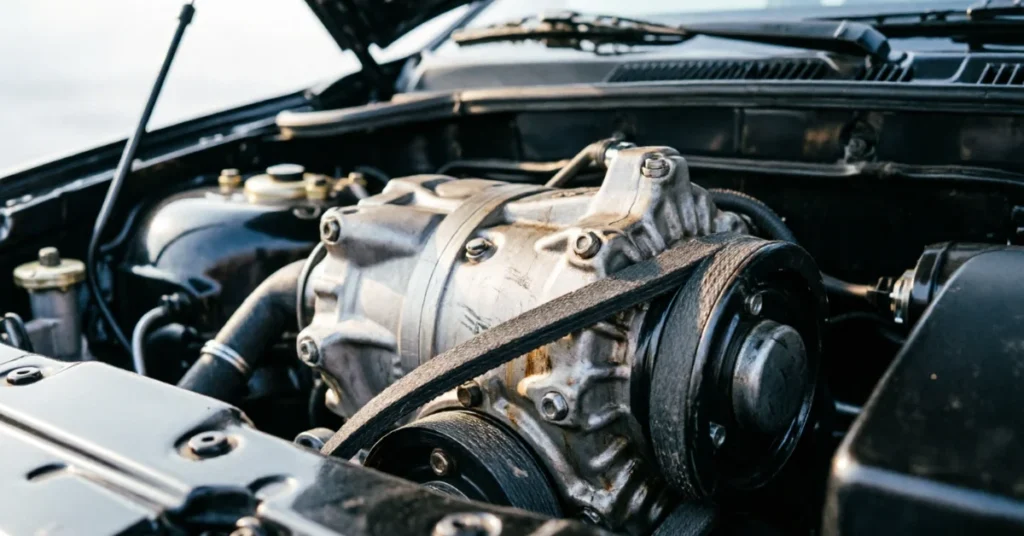
Compressor clutches are a frequent point of failure. If the clutch won’t lock in, you’ll often hear a clicking sound from under the hood instead of the usual quiet hum. Compressor replacement tends to be one of the pricier repairs in this category, since it involves recovering refrigerant, replacing the component, and evacuating the system before recharging.
3. Electrical and Control Module Problems
Modern cars route AC operation through a climate control module, which is essentially a small onboard computer. When a fuse blows, a relay sticks, or a wiring connector corrodes, the compressor may never receive the signal to turn on at all — even though every other part of the system is healthy.
Symptoms that point toward an electrical fault rather than a mechanical one:
- The AC button lights up but nothing kicks on
- The system works intermittently, cutting in and out
- Other electrical accessories nearby are also acting up
A basic multimeter check on the AC fuse and relay is often the fastest and cheapest first diagnostic step, and it’s one a confident DIYer can attempt before booking a shop visit. These electrical issues are a common but often overlooked reason why does my car ac not work even when the compressor and refrigerant levels are fine.
The Modern Car Trap: Eco Mode and Auto Stop-Start
Before panicking about a broken compressor, check your drive modes. In many modern vehicles, engaging “Eco Mode” or having the “Auto Stop-Start” system kick in at a red light will temporarily disable the AC compressor to save fuel. If your AC blows warm at a stoplight but gets cold once you are cruising at 40 mph, your AC isn’t broken—your car is just prioritizing fuel economy. Turn off Eco mode and test again.
4. Condenser and Airflow Restrictions
The condenser sits in front of the radiator and needs steady airflow to release heat from the refrigerant. Bugs, leaves, road debris, and bent cooling fins reduce that airflow and cut cooling capacity even when every other component works correctly.
People who detail cars for a living notice this constantly: a condenser packed with debris after a long highway trip through summer bugs is one of the more overlooked reasons AC performance drops gradually instead of failing all at once. A gentle rinse with low-pressure water and a soft brush, done carefully to avoid bending the thin aluminum fins, restores airflow in many cases.
5. Cabin Air Filter and Blower Motor Issues
Sometimes the cooling system itself is fine, and the real complaint is weak airflow rather than warm air. A clogged cabin filter chokes the amount of air moving across the evaporator, leaving vents that blow cold but faint. A failing blower motor produces a similar symptom, sometimes paired with a grinding or whining noise.
This is one of the cheapest fixes on this list. Cabin filters are typically rated for replacement every 12,000 to 15,000 miles, and swapping one takes a few minutes with no special tools.
What If the AC is Cold But Smells Bad? (Mold & Mildew)
Sometimes the AC cools perfectly, but blows a foul, mildew-like odor (often described as “dirty socks”). This happens because moisture gets trapped on the evaporator core inside the dashboard, creating a breeding ground for mold and bacteria. The Fix: Turn off the AC compressor (A/C button) but leave the blower fan on high for 5–10 minutes before parking. This dries out the evaporator. For existing smells, an evaporator foam cleaner sprayed into the exterior air intake can kill the bacteria.
6. Evaporator Leaks and Blend Door Actuators
The evaporator lives deep inside the dashboard and delivers cold air to the cabin. It’s also the component most exposed to moisture and debris pulled in through the exterior air intake, which makes corrosion and pinhole leaks a real risk over time. Because of its location, evaporator replacement is labor-intensive and rarely a quick job.
A separate but related issue is the blend door actuator, a small motor that mixes hot and cold air to hit your requested temperature. When it fails, you might get air that’s stuck on hot, stuck on cold, or accompanied by a clicking sound from behind the dashboard as the motor tries and fails to move the door.
7. R-134a vs. R-1234yf: Why Refrigerant Type Matters
Not every recharge is as simple as topping off a can from the auto parts store. Vehicles built before roughly 2021 typically use R-134a, while newer models have shifted to R-1234yf, a refrigerant that is far gentler on the atmosphere.
What the Research Shows
Government data on these refrigerants highlights exactly why the switch happened. According to the U.S. Environmental Protection Agency, <cite index=”19-1″>R-134a carries a global warming potential of 1,430, compared with just 4 for the newer HFO-1234yf refrigerant</cite> used in current-generation vehicles. That gap is the driving force behind manufacturers phasing out the older refrigerant in new production.
| Feature | R-134a (Older Vehicles) | R-1234yf (Newer Vehicles, ~2021+) |
|---|---|---|
| Global Warming Potential | 1,430 (High) | 4 (Ultra-low, Eco-friendly) |
| Flammability | Non-flammable | Mildly flammable (A2L class) |
| Service Ports | Standard threaded | Quick-connect, incompatible with R-134a |
| Cost to Recharge | Cheaper ($150 – $250) | More Expensive ($250 – $400+) |
The EPA also requires that <cite index=”16-1″>technicians use refrigerant handling equipment certified either by the agency itself or by an approved independent testing organization</cite>, and service ports for the two refrigerant types are intentionally incompatible so one can’t accidentally be mixed into the other’s system. That’s a strong reason DIY recharge kits work fine for topping off a known-good system but aren’t a substitute for proper leak diagnosis on anything more serious.
The DIY Trap: The Overcharged AC Myth
Many DIYers believe adding more refrigerant will make the air colder. This is false. An overcharged AC system cannot compress the gas properly, leading to high pressure that actually causes the system to blow warm air or even freeze up the evaporator core. If a DIY recharge doesn’t cool the car, stop adding refrigerant—you are likely overcharging it or have a blockage.
DIY Checks Before You Call a Shop
Anyone comfortable with basic tools can rule out a few things before paying for a diagnostic:
- Check the AC fuse against the owner’s manual fuse diagram.
- Listen for the compressor clutch engaging when AC is switched on.
- Inspect the cabin air filter and replace it if clogged or dark with debris.
- Look at the condenser for visible leaves, bugs, or bent fins.
- Check for oily residue around visible hose connections, which often signals a leak point.
If none of that resolves the problem, the issue is almost certainly inside the sealed system or the electrical control circuit, both of which need a shop’s pressure gauges and diagnostic tools.
When It’s Time for a Professional Diagnosis
A qualified technician connects pressure gauges to both the high and low sides of the system to see exactly where readings fall outside normal range. That single test usually narrows the cause down immediately, whether it’s low charge, a failing compressor, or a blocked expansion valve.
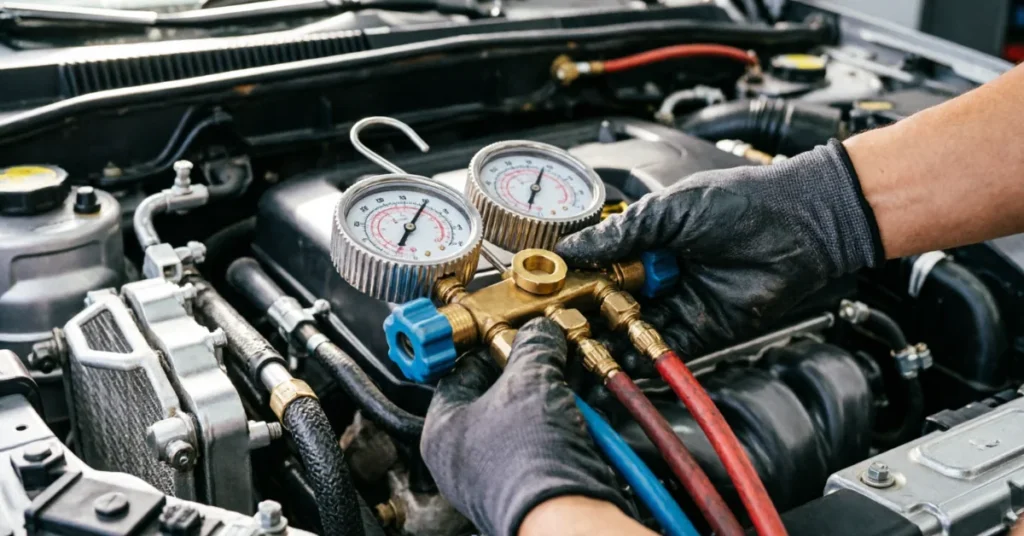
Refrigerant itself is a regulated substance. Handling it without the right recovery equipment risks releasing it into the atmosphere, which is exactly why sales of many refrigerants are restricted to EPA-certified technicians in the first place.
Why Does My Car AC Not Work After Sitting All Winter?
This deserves its own section because it’s the single most common complaint shops hear between April and June. The pattern is predictable: the system cooled fine last fall, then sat unused through five or six months of cold weather, and now it’s blowing warm on the first hot day of the season.
Rubber seals and O-rings shrink slightly when they go unused for months. Small leaks that were barely seeping in October can open up just enough to drain the charge over a winter of sitting idle. That’s exactly why running the AC for a few minutes every couple of weeks, even in January, matters more than most drivers realize.
Preventing Future AC Failures
A little routine care keeps most of these problems from becoming expensive ones:
- Run the AC for a few minutes at least once every couple of weeks, even in winter, to keep seals lubricated.
- Replace the cabin air filter on schedule.
- Have refrigerant pressure checked during routine maintenance, not just when problems start.
- Keep the condenser area clear of debris after long drives through bug-heavy or dusty routes.
A Note on EVs and Hybrids: The High-Voltage AC Difference
If you drive an electric or hybrid vehicle, your AC system doesn’t rely on the engine. Instead, it uses a high-voltage electric compressor and often a “heat pump” for cabin heating. If your EV’s AC fails, it’s rarely a simple refrigerant leak; it usually points to a high-voltage electrical fault, a failing heat pump valve, or a software glitch requiring a dealer-level diagnostic scan.
Conclusion
Now you know the 7 main reasons why does my car ac not work and exactly what to check next. It almost always comes down to a slow refrigerant leak, a tired compressor, a blown fuse, or a clogged condenser and filter working against you. None of these are mysterious once a proper diagnostic is run, and most give warning signs weeks before a total failure. Catching the pattern early, whether that’s a faint hiss under the hood or a fuse that keeps blowing, is what separates a cheap fix from a dashboard-deep repair bill.
FAQs
Why does my car AC blow warm air only sometimes?
Intermittent warm air usually points to an electrical fault, like a loose connector or a failing pressure switch. It can also be caused by modern car features like “Eco Mode” disabling the compressor at idle, rather than a total loss of refrigerant.
Can I just add refrigerant myself to fix warm AC?
You can top off a system that’s slightly low, but beware the “overcharge myth.” If there’s an actual leak, the cold air will fade again within days, and adding too much refrigerant can cause high-pressure damage.
How much does it cost to fix a car AC not work?
Costs vary widely by the failed part and vehicle, ranging from a cheap $15 fuse replacement to a more involved $1,500+ compressor or evaporator repair. (See the cost table above for details).
Is it bad to run my car AC in winter?
No, running it briefly every couple of weeks helps keep internal seals lubricated and can actually prevent leaks from developing.
Do all cars use the same AC refrigerant?
No. Most vehicles from around 2021 onward use R-1234yf, while older models typically use R-134a. The two require different service equipment and cannot be mixed.