

You turn the key, flip the AC on, and there it is: that damp, gym-locker smell rolling out of the vents. If you’ve typed “why does my car AC stink” into your phone while sitting at a red light, you’re far from alone. It’s one of the most common complaints mechanics hear once the weather warms up, and the good news is that most of the time, the fix is cheap and doesn’t require a mechanic’s degree.
The short answer: it’s almost always moisture. Your AC system pulls humidity out of the air to cool it, and that water has to go somewhere. When it doesn’t drain properly, it sits, and anything that sits wet for long enough grows something. That’s the real story behind the smell, and it’s worth understanding before you spend money guessing at fixes.
So Why Does My Car AC Stink? The Four Real Causes
There isn’t just one reason a car’s air conditioning turns foul. In practice, four culprits show up again and again, and they often overlap.
Mold and mildew on the evaporator core. The evaporator sits behind your dashboard and gets cold enough to condense water out of the air, the same way a glass of iced tea sweats on a hot day. That condensation is supposed to drain outside through a small tube. When the surface stays damp between drives, mold and bacteria move in and start feeding on dust that’s collected there. This single issue causes the majority of musty AC complaints mechanics see.
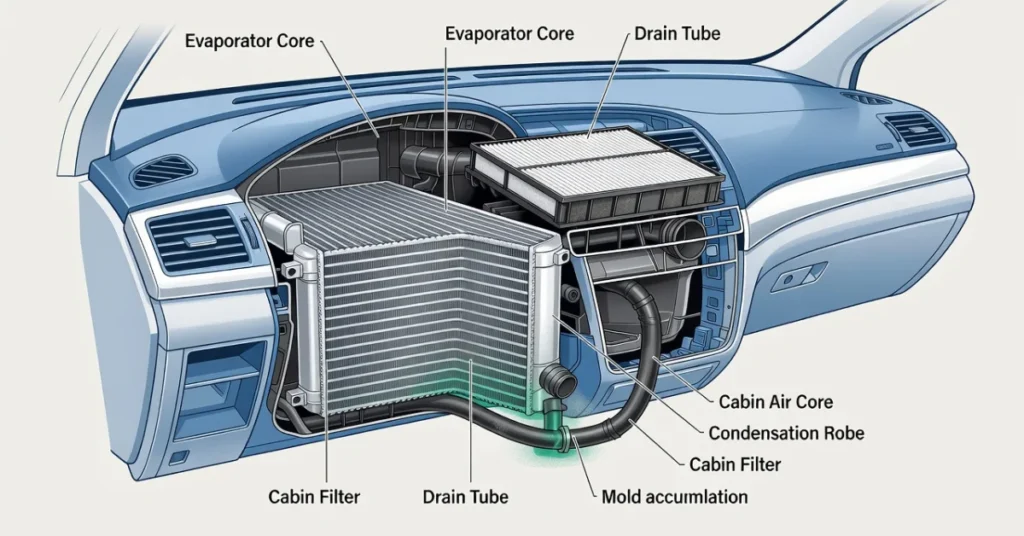
A dirty cabin air filter. Every bit of air blown into your cabin passes through this filter first, and it’s designed to trap pollen, dust, and debris. Left unchanged for too long, it turns into a damp sponge that holds onto exactly the kind of organic material bacteria like to grow on. Swapping it out is one of the easiest fixes on this entire list.
A clogged evaporator drain. If the tube that carries condensation outside gets blocked by debris, water backs up into the evaporator housing instead of leaving the car. That standing water is a breeding ground, and in bad cases it can even leak onto your floor mats.
Debris in the air intake. Leaves, pollen, and even the occasional fast-food wrapper get pulled into the intake vents near your windshield’s base. This buildup traps moisture right where fresh air enters the system, feeding the same bacterial growth from a different angle.
Quick Diagnostic Table: Match the Smell to the Fix
Before you spend money guessing, use this table to narrow down what’s actually happening in your system.
| Smell or Sign | Likely Cause | Fix | DIY or Pro |
|---|---|---|---|
| Musty, basement-like smell on startup | Mold/mildew on evaporator core | Evaporator cleaner spray through intake vent | DIY (mild cases), Pro (persistent) |
| Wet-dog or gym-bag odor | Dirty, saturated cabin air filter | Replace cabin air filter | DIY |
| Smell plus wet carpet or floor mats | Clogged evaporator drain tube | Locate and clear the drain tube | Pro |
| Sweet, syrupy smell with foggy windows | Leaking heater core (coolant seeping in) | Heater core inspection and repair | Pro |
| Oily or chemical smell with weak airflow | Refrigerant leak coating the evaporator fins | Pressure test and refrigerant leak repair | Pro |
Why Does My Car AC Stink Worse in Summer or After Rain?
Humidity is the trigger, so the smell gets worse exactly when you’d expect. Hot, muggy days mean your AC is condensing more water than usual, and short trips don’t give the system time to dry out between uses. Anyone who has driven through a humid summer knows the smell tends to hit hardest the moment you first switch the AC on, then fade slightly once air has been moving for a few minutes. That pattern is a strong sign that trapped moisture, not a mechanical fault, is behind it.
Frequent short hops, like school runs or quick errands, are actually worse for odor than long highway drives. A car that only runs its AC for five minutes at a time never gets hot and dry enough between trips to knock back bacterial growth, so the problem compounds week after week.
What the Research Shows
Detailed analysis of vehicle HVAC complaints consistently points to the same root cause: moisture that isn’t draining or evaporating fast enough. Service data collected across independent repair shops shows that replacing a dirty cabin filter and clearing the evaporator drain resolves the large majority of musty-AC complaints without any deeper repair. The remaining cases usually involve mold that has become embedded enough on the evaporator fins that it needs a professional-grade cleaning treatment rather than a filter swap alone.
Health authorities have also studied mold exposure broadly, and their findings are relevant here even outside the car. Indoor mold exposure is linked to allergy-type symptoms such as sneezing, a runny nose, and skin irritation, and it can trigger asthma flare-ups in people who are already sensitive to it. That’s not a reason to panic about your commute, but it is a reason not to ignore a musty AC smell that keeps coming back.
How to Fix It Yourself
You don’t need a shop visit for most of these fixes. Here’s a realistic order of operations:
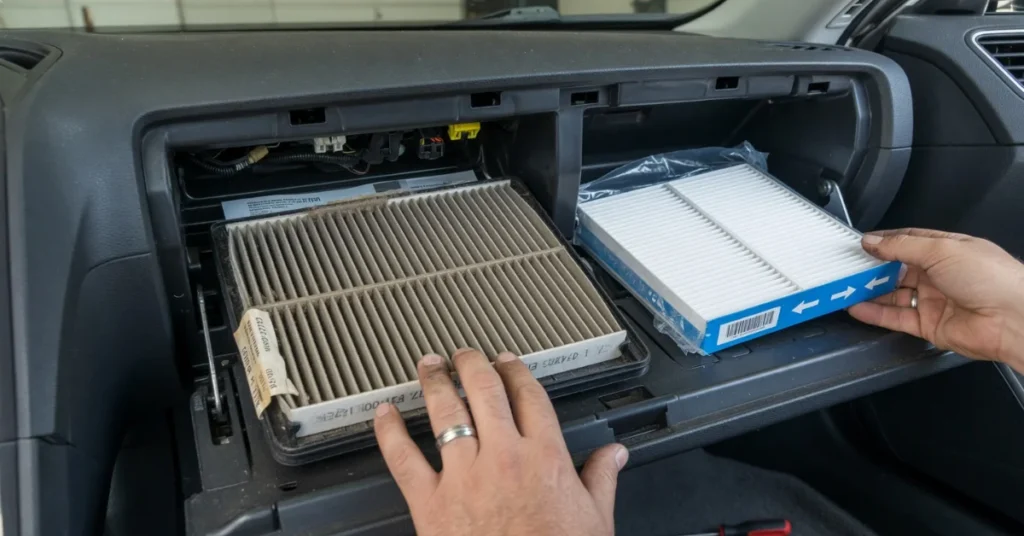
- Replace the cabin air filter first. It’s usually behind the glovebox or under the dash, takes about ten minutes, and costs far less than a service appointment.
- Run the fan without the AC for a minute before you park. This one habit helps dry out the evaporator so moisture doesn’t sit overnight.
- Avoid leaving the AC on recirculate all the time. Recirculate mode traps humid cabin air inside instead of exchanging it, which slows drying.
- Check under the car for a small puddle after AC use. Park on dry pavement, run the AC on high for five to ten minutes, then look underneath near the base of the windshield or firewall. A visible drip or small puddle means the drain is doing its job. No puddle at all, even after a long run in humid weather, is a strong sign the tube is blocked somewhere and water is backing up inside the housing instead.
- Use an AC evaporator cleaner designed for the intake vent, following the product’s instructions closely, if the smell persists after a filter change.
Anyone who has handled routine car maintenance before will recognize these as the same category of job as changing wiper blades: simple, low-risk, and something most owners can knock out on a Saturday morning.
When It’s Time to See a Mechanic
If you’ve replaced the filter, run the fan-dry routine for a couple of weeks, and the smell is still there, the mold has likely worked its way deeper into the evaporator housing than a surface treatment can reach. A technician can flush the case with a commercial-grade disinfectant and inspect the drain line for a clog that isn’t visible from where you’re sitting.
There’s one smell that isn’t about mold at all: a sweet, syrupy odor paired with foggy windows usually points to a leaking heater core, which lets coolant seep into the ventilation system. That’s a different repair entirely and shouldn’t be mistaken for a simple musty-AC problem. A chemical or oily smell, especially paired with weak airflow, can also point to a refrigerant leak rather than mold, and that one genuinely does need a pressure test from a professional.
Does This Happen to Electric and Hybrid Cars Too?
Yes, and in some cases it’s more noticeable. EVs and hybrids often run their AC compressors at lower power and cycle them on and off more frequently than a traditional engine-driven system, which leaves the evaporator core damp for longer stretches between cooling cycles. That extra dwell time gives bacteria and mold more opportunity to establish themselves. Owners switching from a gas car to an EV sometimes assume something is wrong with the new vehicle when they first notice the smell, but the underlying cause and the fix are identical to any other car: clear the filter, dry the system out, and check the drain.
Prevention: Keeping the Smell From Coming Back
Once you’ve cleared it up, a few habits keep it from returning. One growing option worth knowing about heading into 2026 is the antimicrobial-treated cabin filter, now offered by several aftermarket brands, which resists mold and bacterial growth on the filter media itself rather than just trapping debris. It won’t fix an already-contaminated evaporator, but it’s a reasonable upgrade the next time a routine filter swap is due. Change the cabin filter roughly every 15,000 to 30,000 miles, or once a year if you live somewhere dusty or pollen-heavy.
Get in the habit of running the fan alone for the last minute or two of every drive during hot months. And if you notice wet floor mats or a musty smell creeping in even when the AC hasn’t been running, check for a separate water leak elsewhere in the cabin, since that moisture feeds the same problem from a different source.
Owners of older vehicles, in particular, should keep an eye on this. As a car ages, the drain tube and evaporator housing accumulate more grime, and the smell tends to return faster than it did when the car was new. A once-a-year evaporator check during routine service is a small habit that saves a bigger repair bill down the line.
Conclusion
If you’ve been asking why does my car AC stink every time you start the engine, the answer almost always comes down to trapped moisture feeding mold, mildew, or bacteria somewhere in the system, most often the evaporator, the cabin filter, or the drain line. A ten-minute filter swap and a habit of running the fan dry before you park solves this for most drivers without a single trip to the shop. For the stubborn cases, a professional evaporator cleaning clears out what a filter alone can’t reach. Either way, this is one of the more fixable smells your car will ever throw at you.
FAQs
Why does my car AC stink only when I first turn it on?
That first blast of air has been sitting in a damp, closed system since your last drive, so it carries the strongest concentration of trapped odor. It usually fades as fresh air starts moving through.
Is a smelly why does my car AC stink dangerous to breathe?
For most healthy people, it’s unpleasant rather than dangerous, though anyone with allergies or asthma may notice symptoms like sneezing or throat irritation build up over a longer drive.
How much does it cost to fix a smelly car AC?
A cabin filter swap typically runs under fifty dollars in parts, while a full professional evaporator cleaning and drain clearing service tends to land in the low hundreds, depending on your vehicle and location.
Can I use a household disinfectant spray on my car AC?
It’s possible to treat the intake vent yourself with an automotive-specific AC cleaner, but the evaporator itself sits deep behind the dashboard, so a full clean is usually better left to a shop with the right access and tools.
Will a new car ever have this problem?
Yes, moisture buildup has nothing to do with age. Even a brand-new car will develop the smell if it’s driven mostly on short trips in humid weather without ever giving the evaporator time to dry out.