
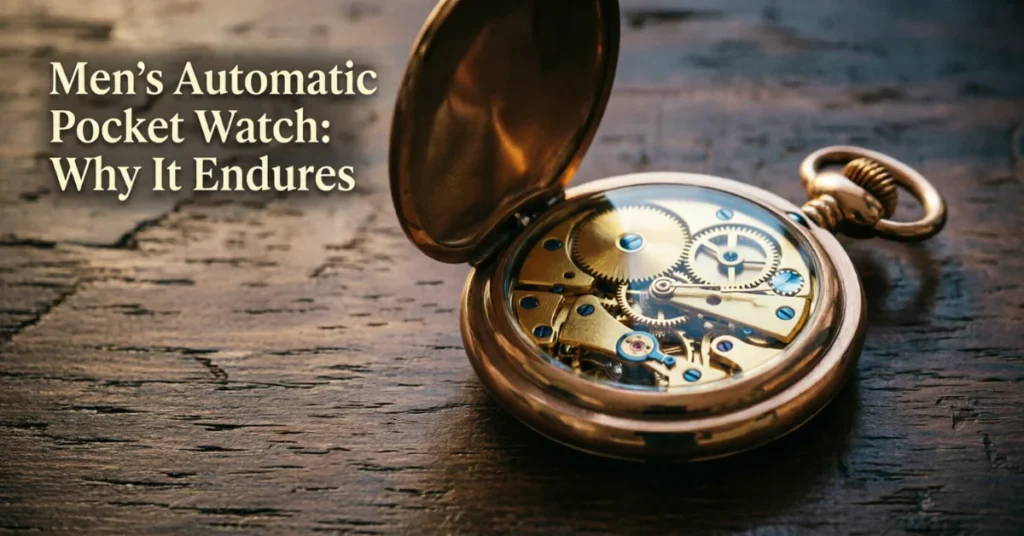
Hold a men’s automatic mechanical pocket watch up to your ear and you’ll hear something a smartphone never gives you: a heartbeat made of metal. That soft, mechanical tick is the sound of a mainspring unwinding, gears turning, and a balance wheel swinging back and forth roughly five times a second. It’s an odd thing to fall for in an age of touchscreens, and yet here we are.
Pocket watches are having a real moment again. Auction houses are seeing record prices for antique pieces, major brands are releasing new pocket-carried designs, and everyday buyers are rediscovering a format that once defined how the world told time. A men’s automatic mechanical pocket watch sits right at the center of that revival, offering something a wristwatch simply can’t: a tactile, deliberate ritual around checking the time.
This piece breaks down what makes these watches tick, literally and figuratively, who’s buying them, and what to know before you get one for yourself or for someone else.
What Is a Men’s Automatic Mechanical Pocket Watch, Exactly?
A men’s automatic mechanical pocket watch is a timepiece with no battery and no quartz crystal. Instead, it runs on a wound mainspring that stores mechanical energy, and it winds itself as the watch moves. Carry it in your pocket during the day, and the small oscillating rotor inside keeps the mainspring topped up.
That’s different from a manual pocket watch, which needs you to twist the crown by hand every day or two. It’s also worlds apart from a quartz version, which uses a battery and a vibrating crystal instead of gears. The table below lays out how the three formats actually compare on the things buyers care about most.
| Feature | Automatic Mechanical | Manual Mechanical | Quartz |
|---|---|---|---|
| Power source | Self-winds from movement | Hand-wound daily | Battery |
| Typical power reserve | 36 to 72 hours | 24 to 48 hours | Years (battery life) |
| Daily accuracy | ±5 to 30 seconds | ±5 to 30 seconds | ±1 to 2 seconds |
| Maintenance | Full service every 5 to 7 years | Full service every 5 to 7 years | Battery swap every 1 to 3 years |
| Feel and appeal | Self-sustaining ritual, visible engineering | Hands-on daily ritual | Convenience, minimal upkeep |
Most modern automatic pocket watches store somewhere between 36 and 72 hours of power reserve once fully wound, which means a day or two of light use before the movement runs down. Anyone who has owned one for a while knows the small satisfaction of feeling that reserve build back up just from a day spent walking around.
The format usually falls into two case styles. A hunter case has a hinged metal cover protecting the crystal. An open-face case skips the cover, showing the dial directly. Skeleton dials, which reveal the moving gear train underneath, have become especially popular with buyers who want to watch the mechanism work.
Why Men’s Automatic Mechanical Pocket Watch Demand Is Climbing in 2026
Something interesting is happening across the wider watch industry right now, and pocket watches are riding the wave. The global mechanical watch market was valued at roughly $79 billion in 2025 and is projected to climb toward $82.4 billion in 2026, according to Global Market Insights, with rising interest in traditional craftsmanship cited as a core driver. That growth isn’t limited to wrist models.
Auction specialists have watched the secondary pocket watch market heat up through 2025 and into 2026, pointing to a wave of high-profile antique collections resurfacing and setting record prices at sale. One 1907 English piece reportedly fetched close to $2.8 million at auction, a signal of just how serious collector demand has become for the format’s rarest examples.
That collector energy trickles down. Interest in the everyday men’s automatic mechanical pocket watch has grown alongside it, driven by buyers who want the craftsmanship story without the six-figure price tag. Search interest in automatic mechanical watches showed a clear seasonal spike in late 2025, with steady demand carrying into gift-giving periods. Anyone shopping in this space right now is walking into a market that’s genuinely active, not a dead category getting a nostalgic nudge.
Part of the appeal is simply sensory. People who own one describe winding it and hearing the movement tick as something closer to a small ceremony than a chore. That’s a hard feeling to manufacture with a battery-powered device, and it’s exactly what’s pulling new buyers in.
How the Mechanism Actually Works
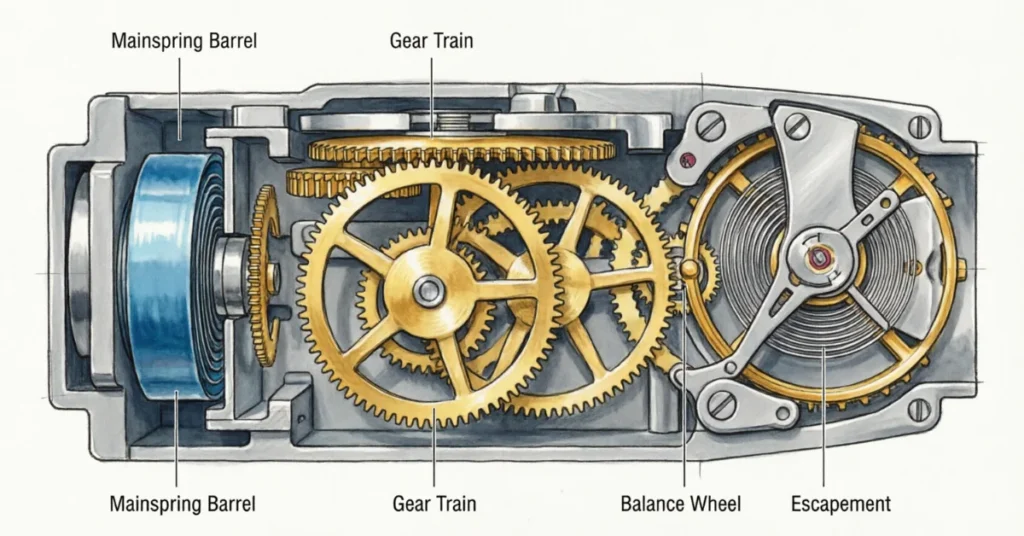
Open the case back of a men’s automatic mechanical pocket watch and you’ll find a small universe of moving parts. Understanding the basics makes the watch far more interesting to own.
- Mainspring: a coiled strip of metal that stores energy when wound, either by hand or by the automatic rotor
- Rotor: a weighted half-disc that swings with movement and winds the mainspring automatically
- Gear train: a series of interlocking gears that transfer energy from the mainspring toward the escapement
- Escapement: the mechanism that releases energy in tiny, regular bursts, controlling the ticking motion
- Balance wheel: the oscillating wheel that regulates timing, typically vibrating at 21,600 to 28,800 beats per hour
- Jewels: small synthetic rubies placed at friction points to reduce wear, often 17 to 21 in a quality movement
Every one of these parts has to work in concert for the watch to keep accurate time. That’s a large part of why a well-built mechanical movement commands respect. There’s no shortcut, no chip doing the work. It’s pure kinetic engineering shrunk down to fit in your palm.
One thing worth flagging here: jewel count gets thrown around a lot in product listings as a quality signal, and it’s misleading on its own. A “17-jewel” or “21-jewel” label just tells you how many friction points are cushioned with synthetic rubies. It says nothing about whether the movement is properly regulated or assembled with care. A cheap, poorly finished movement can carry a high jewel count and still keep worse time than a simpler, well-regulated one. Anyone comparing listings should treat jewel count as one small data point, not the whole story.
Real-World Buying Scenarios
Anyone who has shopped this category for a while knows the market splits into a few clear tiers, and the right pick depends heavily on what the watch is actually for. Real listings make the tiers easier to picture than vague price ranges do.
| Price Tier | Example | Typical Price | Best For |
|---|---|---|---|
| Entry level | ShoppeWatch Eagle skeleton pocket watch | Around $29 | First-time buyers testing the format |
| Budget mid-range | August Steiner silver-tone skeleton | Around $64 | Casual daily carry |
| Mid-range | Bulova Sutton automatic skeleton | Around $357 | Buyers wanting brand reliability |
| Upper mid-range | Charles-Hubert stainless steel half hunter | Around $494 | Gift-quality formal pieces |
| Premium collector | Sturhling Modena 991 automatic skeleton | Around $1,250 | Serious collectors and heirloom buyers |
Prices shift with retailer promotions and availability, so treat these as a general reference rather than a fixed price list.
Everyday collectors tend to gravitate toward mid-range stainless steel pieces with skeleton dials, often priced between $60 and $500. These offer visible movement, decent accuracy, and enough durability for regular handling without collector-level investment.
Gift buyers shopping for a father, grandfather, or groomsman often lean toward hunter-case designs with engraved backs, since the closed cover protects the crystal during travel and the engraving adds a personal touch that a plain wristwatch rarely delivers.
Formal wear buyers pairing a pocket watch with a waistcoat for a wedding or black-tie event usually prioritize a slim open-face design on a matching Albert chain, since bulk and weight matter more when the watch sits visibly against a vest.
Anyone assembling a collection with an eye toward long-term value tends to look further up-market, toward pieces from established Swiss or German manufactures, where the movement finishing and documented provenance carry real weight at resale.
Pros and Cons Worth Weighing
No format is perfect, and honesty here matters more than hype.
What people love:
- No battery ever needed, and no risk of the watch simply dying mid-conversation
- Visible craftsmanship, especially on skeleton dial models
- A genuine conversation piece at formal events, weddings, and gatherings
- Strong resale and heirloom value on well-made pieces
What people find frustrating:
- Lower everyday accuracy than quartz, typically losing or gaining a handful of seconds per day
- Needs regular wear or occasional manual winding to stay powered
- Bulkier than a wristwatch, and not something you’ll glance at mid-stride
- Entry-level mass-produced units can use unregulated movements with inconsistent timekeeping
That last point deserves attention. Buyers new to the category sometimes assume a vintage-style case automatically means vintage-level quality inside. It doesn’t. A watch’s outer design tells you almost nothing about the reliability of the movement beneath it, so it pays to check what caliber is actually inside before buying.
What the Research Shows
Industry data backs up what collectors have been saying anecdotally for the past year. Analysts tracking the broader mechanical watch category expect continued growth through the rest of this decade, with the sector’s compound annual growth rate sitting near 5% out to 2035. Rising affluence, a renewed appreciation for artisan craftsmanship, and interest in wealth-preserving collectibles are cited as the leading drivers behind that trajectory.
Auction data tells a similarly strong story specifically within pocket watches. Major watch auction houses reported total 2025 hauls in the hundreds of millions of dollars, with pocket watches contributing a meaningful share of headline-grabbing results. That kind of activity at the top of the market tends to lift confidence and interest at every price point below it, including the everyday men’s automatic mechanical pocket watch that most buyers are actually shopping for.
Maintenance data matters too. Most horologists recommend a full service every five to seven years for a standard automatic movement, a detail worth budgeting for if you plan to wear the watch regularly rather than keep it in a drawer.
Caring for an Automatic Pocket Watch
Longevity comes down to a few habits.
Wear it or wind it. If you’re not carrying the watch daily, give the crown twenty to thirty gentle turns every few days to keep the mainspring lightly tensioned. Never force the crown once you feel resistance.
Keep it away from strong magnets. Modern electronics, speaker magnets, and induction chargers can magnetize the hairspring and throw off accuracy. Store the watch away from those sources when it’s not in use.
Get it serviced on schedule. A five-to-seven-year service interval keeps the lubrication fresh and prevents the kind of wear that eventually damages the gear train. For that service, a local independent jeweler with horology experience is usually faster and cheaper for a standard men’s automatic mechanical pocket watch, while a brand-authorized service center makes more sense for higher-end pieces where original parts and documented service records affect resale value.
Use a proper chain. A dedicated pocket watch chain with a spring-loaded clip or T-bar attachment distributes weight correctly and protects the case from drops, something a standard necklace simply isn’t built to do. A single Albert chain has one clasp and drapes from the watch to a single buttonhole, while a double Albert splits into two chains from a central T-bar, letting the watch hang from one side and a small fob or key from the other. Regular necklaces lack the secure attachment points these chains offer, so they’re a poor substitute even when the length looks right.
Check the material if you’ll wear it often. There’s no government restriction on pocket watch materials in the US, UK, or EU, but prolonged skin contact is worth a second thought. Nickel-free alloys and hypoallergenic case coatings reduce the odds of irritation for anyone with sensitive skin, and it’s a detail worth checking in the product description before buying, particularly on lower-cost imported pieces.

Who Should Actually Buy One
A men’s automatic mechanical pocket watch makes sense for a specific kind of buyer. If you value ritual over raw accuracy, if you appreciate visible engineering, or if you want something with heirloom potential rather than disposable convenience, this format rewards you well. It’s less suited to anyone who needs split-second timing for sports or shift work, where a quartz or digital watch will simply serve better.
For formal occasions, gifting, and everyday style with a story behind it, though, few accessories carry the same weight. As 2026 continues to push non-wrist watches back into the spotlight, a men’s automatic mechanical pocket watch is proving it never really left the conversation. It just waited for people to look down again.
This article is for general informational purposes and reflects publicly available market research current as of mid-2026.
FAQs
Is a men’s automatic mechanical pocket watch accurate enough for daily use?
Most run within a few seconds to a minute of accuracy per day, which is fine for daily reference but not precise enough for split-second timing needs.
How often does an automatic pocket watch need winding?
If worn daily for several hours, the rotor keeps it wound naturally. If it sits unworn, give the crown a light manual wind every few days to keep the mainspring engaged.
What’s the difference between hunter case and open-face pocket watches?
A hunter case has a hinged metal cover protecting the crystal, while an open-face design shows the dial directly without a cover.
Do these watches hold their value over time?
Well-made pieces from established manufactures tend to hold or appreciate in value, while mass-produced entry-level units generally don’t.
Can I wear a pocket watch with modern, casual clothing?
Yes. Many buyers pair a compact pocket watch with a chain clipped to a belt loop or jacket pocket for a subtle, everyday accent rather than strictly formal wear.