

You’re stopped at a red light, foot off the gas, and the whole car starts to tremble like it’s cold. So why does my car shake when idle, and is it something to fix today or something that can wait? In most cases, the answer comes down to a handful of usual suspects — worn spark plugs, a dirty fuel system, a vacuum leak, or tired motor mounts. None of them are mysterious once you know where to look.
Anyone who has driven an older vehicle knows that a smooth idle is easy to take for granted until it disappears. A healthy engine at rest should feel almost silent, just a faint hum through the seat. When that hum turns into a shudder, it’s the engine telling you something specific — you just need to translate it.
What a Normal Idle Actually Feels Like
Before chasing a problem, it helps to know what “normal” looks like. Most warm gasoline engines settle between roughly 600 and 1,000 RPM at idle, with many modern four-cylinder cars sitting closer to 700–750 RPM once the engine reaches operating temperature. Right after a cold start, it’s common for idle speed to sit higher — often 1,000 to 1,300 RPM — for a minute or two while the engine warms up.
If your tachometer needle is bouncing around, or the idle drops low enough that the car feels like it might stall, that’s a different story from a slightly elevated cold-start idle. Mechanics generally treat a shaky, unstable idle as a symptom worth investigating rather than something to ignore.
Why Does My Car Shake When Idle? The Core Reasons
Here’s where things get practical. Techs who see this issue daily tend to work through the same short list of usual culprits before anything more expensive gets touched.
Worn or fouled spark plugs. Spark plugs ignite the air-fuel mixture in each cylinder. Once they wear down or get coated in carbon, they fire unevenly, which causes a misfire. A misfiring cylinder throws the whole engine off balance, and that imbalance shows up as a shake — especially noticeable at idle, when RPM is low and there’s less momentum to smooth things out.
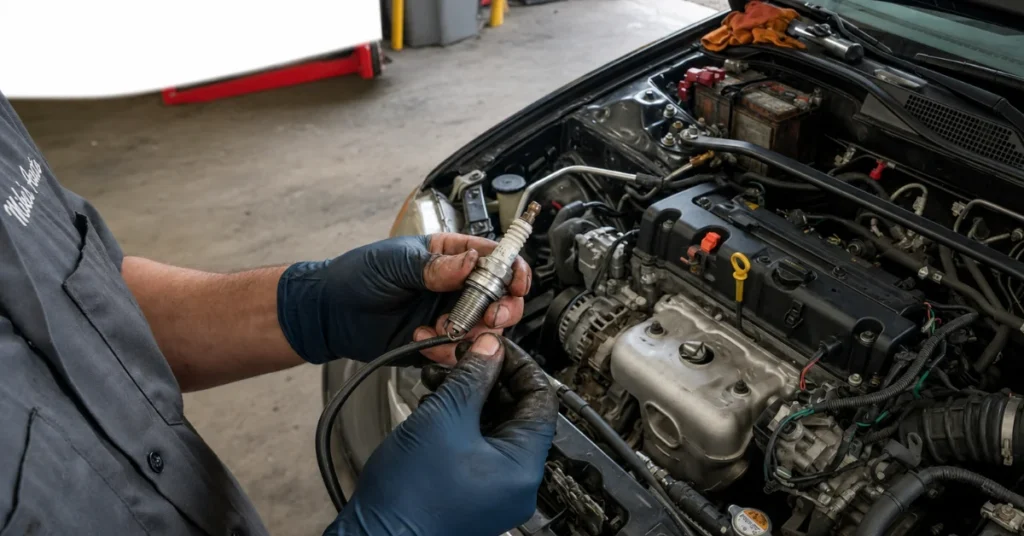
Dirty or clogged fuel injectors. Injectors get exposed to heat and pressure constantly, and over tens of thousands of miles, carbon deposits build up around the nozzle. A clogged injector starves a cylinder of fuel, producing anything from a mild flutter to a pronounced shudder.
Vacuum leaks. Cracked or loose vacuum hoses let unmetered air into the intake, throwing off the air-fuel ratio the engine’s computer is trying to maintain. A vacuum leak often brings a hissing sound along with the shake, and it tends to get worse the longer it’s left unaddressed.
A stuck or clogged PCV valve. The positive crankcase ventilation (PCV) valve recycles gases from the crankcase back into the intake. When it clogs or sticks open, it throws off the air-fuel mixture in a way that mimics a vacuum leak — and it’s a separate part that needs its own check, not just the hoses around it.
A failing idle air control valve. This small valve regulates airflow specifically during idle. When it sticks or fails, idle speed becomes erratic — surging, dropping, or shaking without warning, even though the car may drive fine once you’re moving.
Worn motor mounts. Mounts hold the engine in place and absorb its natural vibration before it reaches the cabin. Rubber degrades with age and mileage, and once a mount fails, every pulse of the engine transfers straight into the seat and steering wheel. A quick way to check: shift into neutral. If the shaking eases noticeably, mounts are a strong suspect.
Timing belt or chain wear. The timing belt keeps the camshaft and crankshaft rotating in sync. A worn or loose belt throws off that timing just enough to create a rough, uneven idle — and it’s often accompanied by a light squealing or ticking noise.
A dirty or clogged air filter. Restricted airflow forces the engine to run rich, which can produce a rough idle along with reduced fuel economy. It’s one of the cheapest and easiest causes to rule out.
Loose or damaged engine hoses. Beyond vacuum lines, any loose intake hose can create the same uneven-air problem that throws idle quality off.
A loose exhaust heat shield. This one gets missed constantly. The thin metal shield wrapped around the exhaust and catalytic converter can rattle loose over time, and at idle that rattling transmits through the floor and feels exactly like an engine shake — even though the engine itself is running fine. A quick look underneath the car near the exhaust, or a rattling sound that changes with engine speed rather than smoothing out, points here instead of the engine bay.
Quick Symptom Reference Table
If you’re trying to figure out exactly why does my car shake when idle for your specific situation, matching the pattern you’re feeling to a likely cause saves a lot of guesswork before you even open the hood. Here’s a fast reference:
| Symptom Pattern | Most Likely Cause | Quick Check |
|---|---|---|
| Shakes only when AC is on | Worn motor mounts | Turn AC off — does the shake ease up? |
| Shakes worse in Drive, better in Neutral | Motor mounts or transmission mount | Shift to Neutral at a stop and compare |
| Shake paired with a hissing sound | Vacuum leak | Listen closely near the intake and hoses |
| Rattling metal sound near the floor | Loose exhaust heat shield | Check underneath the car near the exhaust |
| Shake plus a rotten-egg smell | Failing catalytic converter (from prolonged misfire) | Needs a mechanic’s diagnostic scan |
| Rough idle only right after a cold start | Normal engine warm-up | No action needed if it smooths out in a minute or two |
| Shake with a flashing check engine light | Active, ongoing misfire | Stop driving and get it looked at the same day |
This table isn’t a substitute for a proper diagnostic, but it narrows the search fast — which matters when a five-minute check can save an unnecessary trip to the shop.
A Cause Most Drivers Don’t Know About: Cylinder Deactivation
Here’s something that trips up a lot of owners of V6 and V8 trucks and SUVs. Many modern engines use cylinder deactivation, sometimes called Active Fuel Management or Displacement on Demand, which shuts off a set of cylinders during low-load conditions — including at idle — to save fuel. When those cylinders switch off and back on, some drivers feel a brief, mild vibration that has nothing to do with a fault. It’s the system doing exactly what it’s designed to do.
The difference between this and a real problem comes down to consistency. Cylinder deactivation produces a subtle, momentary shift, not a sustained shake. If the vibration is constant and doesn’t settle, that’s your cue to move down the list of actual causes rather than write it off as normal.
Why Does My Car Shake When Idle but Feels Fine While Driving?
This specific pattern — smooth on the road, rough at a stoplight — points toward idle-specific systems rather than the engine as a whole. At higher RPM, minor misfires or air leaks get masked by sheer engine speed and momentum. At idle, there’s nothing to hide behind.
Techs who deal with this pattern regularly usually check the idle air control valve, vacuum hoses, and motor mounts first, since these are the parts most active — or most exposed — specifically when the engine is turning over slowly. If the AC compressor kicks the shake into a higher gear, that’s often a motor-mount tell, since the added load makes existing vibration more obvious.
What the Research Shows
Detailed reviews of automotive repair data consistently point to spark plug wear and fuel system contamination as the two most frequently diagnosed causes of rough idle across gasoline engines, regardless of make. Analysis from independent repair shops also shows a recurring pattern: complaints that start as “shakes when idling” and go unaddressed for months are disproportionately likely to return as misfire-related check engine codes, since a struggling ignition or fuel system tends to degrade rather than self-correct.
That pattern lines up with basic engine mechanics — a cylinder that isn’t firing cleanly puts extra, uneven load on the ones around it, and that stress compounds over time rather than staying flat.
Different Drivers, Different Situations
Not everyone experiencing this is dealing with the same setup, so a few quick notes by situation:
- Manual transmission drivers should pay attention to whether the shake appears mainly in neutral versus in gear with the clutch engaged — a difference here can point toward the clutch or flywheel rather than the engine itself.
- Hybrid and EV drivers technically don’t “idle” the same way, since the gas engine cycles on and off. A shudder specifically when the combustion engine kicks in is usually a spark plug or engine-mount issue, not a general drivetrain fault.
- Cold-climate drivers should expect a higher, sometimes slightly rougher idle for the first minute or two after starting in freezing temperatures. That’s normal warm-up behavior, not a fault, as long as it smooths out once the engine reaches temperature.
- High-mileage vehicle owners (100,000 miles and up) are statistically more likely to be dealing with worn motor mounts or an aging timing belt simply due to rubber and material fatigue over time.
When to Stop Driving and Get It Checked
Some causes of a rough idle are low-risk and can wait for a scheduled service — a dirty air filter, for instance, won’t strand you. Others carry real consequences if ignored. A sustained misfire pushes extra unburned fuel through the exhaust system, which can damage the catalytic converter — a repair that costs far more than the spark plugs that caused it.
Get the car looked at promptly if the shaking is sudden and severe, if the check engine light comes on alongside it, if you notice a burning or fuel smell, or if the car struggles to accelerate. Vehicle safety resources such as the U.S. National Highway Traffic Safety Administration recommend addressing warning lights and unusual vehicle behavior promptly rather than waiting for a scheduled service date, since a manageable issue today can become a stall-risk issue later.
One distinction worth knowing: a steady check engine light usually means a moderate issue worth scheduling a visit for soon. A flashing check engine light means something different entirely — it signals an active misfire severe enough to damage the catalytic converter in real time. If the light is flashing along with the shake, that’s a same-day stop-and-get-it-checked situation, not a schedule-it-for-next-week one.
How to Fix a Rough Idle
A few steps are realistic for a confident DIYer:
- Check the air filter and replace it if it’s visibly dirty — a five-minute job on most vehicles.
- Inspect visible vacuum hoses for cracks, looseness, or a hissing sound near the intake.
- Check the tachometer against the normal 600–1,000 RPM range once warmed up.
- Note whether the shake changes in neutral versus in gear, and whether it worsens with the AC on.
- Look underneath the car near the exhaust for a loose or rattling heat shield before assuming the engine itself is at fault.
- If the car is due for maintenance, ask the shop to inspect the PCV valve along with the usual vacuum-line check — it’s often skipped in a basic inspection.
Beyond that, spark plug replacement, fuel injector cleaning, and motor mount diagnosis generally call for a lift, a scan tool, and a trained eye — this is where a mechanic earns their fee. A diagnostic scan can usually narrow the cause down within an hour, which beats guessing and replacing parts one at a time.
Conclusion
So, why does my car shake when idle? Nine times out of ten, it’s one of a short, well-understood list: spark plugs, fuel delivery, a vacuum leak, the idle air control valve, or worn motor mounts. None of these are exotic problems, and most are inexpensive to diagnose early. What matters is not letting a minor shudder turn into a stalled cylinder or a fried catalytic converter. If your car shakes when idle and the feeling doesn’t ease up within a few days, a proper diagnostic check is worth the visit — your engine, and your wallet, will thank you later.
This article is for informational purposes only. Always consult a qualified mechanic for a proper diagnosis specific to your vehicle.
FAQs
Q: Why does my car shake when idle but not while driving?
This usually points to idle-specific systems — the idle air control valve, vacuum hoses, or motor mounts — since problems that get masked by speed become obvious at low RPM.
Q: Is it safe to keep driving if my car shakes at idle?
Short-term, usually yes, but a persistent shake often signals a misfire that can damage the catalytic converter over time. Get it checked rather than letting it linger.
Q: Can a dirty air filter really cause my car to shake at idle?
Yes. Restricted airflow throws off the air-fuel ratio, and while it’s one of the milder causes, it’s also one of the cheapest to rule out first.
Q: How much does it cost to fix a rough idle?
It ranges widely — a set of spark plugs might run under $200 installed, while motor mount replacement or a full fuel system cleaning can run several hundred dollars depending on the vehicle.
Q: Does the shaking get worse with the AC on?
Often, yes. The AC compressor adds load to an already-strained idle system, which tends to make existing motor mount or spark plug issues more noticeable.
Q: Could the shake actually be a rattling heat shield instead of the engine?
Yes, and it’s commonly mistaken for engine trouble. A loose exhaust heat shield rattles at idle and can feel like a shake through the floor, even though the engine is running fine. Checking underneath the car near the exhaust can rule this in or out in a couple of minutes.