
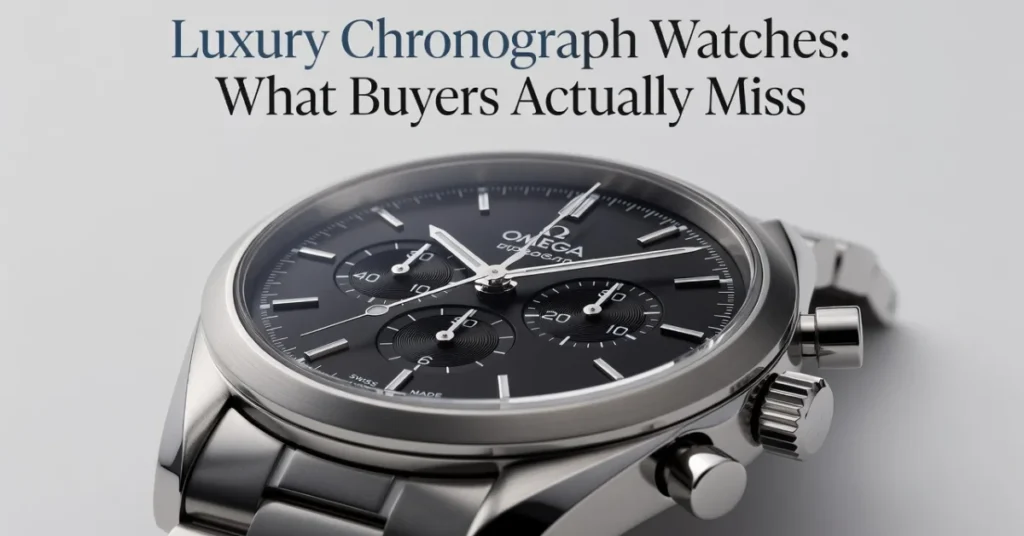
A chronograph looks like a regular watch until you press the pusher and the extra hand starts sweeping. That’s the moment most people fall for luxury chronograph watches, not because of the price tag, but because of what’s happening inside the case. This piece walks through what actually makes these watches worth the money, what separates a $400 piece from a $40,000 one, and what to check before you buy.
What Makes a Chronograph Different From a Regular Watch
A standard watch tells time. A chronograph does that and also works as a stopwatch, built right into the dial. You’ll usually spot two or three sub-dials tracking seconds, minutes, and sometimes hours of elapsed time, plus a set of pushers on the case to start, stop, and reset the function.
The word itself comes from Greek, “chronos” for time, “graph” for writing. Early versions in the 1800s used ink to literally mark elapsed time on paper. Modern watches ditched the ink centuries ago, but the core mechanical idea hasn’t changed much: a separate gear train that engages only when you need it.
Luxury Chronograph Watches at Every Budget Level
Here’s something most buying guides gloss over: this category isn’t just a five-figure club anymore. The market now spans from accessible mechanical pieces under $500 to six-figure grand complications, and knowing where each tier actually sits changes how you shop.
| Budget Tier | Price Range | Movement Type | Who It’s For |
|---|---|---|---|
| Entry | $300–$800 | Meca-quartz or basic mechanical (Seiko VK63, ST1901) | First-time buyers, daily beaters |
| Mid-range | $800–$3,000 | Swiss automatic, often ETA or Sellita-based | Buyers wanting Swiss-made without in-house pricing |
| High-end | $3,000–$15,000 | In-house or heavily modified movements (Omega Co-Axial, Breitling B01) | Enthusiasts, brand loyalists |
| Grand complication | $15,000+ | Flyback, split-seconds, perpetual calendar chronographs | Serious collectors |
Anyone shopping this range for the first time tends to assume “luxury” only starts at Rolex-level pricing. It doesn’t. A mechanical chronograph running a modified ETA base can still deliver real column-wheel actuation and hand-finished bridges well under $3,000.
Movement Sourcing: The Detail Most Buyers Skip
Not every chronograph movement is built the same way inside the same brand’s lineup, and this is where a lot of buyers get surprised after the purchase.
| Movement Source | Example Brands | What It Means for You |
|---|---|---|
| In-house | Omega (Co-Axial), Breitling (B01), Zenith (El Primero) | Higher cost, often better finishing, brand-specific parts for servicing |
| Modified base caliber | Breitling B13 (ETA 7750-based), many mid-tier Swiss brands | Reliable, widely serviceable, lower cost than full in-house |
| Meca-quartz | Entry-level sport chronographs | Battery-powered timekeeping with mechanical pushers, minimal maintenance |
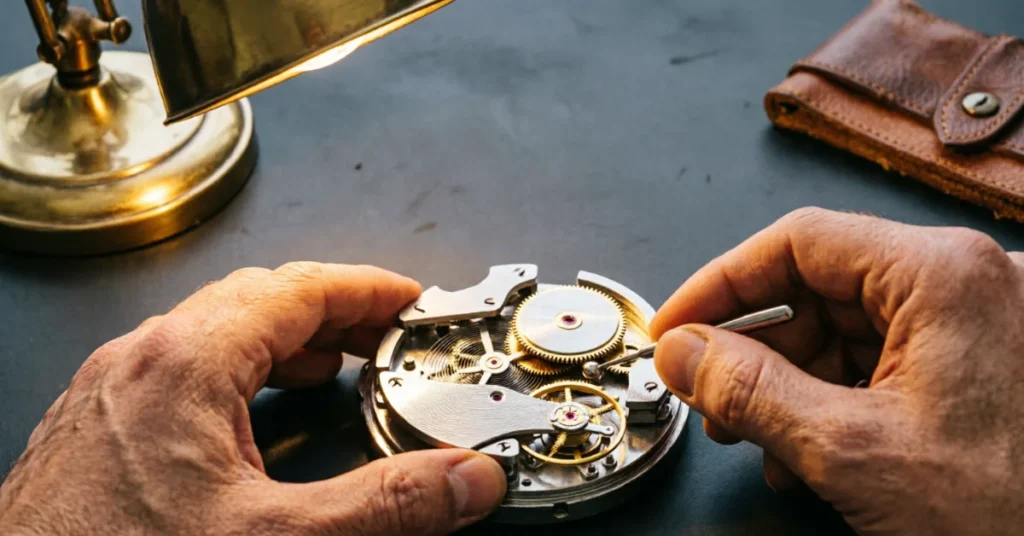
Movement quality matters beyond the spec sheet. Column-wheel construction gives a smoother pusher action and fewer mechanical hiccups over time, which is why brands like Omega and Zenith lean on it heavily. Omega’s Co-Axial escapement, adopted in 1999, cut friction enough that it stretched service intervals out to five or even eight years on some references, longer than the industry-standard five-to-seven-year window.
Case and bracelet materials also shift the price. Ceramic bezels, ceramic-coated steel, or solid gold cases all add manufacturing complexity. Anyone who has handled both a steel sports chronograph and a solid gold dress chronograph knows the weight difference alone changes how the watch feels on the wrist.
Hand finishing rounds out the picture. Beveled bridges, perlage, Côtes de Genève aren’t just decoration. They signal hours of skilled hand labor that a machine-finished movement skips entirely.
Flyback and Split-Seconds: Complications Worth Knowing
Beyond standard start-stop-reset function, two complications separate serious luxury chronograph watches from everything else.
A flyback chronograph lets you reset and restart the timer instantly with a single pusher press, useful for pilots timing consecutive legs of a flight without losing a beat. A split-seconds chronograph (rattrapante) uses two overlapping seconds hands so you can time two events that start together but finish at different moments, like tracking multiple runners in a race. These sit firmly in grand complication territory and usually push prices well past $15,000.
The Watches That Built the Category
A handful of models shaped what people picture when they hear “luxury chronograph.”
- Rolex Daytona — Originally built for endurance racing, it became one of the most requested watches in the world, partly thanks to its motorsport ties and partly scarcity at retail.
- Omega Speedmaster — Worn on the moon during NASA missions, a story no marketing budget could buy.
- Zenith El Primero — Launched one of the first automatic chronograph movements, running at a high beat rate that improves timing accuracy.
- TAG Heuer Carrera — Built with motor racing legibility in mind, clean dials designed to be read at speed.
- Breitling Navitimer — Carries an integrated circular slide rule, still functional for basic flight calculations on the wrist.
Anyone who has shopped this category for a while will tell you the pricing has very little to do with function and a lot to do with heritage and desirability.
What the Research Shows
Data on secondary watch markets consistently points to steel sports chronographs holding value better than quartz or fashion-brand alternatives, largely because production numbers stay deliberately limited relative to demand. Watch dealers who track this space closely note that a $15,000 limited-edition piece can lose a significant chunk of value the moment it’s unboxed, while a well-chosen $4,000 vintage piece from an established maker can actually gain value over a decade. The difference usually isn’t the brand name alone. It’s whether the specific reference has genuine ongoing demand and a movement people trust to service long-term.
Analysts covering the luxury goods sector have flagged mechanical watches, chronographs included, as a relatively resilient category even during broader pullbacks in luxury spending, since buyers treat them as both an object and a store of value.
How to Evaluate One Before Buying
A few practical checks matter more than brand name alone:
- Ask about the movement source — in-house, modified base caliber, or meca-quartz, and whether it’s column-wheel or cam-actuated.
- Check the power reserve — automatic chronographs often run shorter reserves than time-only pieces since the chronograph function drains extra energy.
- Test the pushers — they should feel crisp, not mushy or delayed.
- Confirm service intervals — most luxury chronographs need servicing every five to seven years, though some in-house calibers stretch further; budget for that cost upfront.
- Look at lume and dial printing — cheaper chronographs cut corners here first.
- Ask if it’s a flyback or split-seconds function — if you’re paying grand-complication pricing, confirm you’re actually getting one.
Who Actually Buys Into This Category
Buyers usually fall into a few groups. Collectors chase specific references and historical significance. First-time luxury buyers often want one do-it-all watch that works in a boardroom and on a weekend, and mid-range Swiss automatics tend to fit that brief well. Enthusiasts who grew up around motorsport or aviation gravitate toward chronographs with that heritage baked in, since the function itself came from those worlds. Budget-conscious buyers new to mechanical watches often start with meca-quartz pieces to learn the category before moving up.
Caring for a Mechanical Chronograph
These watches need more attention than a basic quartz piece. Avoid operating the pushers underwater unless the watch is explicitly rated for it, since water can get into the chronograph mechanism through the pusher tube. Keep it away from strong magnets, which can throw off timing accuracy on mechanical movements. And budget for that five-to-seven-year service; skipping it tends to shorten the movement’s life significantly.
Conclusion
Luxury chronograph watches sit at the intersection of engineering and storytelling, and that combination is exactly why they hold their place in the market year after year. Whether the draw is motorsport history, a column-wheel movement, a flyback complication, or simple resale confidence, buyers in 2026 are choosing this category across every budget tier, not just the top end. Understanding the movement, materials, and maintenance behind luxury chronograph watches turns a big purchase into an informed one.
FAQs
Are luxury chronograph watches a good investment?
Some models hold or grow in value, particularly limited or discontinued references, but most should be bought because you’ll wear and enjoy them, not purely as a financial asset.
How often should a luxury chronograph be serviced?
Most manufacturers recommend every five to seven years, depending on usage and movement type, though some in-house calibers extend that further.
What’s the difference between a chronograph and a chronometer?
A chronograph measures elapsed time with a stopwatch function. A chronometer is a precision certification that a watch’s accuracy has been independently tested. A watch can be both.
What’s a flyback chronograph?
It lets you reset and restart the timing function instantly with one pusher press, instead of needing separate stop and reset actions.
Do I need an in-house movement for a watch to count as luxury?
No. Many respected mid-range pieces use modified base calibers and still deliver genuine mechanical quality and reliable long-term servicing.