
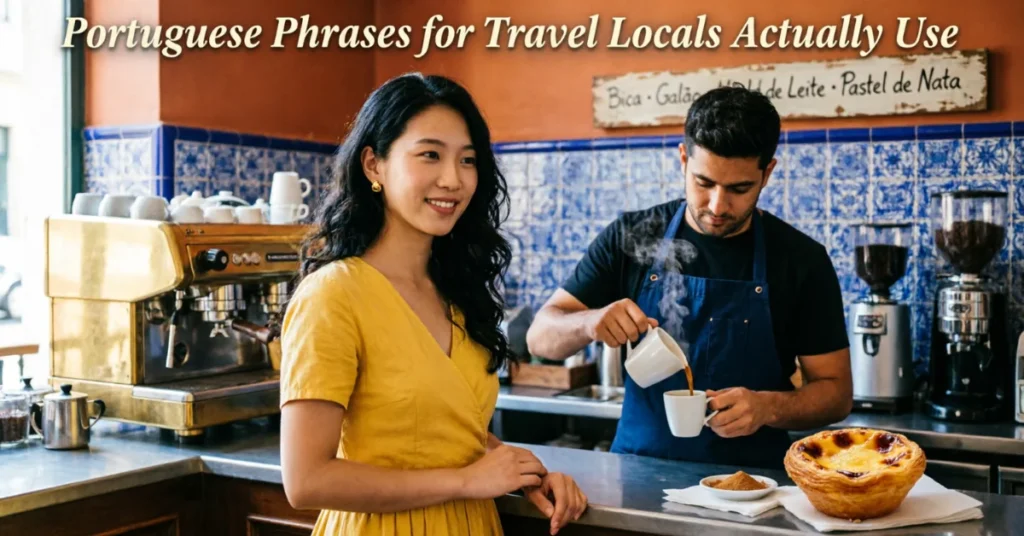
Standing at a Lisbon café counter, you’ll notice something fast: nobody expects you to be fluent. But the moment you offer a shaky “bom dia” before ordering, the whole exchange softens. That small shift is exactly why Portuguese phrases for travel matter so much more than a dictionary would suggest. They’re less about grammar and more about signaling respect.
Portugal welcomed roughly 32.5 million visitors in 2025, an increase of 3.0% compared to 2024, and Brazil pulls in millions more Portuguese-speaking tourists and expats every year. With numbers like that, a huge share of travelers are walking into restaurants, pharmacies, and train stations without knowing a single local greeting. This guide fixes that. Not with a bloated phrasebook, but with the lines that actually get used, in the order you’ll actually need them, plus a few gaps most phrase lists skip entirely.
Why Portuguese Phrases for Travel Matter More Than You’d Think
English gets you far in Lisbon’s tourist zones. It gets you almost nowhere in a village bakery in the Alentejo, or a small pharmacy in the north of Porto.
Locals here will tell you, often with a laugh, that the accent is the hard part, not the vocabulary. Portuguese has a closed, almost swallowed sound compared to Spanish or Italian, and that trips up even experienced language learners on their first trip.
That’s fine. You’re not auditioning for a translation job. You’re trying to order coffee, ask where the bathroom is, and thank someone for their patience. A handful of Portuguese phrases for travel, said with a genuine attempt at pronunciation, does more social work than most people expect.
There’s also a practical safety angle. Pharmacies, train announcements, and taxi negotiations move faster and more accurately when you can say what you need instead of pointing and hoping.
Essential Greetings You’ll Use Every Single Day
These come first because you’ll use them constantly, sometimes a dozen times before lunch.
- Bom dia — good morning (used until roughly midday)
- Boa tarde — good afternoon
- Boa noite — good evening/night
- Olá — hello, casual and safe anywhere
- Como está? — how are you (formal, used with strangers or elders)
- Tudo bem? — everything good? (the everyday, casual version)
- Obrigado (if you’re male) / Obrigada (if you’re female) — thank you
- Por favor — please
- Desculpe — excuse me / sorry
One look at how often “tudo bem” gets tossed around in Portugal and Brazil, and it becomes clear this isn’t just a greeting. It’s practically a verbal handshake, used to open conversations, close them, and check in mid-sentence.
Restaurant and Café Phrases That Actually Work
Anyone who has managed a busy café counter in Porto or Lisbon knows the rhythm: quick order, quick thanks, quick exit unless you’re settling in.
A typical exchange at a Portuguese café goes like this. You greet with “boa tarde,” ask “uma bica, por favor” (a small espresso, please), and close with “a conta, por favor” when you’re ready to pay. That’s the whole transaction, and it barely requires ten words.
Useful lines for restaurants and cafés:
- A mesa para dois, por favor — a table for two, please
- A ementa, por favor — the menu, please
- Queria… — I would like… (softer and more polite than “quero,” which sounds blunt)
- Está delicioso — this is delicious
- Tem menu infantil? — do you have a kids’ menu?
- Onde é a casa de banho? — where is the bathroom?
Brazilian Portuguese swaps a few of these. “Cardápio” replaces “ementa,” for example, so travelers bouncing between Lisbon and Rio should expect small vocabulary shifts, even though the phrases themselves stay recognizable.
Paying the Bill: Tipping Phrases and Etiquette That Actually Match Realityportuguese phrases for travel
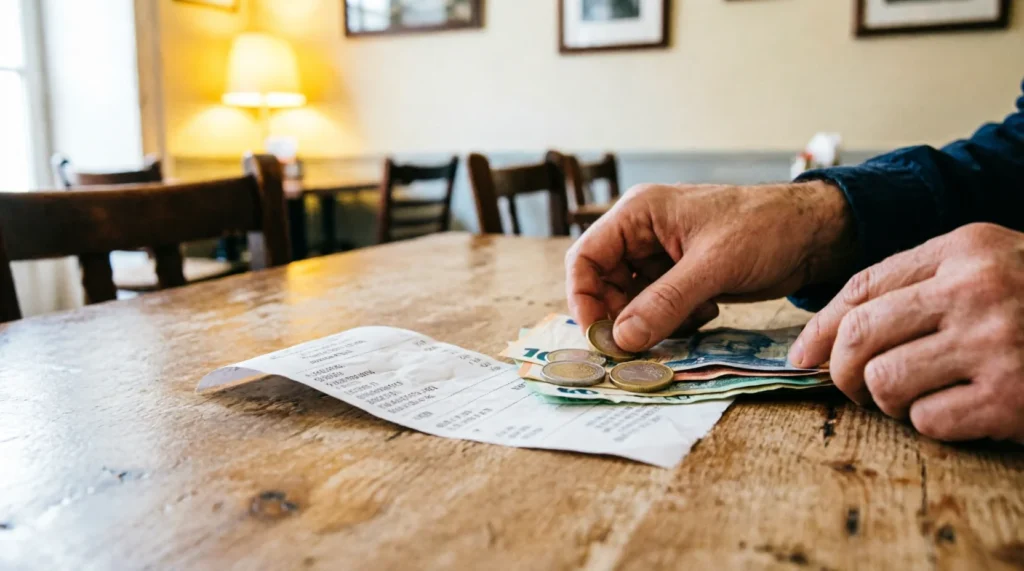
This section gets skipped in most phrase lists, and it causes real confusion at the table. Tipping in Portugal is genuinely optional. Service charges are rarely added automatically, wages aren’t structured around gratuities the way they are in the US, and many locals simply round up the bill instead of calculating a percentage.
Anyone who’s dined across Lisbon, Porto, and smaller towns knows the pattern: leave 5-10% for good service in a sit-down restaurant, round up at a café, and skip it entirely at a quick coffee counter. Avoid leaving only small copper coins, since that reads as an afterthought rather than appreciation.
Phrases that make the moment smooth instead of awkward:
- A conta, por favor — the bill, please
- O serviço está incluído? — is service included?
- Fique com o troco — keep the change (the most common way locals leave a small tip)
- Aceita cartão? — do you accept card?
- Pode dividir a conta? — can you split the bill?
- Só tenho dinheiro — I only have cash
Brazil runs differently. Many sit-down restaurants there add a 10% “serviço” line automatically, and while it’s technically optional, locals almost always pay it. Checking the bill before deciding whether to add a tip saves an awkward moment in either country.
Numbers and Shopping Phrases You’ll Actually Use
Markets, pharmacies, and small shops move fast, and numbers come up constantly, more than most travelers expect before their first trip.
Quick numbers: um (one), dois (two), três (three), quatro (four), cinco (five), seis (six), sete (seven), oito (eight), nove (nine), dez (ten).
Shopping phrases worth memorizing:
- Quanto custa? — how much does this cost?
- Está com desconto? — is this discounted?
- Posso experimentar? — can I try this on?
- Aceita cartão? — do you accept card? (worth repeating here, since small towns still run cash-only)
- Só isto, obrigado/a — just this, thank you
Smaller shops and rural bakeries in Portugal frequently don’t take cards at all, so carrying some cash isn’t just polite, it’s practical.
Getting Around: Transport and Direction Phrases
Anyone who’s tried to catch the last metro in Lisbon on a Friday night knows how fast things move, and how little patience there is for hesitation.
Practical transport phrases:
- Onde fica a estação? — where is the station?
- Quanto custa o bilhete? — how much does the ticket cost?
- Para onde vai este autocarro? — where does this bus go? (“ônibus” replaces “autocarro” in Brazil)
- Preciso de um táxi — I need a taxi
- Está longe daqui? — is it far from here?
- Vire à esquerda / à direita — turn left / right
These sit close to the top of any list of Portuguese phrases for travel because getting lost is one of the most common friction points for first-time visitors, especially in cities with narrow, winding old-town streets like Sintra or Óbidos.
Wifi, Phone, and Hotel Check-In Phrases
Digital nomads and business travelers run into a different set of needs than someone on a weekend trip, and most phrasebooks skip this entirely.
- Qual é a palavra-passe do wifi? — what’s the wifi password?
- Tenho uma reserva em nome de… — I have a reservation under the name…
- A que horas é o check-out? — what time is checkout?
- Preciso carregar o telemóvel — I need to charge my phone (“telemóvel” in Portugal, “celular” in Brazil)
- Têm um quarto disponível? — do you have a room available?
These five cover most front-desk and coworking-space interactions without needing anything beyond the basics.
Emergency and Practical Situations
Nobody wants to need these, but skipping them is a mistake plenty of travelers regret.
- Preciso de ajuda — I need help
- Chame a polícia — call the police
- Onde fica o hospital? — where is the hospital?
- Perdi o meu passaporte — I lost my passport
- Não me sinto bem — I don’t feel well
- Preciso de um médico — I need a doctor
- Sou alérgico a… — I am allergic to…
- Tem algo para dor de cabeça? — do you have something for a headache?
- Fala inglês? — do you speak English?
That last one deserves special mention. Asking “fala inglês?” instead of launching straight into English is a small courtesy that changes how a conversation opens, even if the person switches to English immediately afterward.
The Portuguese Phrases for Travel You Won’t Find in Most Guides
A few words trip up English speakers specifically because they look familiar but mean something else entirely. Knowing these avoids genuinely confusing moments.
- Constipado doesn’t mean constipated. It means you have a cold or stuffy nose, which surprises almost every English speaker who hears it at a pharmacy.
- Esquisito doesn’t mean exquisite. It means weird or strange.
- Pretendo doesn’t mean pretend. It means intend, as in “I intend to visit Porto.”
- Puxe on a door means pull, not push, and reversing the two causes more stuck doors than any traveler wants to admit.
These four alone prevent some of the most common mix-ups travelers run into, and they rarely appear in standard Portuguese phrases for travel lists, which tends to make first encounters with them more confusing than they need to be.
What the Research Shows
Detailed analysis of language-learning behavior shows a consistent pattern among travelers: those who learn even 15-20 core phrases before a trip report smoother interactions with locals, particularly outside major tourist hubs. Researchers studying tourism communication note that pronunciation attempts, even imperfect ones, are read by locals as a marker of respect rather than fluency.
Industry analysts covering Portugal’s tourism sector point to a related trend. As visitor numbers climb and destinations diversify beyond Lisbon, Porto, and the Algarve into regions like the Alentejo and the Azores, English fluency among service staff drops noticeably. That makes basic Portuguese phrases for travel more useful in 2026 than they were a decade ago, not less, since more travelers are venturing into places where English simply isn’t the default.
Portugal vs. Brazil: Same Language, Different Rhythm
This trips up a lot of people planning multi-country trips. European Portuguese and Brazilian Portuguese share the same core grammar and most vocabulary, but pronunciation and a handful of everyday words diverge enough to notice.
| Situation | Portugal | Brazil |
|---|---|---|
| Bus | autocarro | ônibus |
| Bathroom | casa de banho | banheiro |
| You (informal) | tu | você |
| Breakfast | pequeno-almoço | café da manhã |
| Phone | telemóvel | celular |
| Tipping norm | optional, 5-10% | ~10% often automatic |
Neither version is “more correct.” Locals in both countries understand each other fine, and a traveler mixing the two won’t cause confusion, just the occasional friendly correction.
Who Actually Needs This List
First-time visitors to Lisbon or Porto benefit most obviously, but the same Portuguese phrases for travel matter for cruise passengers stopping in Madeira, digital nomads settling into Porto’s coworking scene, and retirees exploring the Algarve long-term. Even short layovers benefit; a traveler with two hours in Lisbon airport still runs into staff who appreciate a “bom dia” before English kicks in.
Solo travelers, particularly those navigating unfamiliar streets at night, benefit from having “preciso de ajuda” and “onde fica o hospital?” ready without hesitation. Families traveling with kids run into their own specific needs, from “tem menu infantil?” at restaurants to asking about a high chair with “tem cadeira alta para bebé?”
Business travelers get one added layer of value: a simple “prazer em conhecê-lo” (pleasure to meet you) at the start of a meeting lands better than diving straight into English, even when the meeting itself proceeds in English afterward.
Tips for Pronunciation That Actually Land
Portuguese vowels get swallowed compared to Spanish, and nasal sounds, like the “ão” in “não,” trip up almost every beginner. A few quick fixes help immediately:
- Soften the “s” at the end of words into a “sh” sound, common in European Portuguese.
- Don’t over-pronounce unstressed vowels; Portuguese drops them more than English speakers expect.
- Practice “obrigado/obrigada” out loud before the trip. It’s used constantly, and getting it smooth removes a lot of first-day anxiety.
Conclusion
Portuguese phrases for travel aren’t about sounding fluent. They’re about showing up with a little effort, and that effort gets noticed everywhere from a Lisbon tram to a Rio beach kiosk. Learning greetings, restaurant basics, tipping etiquette, direction words, and one or two emergency lines covers the vast majority of real situations travelers run into. Locals notice the attempt long before they notice the mistakes, and that’s really the whole point.
FAQs
Do I need to learn European or Brazilian Portuguese before my trip?
It depends on your destination, but the core phrases overlap heavily. If you’re splitting time between Portugal and Brazil, learn the shared basics first and pick up the small vocabulary differences as you go.
Will locals be annoyed if I mispronounce words?
Rarely. Most locals appreciate the attempt far more than they mind an accent, especially outside heavily touristed areas.
Do I need to tip in Portugal?
No, tipping isn’t mandatory. Rounding up the bill or leaving 5-10% for good service is appreciated but never expected, and it’s worth checking whether service is already included before adding more.
What’s the single most useful Portuguese phrase for travel?
“Fala inglês?” (do you speak English?) tends to open doors fastest, followed closely by “obrigado/obrigada” and “por favor.”
Is Portuguese hard to pick up for a short trip?
Not for basic phrases. A focused hour or two of practice before departure covers greetings, ordering, tipping, and directions comfortably.