

If your vents just started blowing warm air on the hottest week of the year, you’ve probably typed one question into Google: how much does a car AC cost to fix? The honest answer is that it depends entirely on which part failed, but most drivers end up paying somewhere between $150 and $2,000. Below, you’ll find real 2026 price ranges by repair type, a symptom-to-cost table, dealer versus independent shop pricing, and how to tell if a quote is fair before you approve any work.
How Much Does a Car AC Cost to Fix in 2026?
Across dozens of shop estimates and repair guides reviewed for this piece, the average total bill for a general AC repair lands close to $384 to $445. That figure blends cheap fixes with expensive ones, so it’s really just a starting point.
A simple refrigerant recharge is the least expensive job, often $150 to $350. A full compressor swap, the most common major repair, typically runs $900 to $2,500 once parts and labor are both counted. Everything else falls somewhere in that gap.
Here’s the thing though. Two cars with the exact same symptom, warm air from the vents, can have wildly different price tags once a technician gets a pressure gauge on the system. That’s why a phone quote is never the final word.
A Quick Range by Repair Type
- Refrigerant recharge (no leak): $150–$350
- Recharge plus leak repair: $250–$800
- Cabin air filter or clogged vent fix: $40–$150
- Hose or O-ring replacement: $100–$500
- Condenser replacement: $400–$1,200
- Evaporator replacement: $700–$1,300
- Compressor replacement: $900–$2,500
- Full AC system replacement (rare): $1,000–$3,500
What’s Actually Wrong? Match Your Symptom to the Repair
Most drivers don’t know which part failed. They just know the AC feels off. Matching what you’re noticing to the likely cause gets you closer to a real number before you even call a shop.
| Symptom | Likely Cause | Typical Repair Cost |
|---|---|---|
| Warm air, compressor clicks on and off fast | Low refrigerant from a leak | $250–$800 |
| Grinding or squealing noise when AC turns on | Failing compressor | $900–$2,500 |
| Musty smell from the vents | Mold in the evaporator or clogged drain | $100–$250 |
| Weak airflow, no unusual smell | Clogged cabin filter or blower motor | $40–$600 |
| Cools fine at highway speed, not at idle | Failing condenser fan | $150–$450 |
| Air stays warm, compressor won’t turn on | Electrical fault or clutch failure | $300–$700 |
None of these symptoms are a guarantee. A tech still needs to put a gauge on the system, but this cuts down the guesswork by a lot before you’re standing at the counter.
What Actually Breaks in a Car’s AC System
Car air conditioning isn’t one part. It’s a closed, pressurized loop made up of a compressor, condenser, evaporator, expansion valve, and a web of hoses carrying refrigerant between them.
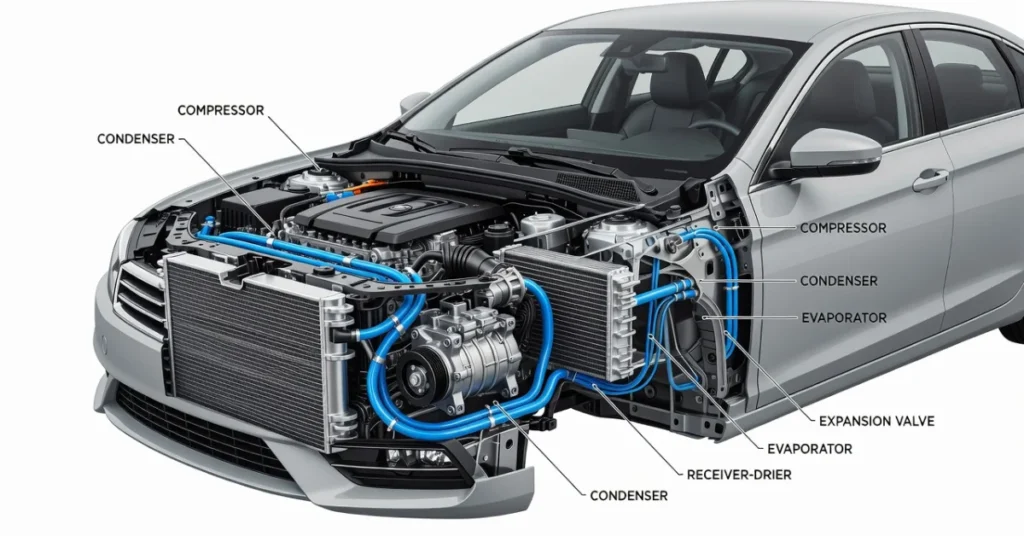
A mechanic who’s spent years under the hood will tell you the same thing every time: low refrigerant almost never means the system just “ran out.” AC systems are sealed. If refrigerant is low, it’s escaping somewhere, and a recharge without finding that leak just buys you a few weeks of cold air before the problem comes back.
That single fact explains why a “simple” recharge sometimes turns into a $600 repair. The tech finds a leaking hose or a failing seal partway through the job, and now you’re paying for parts, not just refrigerant.
Cost by Repair Type, Explained
Refrigerant recharge. This is the entry point for almost every AC complaint. Vehicles built before roughly 2017 use R-134a refrigerant, which is cheaper. Newer cars use R-1234yf, a refrigerant that costs shops more to buy and requires specialized recovery equipment, which shows up on your invoice.
Leak repair. Small leaks at a hose fitting or O-ring are quick fixes. Leaks inside the evaporator, buried behind the dashboard, mean hours of labor just to get to the part, which is why this repair swings so widely in price.
Compressor replacement. The compressor is the hardest-working part of the whole system, and it’s usually the answer when someone asks how much does a car AC cost to fix after hearing grinding or squealing under the hood. Parts alone can run $400 to $2,000 depending on the vehicle, and labor adds several hundred more.
Condenser and evaporator. These act like radiators for the refrigerant. A cracked condenser, often from a rock strike or minor collision, needs replacing rather than repairing in most cases.
What Drives Your Price Up or Down
A handful of factors decide whether your repair lands near the low end of a range or the high end.
Vehicle make matters more than most drivers expect. Luxury and European models, think BMW, Mercedes, or Audi, routinely run 30 to 50 percent higher than a Honda or Toyota for the exact same job. Tighter engine bays and harder-to-source parts are the reason.
Where you live changes the math too. Labor rates run anywhere from $75 to $150 an hour depending on region, and a dealership will almost always charge more than an independent shop for identical work.
Refrigerant type plays a role as well. R-1234yf systems, standard on most 2017-and-newer vehicles, cost noticeably more to service than older R-134a systems.
And finally, timing. Anyone who’s worked a service counter in July knows AC repair demand spikes hard in summer, and some shops adjust pricing when they’re booked solid.
Dealer vs Independent Shop: What You’ll Actually Pay
The type of shop you choose changes the bill almost as much as the repair itself. A dealership carries higher overhead and factory-trained staff, which shows up on the invoice.
| Shop Type | Typical Recharge Cost | Typical Compressor Replacement |
|---|---|---|
| Independent mechanic | $200–$500 | $900–$1,800 |
| Dealership service center | $300–$700 | $1,300–$2,500 |
Labor time is worth understanding too, since it’s half the bill on most jobs. A straightforward recharge usually takes 30 to 45 minutes of shop time. A compressor replacement runs 2 to 4 hours depending on how buried it is in the engine bay. Multiply that by the hourly labor rate a shop quotes you, and you’ve got a rough sanity check on whether the total makes sense.
Dealerships aren’t automatically the wrong choice, especially for late-model vehicles still under warranty coverage or with complex electric compressor systems. For an older daily driver, though, an independent shop with good reviews usually gets you the same repair for less.
DIY Recharge Kits vs a Professional Shop
Auto parts stores sell R-134a recharge kits for $30 to $60, and they can genuinely restore cooling on an older car with a slow, minor leak. That’s the appeal.
But a DIY kit doesn’t diagnose anything. It can’t tell you whether your system is losing refrigerant because of a $15 O-ring or a $900 compressor. Some kits also contain sealants that gum up the works and complicate a professional repair later, which ends up costing more than the shop visit would have.
R-1234yf systems are a different story entirely. Federal handling rules mean this refrigerant needs certified equipment, so DIY recharging isn’t really an option on newer vehicles regardless of budget.
Hybrid, EV, and Older Cars: The AC Cost Story Changes
Not every vehicle fits neatly into the ranges above, and it’s worth breaking out a few segments that get overlooked.
Hybrid and electric vehicles run the AC compressor off the high-voltage battery system instead of a belt, which means the compressor itself is a specialized electric unit. Parts cost more, and only technicians trained on high-voltage systems should touch it. Budget toward the higher end of the compressor range, often $1,200 to $2,800, if you drive a hybrid or EV.
Cars built before 1995 used R-12 refrigerant, which was phased out for environmental reasons. If you’re restoring or maintaining a classic, the system usually needs a full retrofit to R-134a before a shop will even attempt a repair, and that conversion typically runs $500 to $900 on top of whatever repair prompted the visit.
High-mileage daily drivers, the kind most people are actually asking about when they type how much does a car AC cost to fix into a search bar, tend to land in the middle of the pack. Wear-related leaks and a tired compressor are the two most common culprits once a vehicle passes 100,000 miles, so budgeting $400 to $900 is realistic for this group.
One Habit That Prevents a $900 Compressor Repair
Here’s a detail most guides skip entirely. AC compressors have internal seals that stay lubricated only when refrigerant is actively circulating through them. Leave the AC off for months, especially over a mild winter, and those seals can dry out and crack.
Running the AC for five to ten minutes once a week, even in cold weather, keeps the seals lubricated and can head off a leak that would otherwise show up as a $900-plus compressor job down the road. It costs nothing, takes ten minutes, and it’s one of the few genuinely free ways to avoid a major AC bill later.
What the Research Shows
Detailed analysis of shop pricing data collected through 2026 shows a pattern that holds across nearly every region: the gap between a minor and major AC repair keeps widening, not narrowing. Refrigerant recharges have stayed fairly flat in price, while compressor and evaporator jobs have climbed as vehicles pack more sensors and tighter engine bays into every new model.
Industry pricing data reviewed for this piece consistently places compressor failure as the single most expensive common AC repair, and the one most likely to get misdiagnosed by drivers who assume “no cold air” always means “needs a recharge.” Anyone who’s spent time at a service counter will say the same thing: a proper pressure test before authorizing any repair is the most reliable way to avoid overpaying.
How Much Does a Car AC Cost to Fix Compared to Not Fixing It?
Skipping the repair rarely saves money in the long run. A compressor that’s low on refrigerant runs hotter and wears out faster, so a $250 leak repair ignored today can become a $1,500 compressor replacement next summer.
There’s a resale angle too. A car with a broken AC system, especially in a hot climate, sells for noticeably less and sits on the lot longer. Buyers test the AC on almost every test drive, and a blast of warm air ends plenty of deals on the spot.
If your vehicle is still under its factory bumper-to-bumper warranty, AC repairs are usually covered, so it’s worth checking your paperwork before paying out of pocket.
Questions to Ask Before You Approve the Repair
A little pushback at the counter saves real money. Before signing off on any AC job, it’s worth asking:
- What exact part failed, and how did you confirm it with a pressure test or dye test?
- What’s the breakdown between parts cost and labor cost?
- Is this refrigerant R-134a or R-1234yf, and does that change the price?
- Will fixing this part require opening the system again later, or does it solve the root cause?
- Is there a warranty on the part and the labor, and how long does it last?
A shop that answers these clearly, without hesitation, is usually one worth trusting with the repair.

The Bottom Line
There’s no single number that answers how much does a car AC cost to fix, because the honest answer always depends on which part actually failed. A recharge might run you $150. A compressor could run you $2,000. What matters most is getting a proper diagnosis before agreeing to any repair, so you’re paying for the actual problem and not guessing your way through summer.
Written by Haider Ali, a digital content researcher and writer covering technology, culture, news, and emerging trends across the web.
FAQs
How much does a car AC cost to fix on average?
Most drivers pay between $150 and $2,000, with the overall average for a general repair landing close to $400. The final number depends entirely on which part failed.
Why is my car AC blowing warm air?
The most common causes are low refrigerant from a leak, a failing compressor, or a clogged cabin air filter restricting airflow. A shop can usually diagnose it in under an hour.
Can I just add refrigerant myself?
On an older R-134a vehicle, a DIY kit can work as a short-term fix. It won’t repair a leak, though, and newer R-1234yf systems need professional equipment by law.
Is it worth fixing an old car’s AC?
Usually yes, if the repair is a recharge or minor part. A failing compressor on a car near the end of its life is a tougher call, and it’s worth weighing the repair cost against the vehicle’s overall value.
Does car insurance cover AC repair?
Standard coverage typically doesn’t include wear-and-tear AC failures. If the AC was damaged in a covered accident, your policy’s non-collision or collision protection may apply instead.