

You flip the AC switch, the compressor kicks in, and suddenly the whole cabin trembles like it’s sitting on a washing machine. If you’ve been asking yourself why does my car shake when the ac is on, you’re dealing with one of the most common complaints mechanics hear once summer temperatures climb. The good news? It’s rarely a mystery once you know where to look.
This isn’t a random glitch. Something in your engine is struggling to absorb the extra workload the compressor demands, and that struggle shows up as a shake, a shudder, or a rough idle right under your seat.
Quick Reference: Cause, Symptom, And Fix
| Likely Cause | How It Feels | Typical Fix |
|---|---|---|
| Worn engine mount | Shake mainly at idle, calms while driving | Mount replacement |
| Idle air control issue | RPMs bounce right as AC engages | Clean or replace IAC valve |
| Dirty throttle body | Rough idle, sluggish response under load | Throttle body cleaning |
| Worn spark plug / misfire | Jerky, uneven shake, possible check engine light | Spark plug replacement |
| Failing AC compressor/clutch | Shake plus grinding or squealing noise | Compressor or clutch replacement |
| Worn serpentine belt | Pulsing vibration, possible squeal | Belt replacement |
| Blower motor issue | Rattling from dashboard, not engine bay | Blower motor cleaning or replacement |
This table is a starting point, not a diagnosis — the sections below explain each cause in more depth.
Why Does My Car Shake When The AC Is On? The Short Answer
The AC compressor is basically a second small engine bolted to your main one. It runs off a belt connected to the crankshaft, and the moment it engages, it pulls extra horsepower to spin the refrigerant through the system.
That sudden draw increases the load on your engine. A healthy engine barely notices. A worn one does, and the result is vibration you can feel in the steering wheel, the seat, or the floorboard. Anyone who has spent time under the hood diagnosing rough idles knows the AC compressor is often the first suspect they rule in or out.
Most of the time, the shake traces back to one of a handful of parts: engine mounts, the idle air control system, spark plugs, the AC compressor clutch itself, or a belt that’s seen better days. Let’s break each one down.
Worn Or Broken Engine Mounts
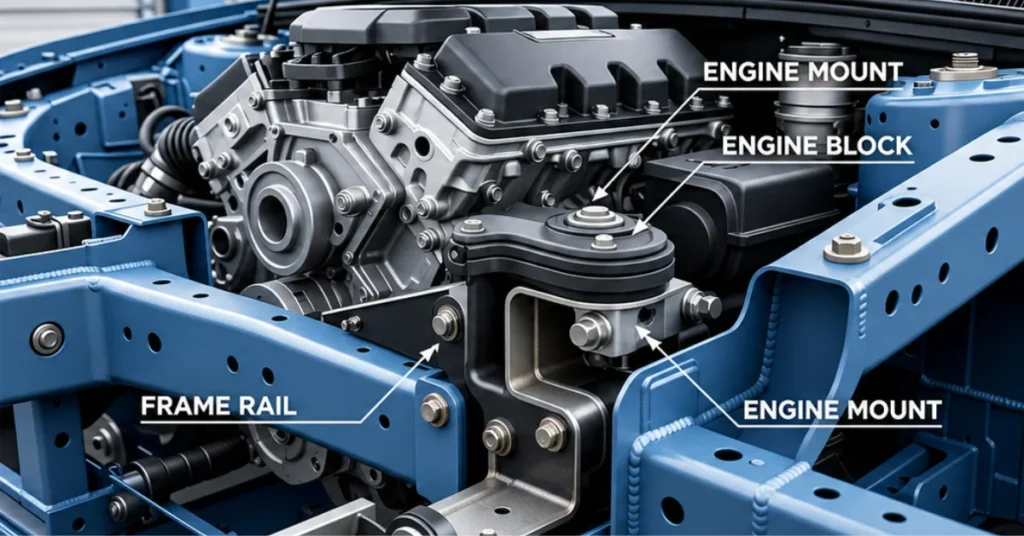
Engine mounts hold your motor in place and absorb the vibration it naturally produces. When the AC compressor kicks the load up a notch, those mounts have to work harder to keep everything steady.
A cracked or collapsed mount can’t do that job anymore. Instead of soaking up the vibration, it lets the whole engine rock, and you feel every bit of it inside the cabin. Mechanics routinely flag this as one of the leading reasons a car vibrates specifically when the compressor engages, since the extra torque exposes a mount that was already borderline.
You’ll usually notice this shake most at idle — at a red light, in the driveway, or waiting in a drive-thru — and it tends to calm down once you’re moving and the engine load shifts.
Idle Air Control Valve Or Idle Speed Issues
Your engine’s idle air control valve tells the motor how much extra air to pull in when a load like the AC compressor kicks on. When it’s working right, your idle speed rises slightly and smooths out the added strain.
When it’s dirty, sticking, or failing, the engine can’t compensate fast enough. RPMs dip, surge, or bounce, and that instability translates into a shake you feel through the whole car. This is a big reason people specifically notice the problem right as the compressor clutch engages rather than while just idling with the AC off.
Dirty Throttle Body
The throttle body regulates airflow into the engine. Over time, carbon buildup coats the walls and the throttle plate, which throws off the air-fuel ratio the engine expects.
Add the AC’s extra demand on top of that imbalance, and the engine has to work with less precision exactly when it needs more. A simple throttle body cleaning, something most shops can do in under an hour, solves this more often than drivers expect.
Worn Spark Plugs Or A Developing Misfire
Spark plugs ignite the fuel-air mixture inside each cylinder. When one is fouled, worn, or gapped incorrectly, that cylinder can misfire under stress. The AC compressor is exactly the kind of stress that pushes a marginal spark plug over the edge.
A misfire under AC load often feels like a jerky, uneven shake rather than a smooth vibration, and it may come with a rougher idle overall, not just when the compressor engages. If your check engine light flickers around the same time, this is worth checking first.
Failing AC Compressor Or Clutch
Sometimes the problem sits inside the AC system itself. A compressor with worn internal bearings, or a clutch that’s engaging unevenly, can generate its own vibration that transfers straight into the engine bay and cabin.
You can often spot this one by listening. Grinding, clicking, or squealing right as you switch the AC on points to the compressor rather than the engine’s supporting systems. If the noise and shake show up together, a mechanic will usually check compressor health before touching anything else.
Loose Or Worn Serpentine Belt
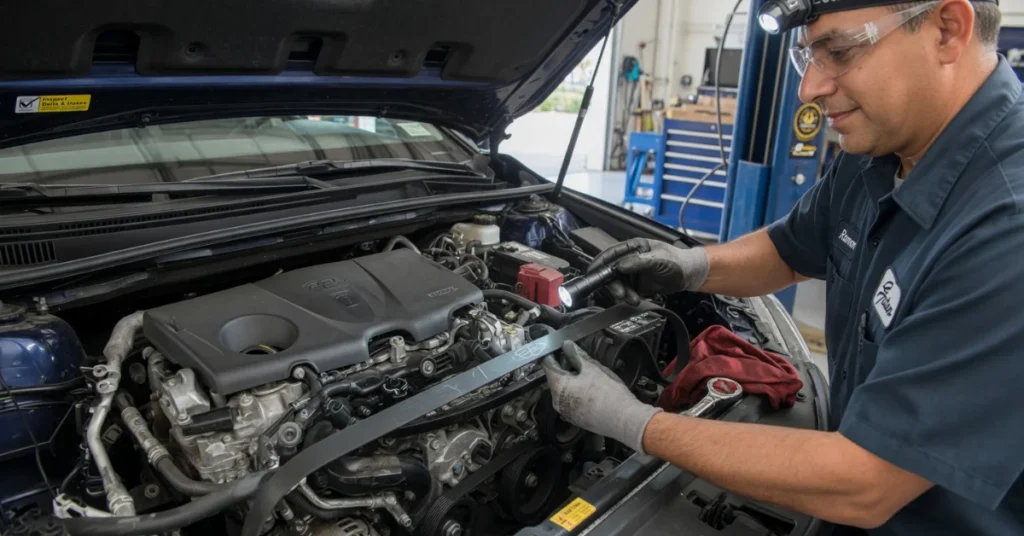
The serpentine belt drives your AC compressor along with the alternator and power steering pump. A belt that’s glazed, cracked, or improperly tensioned can slip or judder when the compressor engages, sending a pulsing vibration through the engine.
This is a cheap part to inspect and an even cheaper one to replace before it strands you somewhere inconvenient.
Why Does My Car Shake When The AC Is On More At Idle Than While Driving?
This is one of the most common follow-up questions, and it makes sense once you understand engine load. At idle, your engine is running at its lowest RPM, which means it has the least reserve power available to absorb a sudden demand like the AC compressor.
Once you’re driving and the RPMs climb, that same load becomes a much smaller percentage of what the engine is already producing, so the shake often fades or disappears. That pattern alone tells a mechanic a lot: idle-only shaking usually points toward mounts, idle control, or a mild misfire, while shaking that persists at higher speeds leans more toward the compressor or belt.
What The Research Shows
Detailed analysis from repair-tracking platforms consistently flags worn motor mounts as one of the most frequently reported causes of engine vibration tied directly to an added mechanical load, exactly the kind of load the AC compressor introduces. Reports collected across a wide range of makes and models describe the same pattern: vibration that intensifies specifically when the compressor clutch engages, then eases once the mount is replaced.
That consistency across different vehicle brands is worth paying attention to. It’s not a quirk of one manufacturer or one engine type — it’s a mechanical relationship between added load and mount condition that shows up again and again in real shop diagnostics.
Who Should Worry, And Who Shouldn’t
A little extra vibration for a second or two right as the compressor engages, especially in an older car with plenty of miles, isn’t automatically a red flag. Small engines and higher-mileage vehicles often show a brief, mild shake that fades quickly and never comes with noise or performance loss.
What separates a normal reaction from a real problem is duration, intensity, and company. Shaking that lasts the entire time the AC runs, that gets worse over weeks, or that arrives with noise, a check engine light, or a rough idle even with the AC off deserves an inspection sooner rather than later.
Drivers of manual transmission cars sometimes notice the shake more at a stop with the clutch engaged, since there’s less drivetrain slack to absorb the vibration compared to an automatic sitting in gear. Hybrid and newer stop-start vehicles can also feel it differently, since the engine may be restarting from idle-off right as the AC engages, layering two separate load events together. That’s the real question behind why does my car shake when the ac is on for most daily drivers.
Electric And Hybrid Vehicles: A Different Kind Of AC Shake
Most advice on this topic assumes a traditional belt-driven compressor, but that’s not how every car works anymore. In many hybrids and full EVs, the AC compressor runs off its own electric motor instead of pulling power from the engine’s crankshaft.
That changes the diagnosis entirely. There’s no belt to slip and no engine load to spike, so a shake in an EV or hybrid when the AC turns on more often points to a loose compressor mounting bracket, a failing electric compressor motor, or vibration traveling through the refrigerant lines themselves. In hybrids that still have a gas engine for backup power, a shake can also show up only when that engine restarts to recharge the battery at the same moment the AC engages, which owners sometimes mistake for an AC-only issue.
If you drive an EV or hybrid, mention that specifically when you describe the problem to a shop. A tech chasing engine mounts on a car that has no belt-driven compressor is chasing the wrong lead.
The Cabin Blower Motor Nobody Checks
Almost every guide to this problem stops at the engine bay, but the shake or rattle you’re feeling doesn’t always start there. The cabin blower motor, tucked behind the dashboard, pushes air through your vents whenever the AC or heater runs.
A blower wheel with a cracked fin, a build-up of leaves or debris, or a bearing that’s starting to wear can produce a vibration or rattling noise that feels like it’s coming from the engine when it’s actually coming from behind your glovebox. Anyone who has replaced a blower motor knows this fix is often far cheaper than a mount or compressor job, and it’s easy to rule in or out: if the vibration seems to come from inside the dash rather than under the hood, or if you hear it even with the engine off but the fan running, the blower is worth checking before anything else.
Could Refrigerant Levels Be Part Of It?
An overcharged or undercharged AC system forces the compressor to work outside its designed range. Too much refrigerant raises internal pressure and strains the compressor with every cycle; too little causes the clutch to cycle on and off rapidly, which can feel like a pulsing shake rather than a steady one.
This is less common than a worn mount or belt, but it’s worth a mention on a service visit, especially if your AC has been recharged recently or if the cooling performance feels inconsistent alongside the shaking.
How To Diagnose It Yourself Before Calling A Mechanic
Before you dig into why does my car shake when the ac is on any further, a few checks can narrow things down
- Turn the AC on and off repeatedly while parked and listen for a distinct clunk, grind, or squeal timed to the compressor engaging.
- Shift into neutral briefly (safely, in a parking lot) with the AC on — if the shake noticeably drops, engine mounts are a likely culprit.
- Check under the hood for visibly cracked, oily, or shiny/glazed rubber on the mounts or belt.
- Note whether the shake happens only at idle or continues once you’re driving at speed.
- Watch for a check engine light or unusually rough idle even with the AC switched off, which points more toward ignition or air-intake issues than the AC system itself.
Anyone who has run a basic diagnostic like this before visiting a shop tends to get a faster, cheaper repair, since it narrows down labor time instead of paying for a broad inspection.
Prevention And Long-Term Fixes
The simplest way to stop asking why does my car shake when the ac is on every summer is routine maintenance. Routine maintenance catches most of these problems long before they turn into a full shake. Spark plug replacement on schedule, periodic throttle body cleaning, and visual belt inspections during oil changes all cost far less than an emergency repair mid-summer when the AC finally gives out under load.
If your car is already shaking, don’t just turn the AC off and ignore it. A worn mount left unaddressed can eventually damage the transmission mount or nearby components, turning a moderate repair into a bigger one.
Conclusion
If you’ve been asking why does my car shake when the ac is on, the answer almost always comes down to how well your engine handles the extra load the compressor introduces. Worn mounts, a struggling idle control system, tired spark plugs, a failing compressor, or a slipping belt each leave a slightly different fingerprint, and a short diagnostic check can usually tell you which one you’re dealing with. Catch it early, and it’s a straightforward fix. Ignore it, and a small shake has a way of becoming a bigger repair bill.
FAQs
If you’re wondering why does my car shake when the ac is on and whether it’s safe to keep driving?
Short trips are usually fine if the shake is mild and brief, but persistent or worsening vibration is worth having checked before it stresses other components.
Does this mean my AC compressor is broken?
Not necessarily. The compressor is only one of several possible causes — engine mounts and idle control issues are reported just as often.
Will an oil change fix a shaking car?
Not directly, but a routine service visit is a good time to have a mechanic inspect mounts, plugs, and belts, all of which do relate to this issue.
Why does the shake stop once I start driving?
Higher RPMs give the engine more reserve power, so the added load from the compressor becomes a smaller share of total output, easing the vibration.
How much does it typically cost to fix?
Costs vary widely by cause and vehicle, from a simple belt or plug replacement to a more involved mount job, so it’s best to get a shop’s direct quote rather than assume a fixed number.