
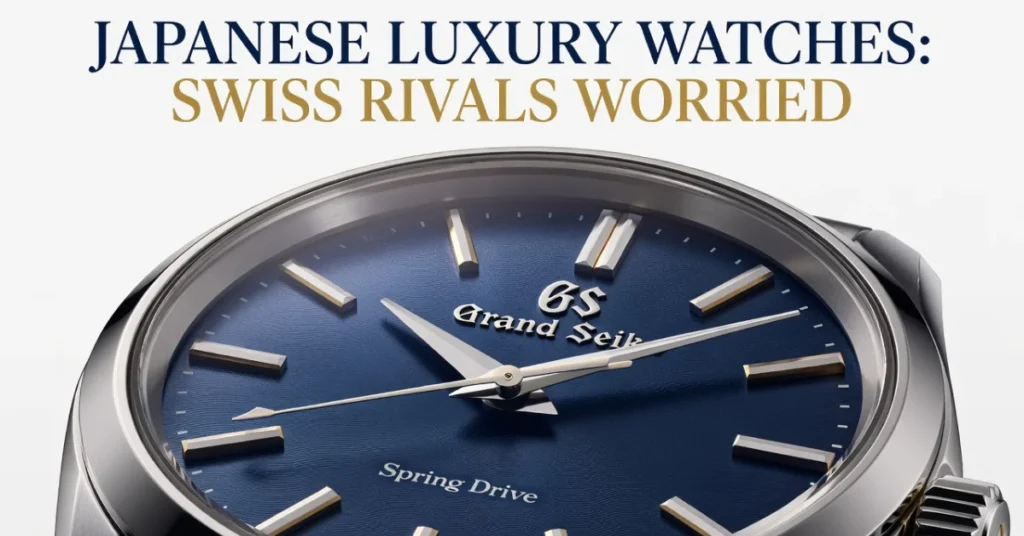
A watch collector in Ginza once told a visiting journalist that Switzerland builds watches to be admired, while Japan builds them to be trusted. That line sticks because it captures something real. Japanese luxury watches have spent six decades proving they belong in the same conversation as anything made in Geneva or Le Locle, and in 2026, that conversation has shifted. Grand Seiko, Credor, and a handful of independent artisans are no longer treated as the “affordable alternative.” They’re treated as the benchmark.
This piece breaks down what actually makes Japanese luxury watches different, who buys them, what’s new this year, where the real friction points sit, and why so many longtime Swiss loyalists are quietly adding a Japanese piece to the collection.
What Makes Japanese Luxury Watches Different From Swiss Icons
The story doesn’t start with luxury at all. It starts with the Meiji era, when Japan launched an aggressive push to match Western industry in every field, watchmaking included. Kintaro Hattori founded Seiko in 1881, and Kazumasa Tokiwa founded Citizen decades later, both chasing the same goal: match the West, then beat it.
That chase paid off in 1969, when Seiko released the world’s first quartz wristwatch, a moment that reshaped the entire industry and briefly put Swiss mechanical houses on the back foot. Grand Seiko emerged from a different ambition. The brand launched in 1960 as Seiko’s statement that it could produce watches as good as, if not better than, any luxury offering from Switzerland. In 2017, it split from its parent company entirely, gaining its own leadership, design studios, and identity.
What separates Japanese luxury watches from Swiss competitors isn’t marketing. It’s process. Grand Seiko’s Zaratsu polishing technique produces mirror flat edges by hand, a finish machines still can’t replicate cleanly. And the Spring Drive movement, exclusive to the brand, merges mechanical winding with quartz level regulation. The result is a second hand that glides instead of ticks, holding accuracy to within a second a day.
Breakdown: Grand Seiko, Credor and the Independents Building Japanese Luxury Watches
Not every Japanese brand plays in the same tier, and lumping them together misses the point. Here’s how the main names actually stack up:
| Brand | Price Range | Signature Tech | Best For |
|---|---|---|---|
| Grand Seiko | $1,800 to $50,000+ | Spring Drive, Zaratsu polishing | First luxury upgrade |
| Credor | $53,000+ | Hand-painted porcelain dials | Ultra-exclusive collectors |
| Citizen (high-end) | $500 to $5,000 | Eco-Drive (light-powered) | Practical daily luxury |
| Independents (e.g. Asaoka) | Custom, $10,000+ | Fully handmade movements | Horology enthusiasts |
Grand Seiko sits as the flagship luxury line, priced from roughly $1,800 up past $50,000 for limited pieces. Dials like Snowflake and Birch draw directly from Japanese landscapes.
Credor is Seiko’s quieter, more exclusive luxury arm, launched in 1974 and carrying no Seiko branding at all. The Eichi II, its most celebrated piece, uses a hand-painted porcelain dial, and only about 20 units are produced annually, starting around $53,000.
Independent artisans make up a smaller but growing scene. One notable name, Hajime Asaoka, taught himself watchmaking from books and online videos and now builds fully handmade timepieces from scratch.
Citizen and Casio’s high-end lines are less prestigious than Grand Seiko but still relevant, especially through Citizen’s Eco-Drive technology, which converts light into power and has been refined for fifty years.
Anyone who has actually handled a Grand Seiko Evolution 9 case next to a Rolex Datejust notices the difference immediately. The finishing sits at a different angle depending on the light, something Swiss competitors rarely attempt at a comparable price point.
The 2026 Novelties: What’s Actually New This Year
This is the part most guides skip, and it’s where the real news sits. Grand Seiko’s 2026 lineup, unveiled across Watches and Wonders Geneva in April and later releases through the year, went far beyond a routine refresh.
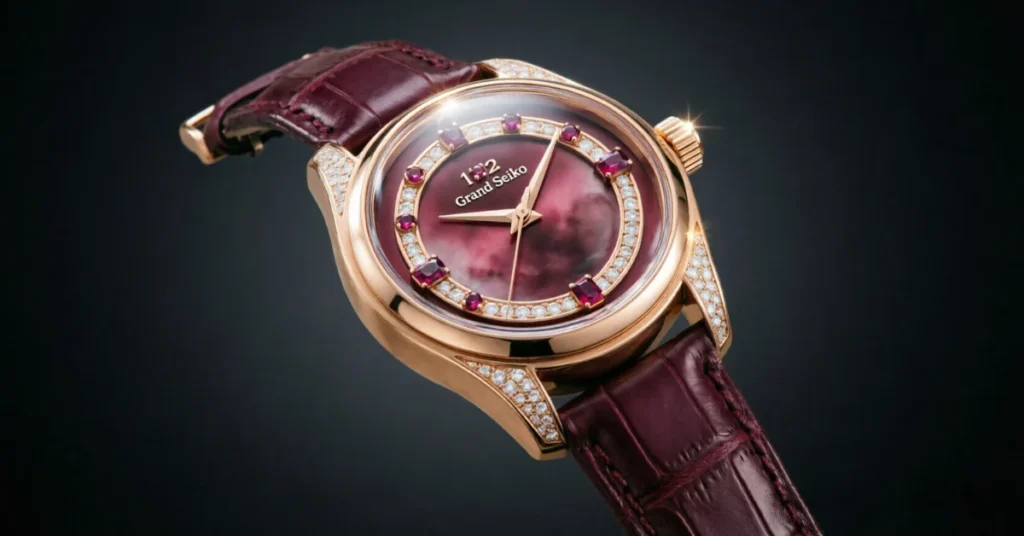
The SBGD228 “Red Lion” carries a 44.5mm case forged in 18k rose gold, set with over 250 diamonds and deep-hued Mozambique garnets around a wine-red mother-of-pearl dial. It’s a tribute to the brand’s founding lion emblem.
On the tool-watch side, the SLGB023 and SLGB025 “Ushio” divers became the smallest dive watches in Grand Seiko’s history at 40.8mm, built from High-Intensity Titanium that’s 30% lighter than steel. Both run on the new Caliber 9RB1, a movement that holds annual accuracy within plus or minus 20 seconds thanks to a vacuum-sealed crystal oscillator.
At the top of the range, the SBGZ011 ships with a solid platinum clasp and carries an $84,000 list price, available only through Grand Seiko boutiques starting July 2026. Altogether, the brand released more than two dozen new references in 2026, with textured, nature-inspired dials as the clear theme of the year.
Real-World Use Cases: Who Actually Buys Japanese Luxury Watches
Three distinct buyer types show up again and again in this market.
The Swiss collector diversifying. Someone who already owns a Rolex or an Omega and wants a mechanical experience that doesn’t overlap with anything else in the box. Grand Seiko’s Spring Drive fills that gap perfectly, since nothing Swiss moves quite like it.
The traveler buying in Japan. Tokyo’s Ginza district remains a magnet for this crowd, home to the Grand Seiko boutique and Seiko’s flagship Dream Square store. Tourists chase JDM references, models built only for the domestic market with unique dials, sapphire crystals, or movements never exported. Until November 2026, eligible tourists received an instant 10% tax exemption on qualifying purchases at checkout; after that date, Japan moves to a refund-based system where buyers pay full price and claim the refund before leaving the country.
The value-first buyer. Someone who wants mechanical craftsmanship without the six-figure price tag. Entry-level Grand Seiko pieces around $3,000 to $5,000 sit in a sweet spot that few Swiss houses can match at that price.
What the Research Shows
Detailed analysis of the wider luxury goods sector shows Japan holding a genuine, if modest, footprint. According to Statista, worldwide revenue in the luxury watches category reached roughly $63.44 billion in 2026, with growth expected near 2.92% annually through 2031. Japan remains a smaller slice of that total compared to giants like the United States, but its influence on design language and movement technology far outweighs its raw revenue share.
Industry analysts note that Asia-Pacific buyers, Japanese collectors among them, tend to prioritize authenticity, condition, and provenance over flash, a pattern that shapes how brands there market their pieces. That consumer instinct is part of why Grand Seiko emphasizes hand-finishing and heritage storytelling rather than celebrity endorsements.
The Challenges Facing Japanese Luxury Watches in the Global Market
It isn’t all smooth sailing. A few real friction points hold Japanese luxury watches back from matching Swiss brand recognition dollar for dollar.
Brand perception lag. Decades of dominance in cheap quartz watches left a lasting impression. Plenty of shoppers still associate “Japanese watch” with a $20 Casio, not a $50,000 Credor, and that perception takes years to shift.
Limited global retail footprint. Grand Seiko only became available in the United States in 2017. Boutique presence outside Japan and a few major cities is still thin compared to the Swiss majors, which have decades of flagship stores worldwide.
Resale market maturity. Rolex and Patek Philippe benefit from an enormous, established secondary market that supports resale value. Japanese luxury watches, Grand Seiko especially, are catching up but haven’t reached that same liquidity yet.
Production scale versus exclusivity. Some limited pieces, like Credor’s Eichi II, deliberately stay scarce. That protects prestige but also slows the pace at which new collectors can enter the category.
Servicing access. This one rarely gets mentioned. Grand Seiko’s official service network outside Japan is still limited to a handful of authorized centers in major markets like the United States and parts of Europe. Owners outside those regions often ship watches back to Japan for full Spring Drive servicing, which adds weeks to turnaround time compared to sending a Rolex to a nearby authorized dealer.
Authentication risk. JDM-exclusive references, precisely because they’re rare and sought after outside Japan, attract a fair number of counterfeits on resale marketplaces. Buyers shopping secondhand should always confirm serial numbers through an authorized Grand Seiko boutique or Seiko’s own verification channels before paying, especially for limited editions like the Eichi II.
None of these are fatal. They’re the same growing pains any category faces while building trust outside its home market.
Outlook: Where Japanese Luxury Watches Go From Here
The trajectory looks steady rather than explosive. Grand Seiko’s 2026 lineup leaned hard into textured dials inspired by Japanese landscapes and continued refining its Ultra Fine Accuracy movement family. That kind of steady, craft-first iteration, rather than flashy reinvention, is exactly what’s built the brand’s reputation.
Expect three things over the next few years: wider international boutique expansion, growing interest from younger collectors priced out of Swiss majors, and a slow but real narrowing of the resale-value gap. Japanese luxury watches aren’t trying to replace Switzerland. They’re carving out a permanent second lane, one built on precision, restraint, and craftsmanship that speaks for itself.
Conclusion
Japanese luxury watches have moved past the point of needing to prove themselves. Grand Seiko’s Spring Drive, Credor’s hand-painted dials, and a small but serious independent scene have earned genuine respect from collectors who once wouldn’t have looked twice. The brands still face real hurdles around global recognition, servicing access, and resale liquidity, but the craftsmanship argument is settled. Anyone shopping this category in 2026 isn’t settling for an alternative. They’re choosing a different kind of excellence entirely.
FAQs
Are Japanese luxury watches actually considered luxury, or just premium?
Grand Seiko and Credor meet every technical benchmark of true luxury watchmaking: hand-finishing, in-house movements, and genuine scarcity on top pieces. They sit firmly in the luxury tier, not just premium.
What’s the entry price for a genuine Japanese luxury watch?
Grand Seiko starts around $1,800 to $3,000 for base models, climbing well past $50,000 for limited editions and Credor’s rarest pieces.
Is Grand Seiko better than Rolex?
Neither wins outright. Grand Seiko often edges ahead on hand-finishing and movement innovation like Spring Drive, while Rolex holds a stronger resale market and broader global recognition.
Where’s the best place to buy Japanese luxury watches?
Tokyo’s Ginza district, home to Grand Seiko’s flagship boutique and Seiko’s Dream Square, remains the top destination, especially for JDM-exclusive references.
How do I service a Grand Seiko outside Japan, and is authentication a concern?
Authorized service centers exist in major markets like the US, but full Spring Drive servicing often still routes back to Japan. For secondhand purchases, always verify serial numbers through an authorized boutique first, since JDM references are a common counterfeit target.