
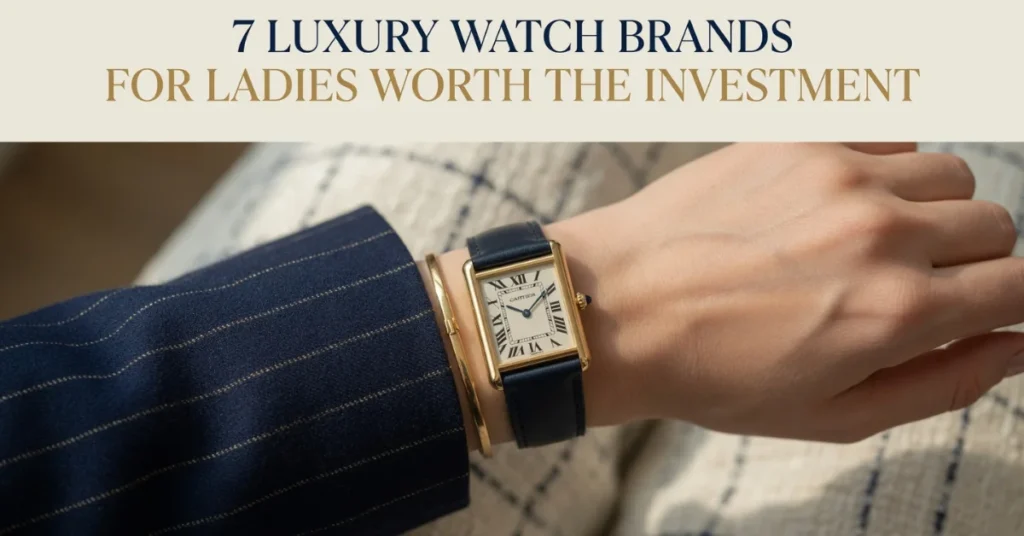
A watch used to be something you inherited from a grandmother and wore twice a year. That’s not really true anymore. Walk into any boardroom, wedding, or airport lounge in 2026 and you’ll spot women wearing timepieces the way they used to wear a signature handbag — as a quiet signal of taste, not a shout for attention. Choosing among the best luxury watch brands for ladies today means weighing heritage, craftsmanship, resale value, and honestly, how a piece feels on your wrist every single day.
This isn’t a random list pulled from a catalog. It’s built around what actually holds up over time — mechanically, financially, and stylistically — plus the ownership details most guides skip entirely.
Why Luxury Watch Brands for Ladies Matter More Than Ever
Women aren’t buying watches as afterthoughts to men’s collections anymore. They’re buying them as their own category, with their own logic. A well-chosen piece from established luxury watch brands for ladies can be worn to a job interview and a dinner party without missing a beat.
Part of this shift comes from watches being treated as tangible assets rather than pure accessories. Anyone who has shopped the pre-owned market knows certain references barely move in price, and some climb. That’s a different mindset than buying a fast-fashion bag that loses value the moment it leaves the store.
There’s also a practical angle. A mechanical watch from a respected maison, if cared for, can be serviced and worn for decades. It’s not disposable. It’s not seasonal. It’s the rare luxury purchase that ages with you instead of aging out of style.
Luxury Watch Brands for Ladies Compared at a Glance
Before going deeper into each house, here’s how the major names stack up side by side. Prices are approximate starting points for new pieces and will vary by dial, metal, and retailer.
| Brand | Popular Women’s Model | Starting Price (approx.) | Case Size | Movement | Resale Strength |
|---|---|---|---|---|---|
| Rolex | Lady-Datejust / Oyster Perpetual | £7,000–£9,500 | 28mm–31mm | Automatic | Very strong |
| Cartier | Tank / Panthère | £3,000–£5,500 | 25mm–31mm | Quartz or automatic | Strong |
| Patek Philippe | Twenty~4 | £25,000+ | 25mm–36mm | Automatic | Very strong, limited supply |
| Omega | Constellation / Seamaster Aqua Terra | £4,500–£6,500 | 27mm–30mm | Co-Axial automatic | Moderate to strong |
| Bulgari | Serpenti Seduttori | £8,000–£12,000 | 27mm–35mm | Quartz or automatic | Moderate |
| Chopard | Happy Sport | £5,000–£8,000 | 30mm–36mm | Automatic | Moderate |
| Chanel | J12 | £5,000–£8,000 | 33mm–38mm | Quartz or automatic | Moderate |
| TAG Heuer | Carrera | £2,500–£4,500 | 29mm–36mm | Quartz or automatic | Moderate |
Rolex: The Benchmark for Everyday Prestige
Rolex rarely needs an introduction, and that’s exactly the point. The Lady-Datejust and Oyster Perpetual remain the two most requested references for women, prized for being dressy enough for the office and durable enough for daily wear without babying.
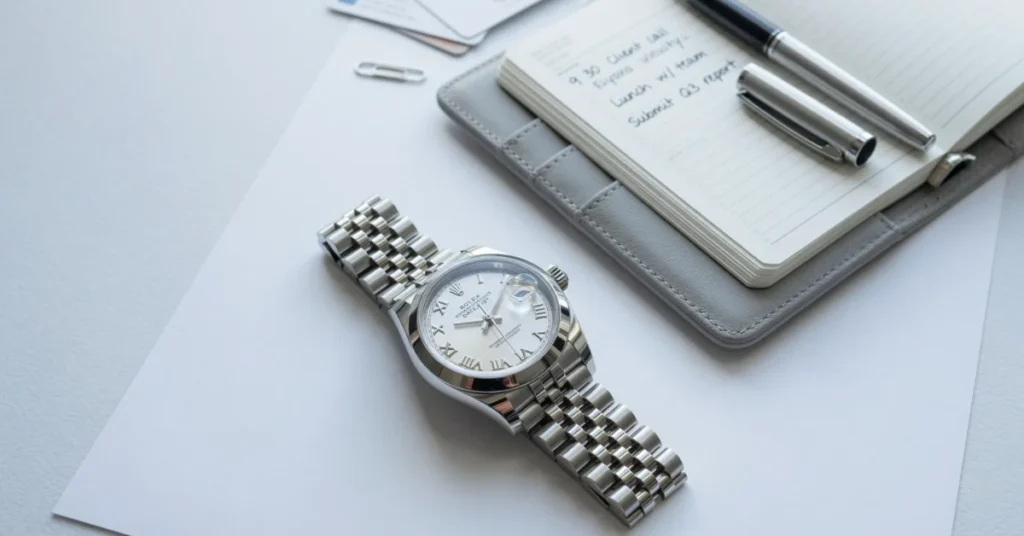
Steel Rolex models, in particular, have built a reputation for holding value on the secondary market better than almost anything else in the category. That reputation isn’t hype — it’s a function of tightly controlled production and demand that consistently outpaces supply.
For a first serious watch, the Datejust 31 is the reference most retailers and collectors point to, thanks to its versatile size and dial customization.
Cartier: Jewelry-First Watchmaking
Cartier approaches watches differently than most Swiss houses — design comes first, movement second, though the movements are perfectly capable. The Tank, with its rectangular case and Roman numerals, has been worn by everyone from Princess Diana to modern editors, and it hasn’t dated a single day since it launched over a century ago.
The Panthère, revived from its 1980s heyday, has become something of a cult favorite again, blending gold-link bracelets with a fluid, almost jewelry-like drape on the wrist. Anyone shopping among luxury watch brands for ladies who wants something instantly recognizable but not sporty tends to land on Cartier.
Patek Philippe: Quiet, Serious Craftsmanship
Patek Philippe doesn’t chase trends, and that restraint is precisely why collectors respect it. The Twenty~4 was designed specifically for women rather than shrunk down from a men’s case, which matters more than it sounds — proportions, clasp comfort, and dial legibility are noticeably better as a result.
Patek pieces are harder to acquire than most, often requiring a relationship with an authorized dealer built over years. That scarcity is part of what keeps resale value strong. This is the brand serious collectors gravitate toward once they’ve moved past their first or second watch.
Omega: Swiss Precision at a More Accessible Entry Point
Omega delivers genuine in-house engineering — the Co-Axial Master Chronometer movement is a legitimate technical achievement — at a price point noticeably below Rolex or Patek Philippe. The Seamaster Aqua Terra and Constellation are the two most popular women’s references, offering water resistance and daily durability without sacrificing polish.
Omega is often where buyers land when they want authentic Swiss mechanical watchmaking without the multi-year waitlists that plague some competitors.
Bulgari and Chopard: Playful Luxury with Real Engineering Behind It
Bulgari’s Serpenti Seduttori wraps the wrist in a way no rectangular or round case can, drawing on the brand’s decades of snake-motif jewelry design. Chopard’s Happy Sport, with its floating diamonds visible through the dial, brings a genuinely playful energy that’s rare in a category often obsessed with seriousness.
Both brands prove that luxury watch brands for ladies don’t have to choose between fun and craftsmanship. Chopard in particular has kept its steel Happy Sport models relatively attainable, while still holding demand on the pre-owned market.
Chanel, TAG Heuer, and IWC: The Overlooked Middle Tier
Most guides stop at Rolex, Cartier, and Patek Philippe. That leaves out a genuinely useful tier for buyers who want real Swiss or French-Swiss craftsmanship without the six-figure ceiling.
Chanel’s J12 remains one of the most distinctive sports watches in the category, built in scratch-resistant ceramic and originally launched as a unisex piece — its black or white case reads as sharp and modern rather than jewelry-adjacent. TAG Heuer’s Carrera line has quietly become a favorite among younger professional buyers, offering chronograph-grade engineering at a price closer to entry-level than most houses on this list. IWC’s Portofino and smaller Da Vinci references, meanwhile, sit in a similar bracket to Omega but carry a slightly more understated, old-money aesthetic that appeals to buyers who don’t want an obvious logo moment.
None of these three dominate resale conversations the way Rolex or Cartier do, but they fill a real gap for buyers who want authentic craftsmanship in the £2,500–£8,000 range.
What the Research Shows
Detailed analysis of the current market backs up what’s visible on wrists everywhere. Statista’s 2026 market forecast puts global revenue in the luxury watches segment at roughly $63.44 billion this year, with annual growth projected near 2.92% through 2031, and luxury pieces are expected to account for around half of all watch sales worldwide in 2026. <cite index=”11-1″>Revenue in the Luxury Watches market amounts to US$63.44bn in 2026, with the market expected to grow annually by 2.92% CAGR through 2031</cite>.
Industry reporting on the women’s segment specifically shows Rolex, Cartier, Omega, and Patek Philippe continuing to dominate collector attention across both new and pre-owned markets, which lines up with what retailers and auction houses have been observing through 2025 and into 2026. Watch experts covering the space have also noted a behavioral shift — women increasingly buy timepieces to mark personal milestones and treat them as long-term holds rather than impulse purchases.
What Owning a Luxury Watch Actually Costs Long-Term
This is the part most articles skip entirely, and it matters more than the sticker price.
Servicing. A mechanical watch needs a full service roughly every four to six years to keep its movement accurate and its water resistance intact. For brands like Rolex or Omega, a full service typically runs somewhere between £300 and £800 through an authorized center; Patek Philippe or Vacheron Constantin servicing tends to sit noticeably higher given the complexity of their movements. Quartz pieces from Cartier or Chanel need far less — mainly battery changes every two to three years.
Insurance. Most standard home contents policies cap jewelry and watch payouts well below what a Rolex or Patek Philippe is actually worth. Anyone who has owned a watch above roughly £5,000 in value typically needs a separate specified-items rider or a standalone insurer, which usually costs a small percentage of the watch’s appraised value per year.
Authentication and dealer risk. Buying secondhand luxury watch brands for ladies without proper documentation is one of the fastest ways to lose money. Always confirm the serial number matches the papers, ask for original box and warranty card, and buy only from authorized dealers or established platforms that offer independent authentication and a return window. A suspiciously low price on a well-known reference is almost always a red flag, not a bargain.
Buying abroad. Shopping for a watch while traveling — Switzerland, Dubai, and parts of Asia are common stops — can mean meaningful VAT or duty-free savings, but only if you handle the paperwork correctly and declare the item where required on return. It’s worth checking your home country’s import allowance before assuming a lower sticker price abroad is a genuine saving.
How to Choose Among Luxury Watch Brands for Ladies
Picking the right piece isn’t just about the logo on the dial. A few things worth weighing:
- Wrist size and case diameter. Most women’s cases run between 26mm and 34mm. A quick way to check fit before buying: wrap a strip of paper around your wrist, measure it, and compare against the brand’s published lug-to-lug and case diameter — a case noticeably wider than your wrist will look bulky rather than elegant.
- Movement type. Automatic and mechanical movements cost more upfront but tend to hold value better than quartz.
- Resale demand. Steel sports models from Rolex, Cartier Tanks, and Omega Constellations consistently move fastest on the pre-owned market.
- Budget realism. Entry-level Swiss luxury starts around £3,000–£5,000 with TAG Heuer or Cartier; true blue-chip pieces from Patek Philippe or vintage Cartier can run well into six figures.
- Servicing access. Confirm the brand has authorized service centers near you before buying — this affects long-term ownership cost.
Anyone who has managed a small watch collection over a few years knows the pieces that get worn most aren’t always the flashiest ones. They’re the ones that fit comfortably and match nearly everything in the closet.
Conclusion
Choosing between the leading luxury watch brands for ladies in 2026 comes down to matching heritage and craftsmanship with how you actually live day to day. Rolex and Cartier remain the safest, most liquid entry points. Patek Philippe sits at the top for serious collectors. Omega, Chanel, TAG Heuer, and Bulgari offer real Swiss or French-Swiss quality without the multi-year waitlist, and factoring in servicing, insurance, and authentication costs upfront will save far more regret than chasing the lowest sticker price. Whichever direction feels right, the goal stays the same — a watch that earns its place on your wrist for decades, not seasons.
FAQs
Which luxury watch brand is best for women just starting a collection?
Rolex and Omega are usually recommended first, since both offer strong resale demand and widely available servicing.
Are women’s luxury watches actually a good investment?
Some steel sports references from Rolex and Cartier have held or grown in value, though watches shouldn’t be treated as guaranteed financial investments — buy what you’ll wear.
What’s the price difference between Rolex and Cartier for women?
Entry-level steel Rolex pieces typically start around £7,000–£9,500, while Cartier’s smaller Tank models can start lower, closer to £3,000–£4,000.
How often does a luxury watch need servicing, and what does it cost?
Most mechanical watches need a full service every four to six years, typically ranging from around £300 to £800 through an authorized center, with high-complication brands costing more.
How do I know if a luxury watch is authentic before buying secondhand?
Buy only through authorized dealers or established resellers who provide original papers, box, and service history, and always verify the serial number against the documentation — never rely on price alone as a sign of authenticity.