
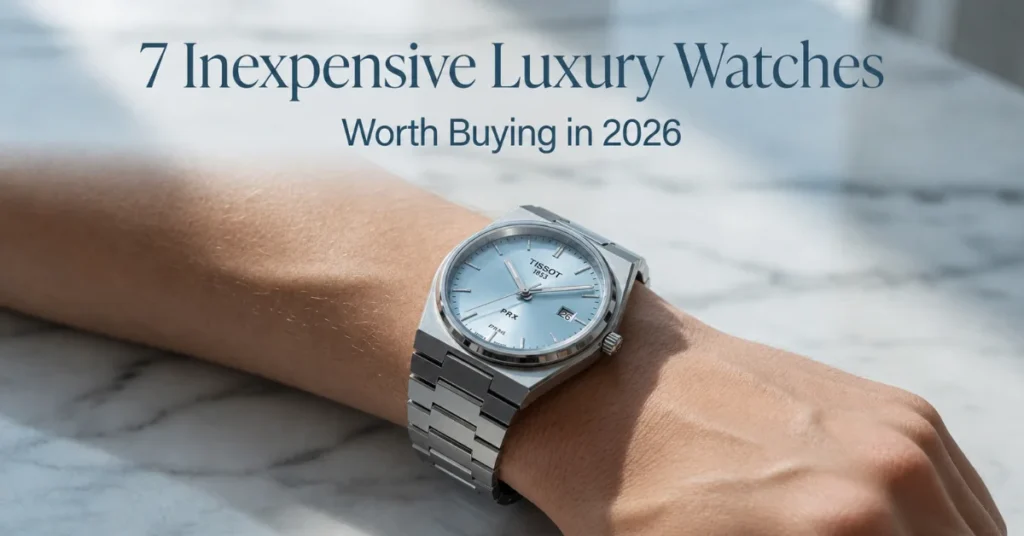
ou don’t need five figures in your bank account to wear something that feels genuinely special on your wrist. That’s the honest starting point for anyone researching inexpensive luxury watches in 2026 — a category that’s grown from a niche curiosity into one of the most searched corners of the watch world.
Ten years ago, “affordable” and “luxury” rarely sat in the same sentence without irony. Now they do, and for good reason. Swiss and Japanese manufacturers have quietly built entire lineups aimed at buyers who want real craftsmanship without the six-figure price tag attached to it.
Why Inexpensive Luxury Watches Are Having a Moment
Anyone who’s shopped for a first serious watch knows the frustration. Step into a boutique, ask about entry points, and the numbers can feel designed to scare you off. That gap between fashion watches and true horology used to be enormous.
It isn’t anymore. Brands like Tissot, Hamilton, Longines, and Seiko have spent the last decade closing that distance, and the result is a wave of inexpensive luxury watches that borrow real Swiss and Japanese movement technology, sapphire crystal, and finishing techniques once reserved for pieces costing ten times as much.
The Tissot PRX Quartz sits right at the entry point of this shift, priced around $350 new — Swiss-made, with a stainless steel integrated bracelet and sapphire crystal that would have been unheard of at that price a generation ago. Step up slightly and the Tissot PRX Powermatic 80 brings an automatic movement with an 80-hour power reserve for roughly $725.
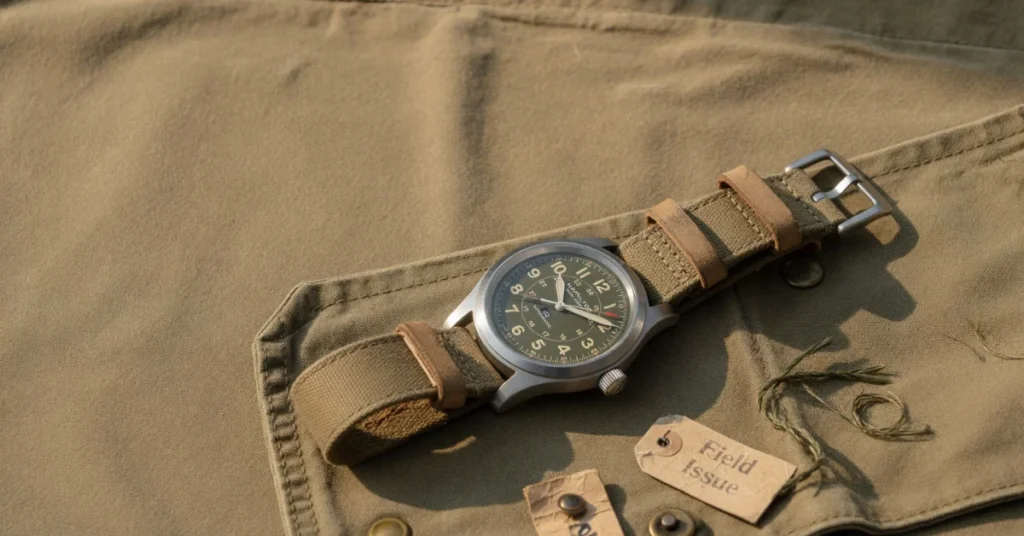
Hamilton’s Khaki Field line tells a similar story. It carries a genuine military heritage, a Swiss automatic movement, and a price around $695, proving that heritage doesn’t have to come with a heritage-sized invoice.
Compare the Top Inexpensive Luxury Watches at a Glance
Scanning specs side by side makes the decision far easier than reading five separate reviews. Here’s how the most searched models actually stack up.
| Model | Price (approx.) | Movement | Water Resistance | Case Size | Best For |
|---|---|---|---|---|---|
| Tissot PRX Quartz | ~$350 | Swiss Quartz | 100m | 35mm / 40mm | First-time buyers |
| Seiko Presage | $350–$550 | Japanese Automatic | 30–50m | 40.5mm | Dial design lovers |
| Hamilton Khaki Field | ~$695 | Swiss Automatic | 50m | 38mm / 42mm | Everyday, rugged use |
| Tissot PRX Powermatic 80 | ~$725 | Swiss Automatic | 100m | 40mm | Long power reserve |
| Longines Spirit | ~$2,200+ | Swiss Automatic (COSC) | 100m | 40mm | Chronometer-grade accuracy |
| Tudor Black Bay 58 (pre-owned) | ~$2,000+ | In-house Automatic | 200m | 39mm | Serious collectors |
Notice how case size varies almost as much as price. That detail matters more than most guides admit, and it’s worth its own section.
Understanding Movements: Quartz, Automatic, and Swiss Quartz
Nobody explains this part clearly enough, and it’s exactly where first-time buyers get stuck.
Quartz movements run on a battery and a vibrating crystal. They’re accurate to within seconds a month, need almost no maintenance, and cost less to produce — which is why Swiss quartz watches like the Tissot PRX Quartz can enter the market at such approachable prices.
Automatic movements run on a mainspring wound by the natural motion of your wrist. No battery, no button, just mechanical engineering doing its job every time you move. They’re less accurate day to day, typically losing or gaining a handful of seconds, but collectors value them precisely because of the craftsmanship involved.
Neither option is objectively better. A buyer who wants precision and zero maintenance leans quartz. A buyer drawn to mechanical engineering and the small ritual of winding a watch leans automatic. Anyone shopping this category should decide that preference first, since it narrows the field faster than price ever will.
The Real Cost of Ownership Nobody Mentions
Most articles stop at the sticker price, which only tells half the story.
Automatic watches typically need a service every four to five years, and that service usually runs between $150 and $400 depending on the brand and movement complexity. Skip it too long, and lubrication breaks down, accuracy drifts, and repair costs climb.
Quartz watches skip almost all of that. A battery swap every one to two years, usually under $20 at a local jeweler, is the entire maintenance story. For buyers comparing inexpensive luxury watches purely on long-term cost, that difference adds up meaningfully over a decade of ownership.
Strap and bracelet replacement is the other overlooked cost. Leather straps wear out within two to three years of regular use, while steel bracelets essentially last the life of the watch. Budgeting an extra $50 to $150 for strap replacements down the line keeps expectations realistic.
Authorized Dealers, Grey Market, and Pre-Owned Platforms
Where you buy changes the experience just as much as what you buy.
Authorized dealers offer full manufacturer warranty, guaranteed authenticity, and after-sales service directly through the brand. Prices sit at full retail, but the peace of mind is real.
Grey market sellers stock genuine watches sourced outside official distribution channels, often at a discount. The watch itself is real, but manufacturer warranty coverage can be limited or void entirely, so buyers need to read seller terms closely.
Pre-owned specialist platforms authenticate each piece before resale and typically offer their own warranty period, separate from the manufacturer’s. This route has genuinely expanded what counts as an inexpensive luxury watch, since a five-year-old Tudor or Omega performs identically to a new one when properly serviced and authenticated.
A quick red flag checklist before buying from any secondary seller: no verifiable return policy, pressure to pay outside a secure platform, or an unwillingness to provide close-up photos of the movement and serial number. Any one of those should end the conversation.
Inexpensive Luxury Watches for Women
Nearly every guide on this topic skews toward men’s field and dive watches, which leaves a real gap. Women shopping this category have strong options too, and they deserve equal attention.
The Tissot PRX in its 35mm case brings the same Swiss quartz reliability and integrated bracelet design in a size built for smaller wrists. Longines’ PrimaLuna collection leans into softer, rounded case shapes with mother-of-pearl dial options, typically starting around $1,000. Seiko’s smaller Presage references also scale down nicely without losing the automatic movement that makes the line appealing in the first place.
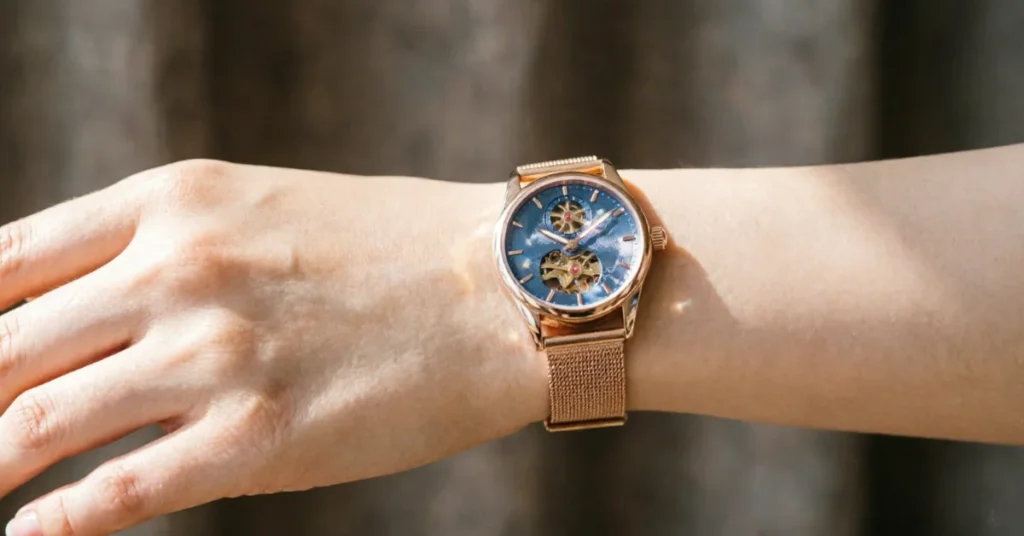
Case size matters more here than brand name. A watch that photographs beautifully on a 42mm men’s model can look oversized and heavy on a smaller wrist, which is exactly why the sizing conversation deserves its own space.
Getting the Sizing and Fit Right
Case diameter gets all the attention, but lug-to-lug measurement, the distance between the two ends of the case where the strap attaches, actually determines how a watch sits on the wrist far more accurately.
A 40mm watch with a long lug-to-lug measurement can overhang a smaller wrist noticeably, while a 40mm watch with a compact lug-to-lug design sits comfortably even on slimmer builds. Anyone buying online without trying a piece on first should look up this specific measurement rather than relying on case diameter alone.
As a rough guide: wrists under 6.5 inches generally suit 34–38mm cases, wrists between 6.5 and 7.5 inches suit 38–42mm, and larger wrists comfortably carry 42mm and above.
Buying Internationally: Customs and Import Considerations
For buyers ordering an inexpensive luxury watch from outside the country where it’s sold, import duty is the detail that catches people off guard after checkout.
Most countries apply customs duty and sales tax on imported watches above a certain declared value, and this cost lands on the buyer, not the seller, unless explicitly stated otherwise. Rates vary widely by country and current trade policy, so checking local customs guidance before ordering avoids an unpleasant surprise at delivery. Buying through an authorized local dealer or a pre-owned platform with local warehousing sidesteps this issue entirely, often for a similar final price once duty is factored in.
What the Research Shows
Market analysis places the worldwide luxury watch industry above sixty billion dollars in value for 2026, with steady annual growth expected through the next several years. That figure alone tells you this isn’t a passing trend, it’s a segment mature enough to support entire product lines built specifically for value-conscious buyers.
What’s notable is where the growth is concentrated. Industry reporting consistently points to younger buyers, including a meaningful share of Gen Z shoppers, entering the luxury watch conversation for the first time, often through pre-owned pieces or entry-tier releases rather than flagship models. Anyone who’s browsed a watch forum in the past year has probably noticed the same pattern: more first-time buyers, more questions about starter luxury pieces, fewer people waiting until they can afford a five-figure watch to get started.
Pros and Cons of Going This Route
There’s plenty to like here, but a fair look means covering both sides.
What works in favor of inexpensive luxury watches:
- Real mechanical or Swiss quartz movements instead of mass-produced fashion mechanisms
- Sapphire crystal and finishing quality that holds up to daily wear
- Brand heritage that means something in the wider watch community
- Reasonable resale value on well-regarded models, particularly Tudor and Longines
Where the trade-offs show up:
- Some entry-tier models use simpler movements than a brand’s flagship pieces
- Availability can be tighter on the most popular references
- Buying pre-owned requires real care around authentication and seller reputation
- Ongoing service costs on automatic movements add up over a decade
Anyone who has spent time comparing options across price brackets tends to notice the same pattern. The sweet spot sits somewhere between $350 and $2,000, where quality and price finally line up without compromise on either side.
Expert View on the Category
Watch retailers and long-time collectors describe this segment as the entry point that actually keeps people in the hobby long-term, rather than scaring them away. Industry voices covering this space note that buyers who start with a well-chosen inexpensive luxury watch are far more likely to stay engaged with serious watchmaking than those who jump straight to an unreachable price bracket and give up when the numbers don’t work.
That view lines up with what’s actually happening in showrooms and online marketplaces. Retailers report steady, sustained interest in the sub-$1,000 category, and pre-owned platforms describe rising demand for authenticated dive watches and field watches specifically, the exact models built to survive daily use rather than sit in a drawer.
Conclusion
The gap between “affordable” and “genuinely well made” has narrowed more than most people realize, and inexpensive luxury watches sit right at the center of that shift. Whether the goal is a first serious timepiece, a durable daily-wear option, or a smarter way into the hobby, this category delivers real craftsmanship without the traditional price barrier. Buyers who take time comparing movements, sizing, ownership costs, and seller reputation tend to walk away with a piece they’ll actually wear for years, which, at the end of it all, is the entire point of owning inexpensive luxury watches in the first place.
FAQs
What counts as an “inexpensive” luxury watch?
Generally anything Swiss-made or built with genuine mechanical craftsmanship priced under roughly $2,000, though some collectors stretch that definition toward $3,000.
Is buying a pre-owned luxury watch actually safe?
Yes, provided the seller offers authentication and a return policy. Established resellers built specifically around pre-owned luxury pieces are generally the safer route over marketplace listings from unverified individuals.
Do these watches hold their value?
Some do remarkably well, particularly Tudor and certain Longines references. Others depreciate like most consumer goods. Value retention isn’t guaranteed across the entire category.
What’s the best starting price point for a first purchase?
Most first-time buyers land somewhere between $350 and $750, which covers genuinely well-made Swiss and Japanese options without financial risk.
Are quartz movements considered lower quality than automatic ones?
Not necessarily. Swiss quartz movements, like those found in the Tissot PRX Quartz, offer excellent accuracy and reliability. The choice comes down to preference rather than quality.