

Everyone books New York, Boston, and Miami first. Fair enough — they earn the hype. But the most interesting east coast travel destinations for 2026 sit a little further off the interstate, in towns that don’t trend on Instagram every July.
This guide skips the obvious top-ten recycling and focuses on places that reward the extra hour of driving. Some are quiet islands. Some are old port towns. A few are cities that get overshadowed by their flashier neighbors. All of them belong on a serious list of east coast travel destinations, whether you’re planning a weekend escape or stitching together a two-week coastal road trip.
Why the East Coast Still Wins for 2026 Travel
The region runs roughly 2,000 miles from Maine to Florida, and that range is the whole point. You can chase lighthouse fog in Acadia one week and lie on warm sand in the Keys the next, without ever leaving the same coastline.
Seven of the top ten most-searched domestic summer destinations for 2026 are coastal or beach spots, a reminder that the shoreline pull hasn’t faded even as travelers spread out to smaller towns. Myrtle Beach, for instance, earned the top spot as the most searched domestic summer destination for 2026, drawing families with sixty miles of flat, walkable beach and lower rental rates than comparable Florida markets.
Amtrak corridors, regional airports, and short flight times between cities also make it easy to combine two or three towns into one trip — something that’s harder to pull off on the West Coast, where distances stretch out fast.
Chincoteague and Assateague Islands, Virginia/Maryland
Skip the boardwalk crowds and head for this 37-mile barrier island split between Maryland and Virginia. Wild horses roam freely across Assateague State Park and the Chincoteague National Wildlife Refuge, and visitors can spend the day shelling, crabbing, kayaking through marshland, or cycling wooded trails.
It’s an easy add-on for anyone road-tripping between D.C. and the Outer Banks, and it feels genuinely undeveloped compared to most mid-Atlantic beach towns.
Acadia National Park, Maine
Acadia rewards travelers who show up early and pack for a full day of shifting weather. Granite shoreline in the morning, a climb up Cadillac Mountain by midday, then dinner in Bar Harbor by evening — the variety packed into a small footprint is what sets it apart from other east coast travel destinations.

One planning note for 2026: vehicle reservations for the Cadillac Summit Road are required from late May through late October, and they’re released only two days in advance. If you miss the window, renting an e-bike in Bar Harbor gets you up the summit without a car reservation.
Charleston, South Carolina
Charleston keeps showing up on 2026 travel roundups for good reason — cobblestone streets, pastel row houses, and a food scene that’s grown well past its Lowcountry roots. Visiting during shoulder season (spring or fall) means milder heat and noticeably thinner crowds around the historic district.
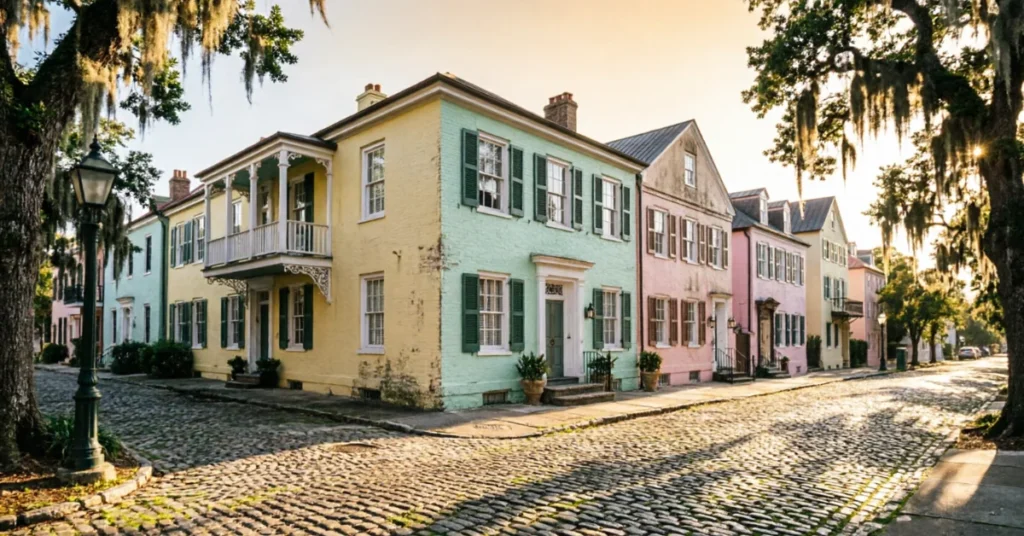
Pair it with a day trip to nearby barrier islands or plantations for a fuller sense of the region’s layered, complicated history.
St. Augustine, Florida
America’s oldest continuously occupied European-founded city packs centuries of Spanish, English, African American, and Native American history into a walkable downtown. Castillo de San Marcos and Fort Mose Historic State Park anchor most visits, and the old town’s narrow streets make it easy to cover on foot in an afternoon.
Newport, Rhode Island
Newport trades subtlety for spectacle. The Gilded Age mansions along Bellevue Avenue are the draw, but the Cliff Walk — a 3.5-mile public trail hugging the Atlantic — is arguably the better experience, and it’s free.
Sailing culture still runs deep here too, so a harbor cruise or sunset sail is worth building into an itinerary.
Portland, Maine
Portland punches well above its size for food. A compact peninsula, a working waterfront, and one of the highest restaurants-per-capita ratios in the country make it a strong base for exploring the wider Maine coast without committing to a full week Down East.
Outer Banks, North Carolina
A string of barrier islands running roughly 200 miles, the Outer Banks mixes towering dunes (Jockey’s Ridge), Wright Brothers history in Kitty Hawk, and wild horse populations near Corolla. It stays less crowded than Myrtle Beach while offering a similarly long, flat coastline.
Savannah, Georgia
Spanish moss, historic squares, and a walkable riverfront make Savannah one of the more atmospheric stops on the southeastern coast. It sits close enough to Charleston and Hilton Head to combine into a single Lowcountry-to-Georgia loop.
Cape May, New Jersey
Cape May holds one of the largest concentrations of Victorian architecture in the country, and its position at the southern tip of New Jersey makes it a genuine departure from the boardwalk-arcade version of the Jersey Shore most people picture.
Provincetown, Massachusetts
At the very tip of Cape Cod, Provincetown blends whale-watching access, dune shacks, and a well-established arts and LGBTQ+ community into a small-town footprint. The light here has drawn painters for over a century, and it’s easy to see why once you’ve watched a sunset from the dunes.
Baltimore’s Fells Point, Maryland
Baltimore rarely makes east coast travel lists, but Fells Point — a cobblestone waterfront neighborhood dating to the 1700s — offers a mix of maritime history, seafood, and nightlife that’s easy to underestimate. It’s a strong stopover for anyone driving between D.C. and Philadelphia.
Key West, Florida
The southernmost point in the continental U.S. still delivers on the Hemingway-and-sunset mythology, but it’s also the gateway to the Dry Tortugas and some of the best reef diving on the eastern seaboard. Late spring tends to bring calmer seas and fewer cruise-ship crowds than peak winter season.
East Coast Travel Destinations at a Glance
| Destination | Best For | Best Season | Nearest Major Hub |
|---|---|---|---|
| Chincoteague/Assateague | Wildlife, low-key beach days | Late spring, early fall | D.C. (~3.5 hrs) |
| Acadia National Park, ME | Hiking, coastal scenery | June–October | Portland, ME (~3 hrs) |
| Charleston, SC | History, food scene | March–May, Oct–Nov | Charlotte (~3 hrs) |
| St. Augustine, FL | History, walkable old town | Winter, early spring | Jacksonville (~45 min) |
| Newport, RI | Architecture, sailing | June–September | Boston (~1.5 hrs) |
| Portland, ME | Food, compact city break | Summer, early fall | Boston (~2 hrs) |
| Outer Banks, NC | Beaches, dunes, less crowded | Late spring, fall | Norfolk, VA (~1.5 hrs) |
| Savannah, GA | Historic squares, walkability | Spring, fall | Charleston (~2 hrs) |
| Cape May, NJ | Victorian architecture | Late spring, fall | Philadelphia (~2.5 hrs) |
| Provincetown, MA | Arts scene, whale watching | June–September | Boston (ferry, ~1.5 hrs) |
| Fells Point, Baltimore | Waterfront history, nightlife | Spring, fall | D.C. (~1 hr) |
| Key West, FL | Reef diving, island culture | Late spring | Miami (~4 hrs) |
Hurricane Season: The Gap Most East Coast Guides Skip
Most east coast travel destinations lists gloss over one detail that actually matters for trip planning: the Atlantic hurricane season runs officially from June 1 through November 30, 2026, covering the exact window most people book summer and fall beach trips.
NOAA’s 2026 outlook leans toward a quieter-than-average year, giving roughly even odds of a near-normal season and a slightly higher chance of a below-normal one. That’s reassuring, but not a guarantee — a single storm making landfall can still disrupt flights, close beaches, and force evacuations regardless of how quiet the season looks on paper. The historical peak stretches from mid-September into October, so trips to hurricane-exposed spots like the Outer Banks, Charleston, or St. Augustine during that stretch are worth booking with refundable rates or travel insurance as a buffer.
Practical takeaway: if a trip falls between August and October, check the National Hurricane Center’s tropical outlook a few days before departure rather than relying on the seasonal forecast alone.
Planning Notes for 2026
A few practical shifts are worth building into any east coast travel destinations itinerary this year:
- Book national park reservations early. Timed-entry systems are expanding at parks like Acadia, and popular slots disappear within minutes of release.
- Consider shoulder season. April–May and September–October generally mean lower prices and thinner crowds across most of these towns.
- Watch Miami in June and July. Miami is hosting matches for the 2026 FIFA World Cup, and hotel availability in South Florida will tighten significantly during that window.
- Amtrak fares climb closer to travel dates. Booking Northeast Corridor routes weeks ahead, rather than days, tends to save real money.
Who Should Prioritize Which Stops
Families with younger kids will likely get more out of flat, low-surf beaches like Myrtle Beach or the Outer Banks than the rockier coastline further north. Couples chasing a quieter, design-forward trip tend to gravitate toward Newport, Cape May, or Provincetown. History-focused travelers get the most mileage out of St. Augustine, Savannah, and Charleston, where a single afternoon can cover several centuries. And anyone building a multi-stop road trip should lean on the Northeast’s short driving distances — Boston to Newport, or D.C. to Baltimore, are both under two hours.
Conclusion
The strongest east coast travel destinations for 2026 aren’t necessarily the loudest ones. A barrier island with wild horses, a fishing town with better food than its size suggests, a Victorian seaside town nobody associates with New Jersey — these are the trips people actually remember. Whichever combination you pick, the coastline’s biggest advantage stays the same: nowhere else packs this much variety into drives this short.
FAQs
What’s the best time of year to visit east coast travel destinations?
Late spring (May) and early fall (September–October) generally offer the best balance of mild weather, lower prices, and smaller crowds across most of the coast.
Can you combine multiple east coast cities in one trip?
Yes — Amtrak’s Northeast Corridor and regional airports make it easy to link cities like Boston, Newport, New York, and D.C. into a single itinerary without renting a car for the whole trip.
Are national parks on the east coast harder to visit in 2026?
Some are. Acadia’s Cadillac Summit Road now requires a timed vehicle reservation from late May through October, so booking ahead — or using an e-bike as a workaround — matters more than it used to.
Which east coast destination is best for a first-time visitor?
Charleston or Savannah tend to work well for first-timers, since both are walkable, compact, and packed with history without requiring a car once you’ve arrived.
Is the East Coast a good option for a family beach vacation?
Yes. Areas like Myrtle Beach and the Outer Banks offer long, flat, low-surf beaches that suit younger children better than the rockier coastline in New England.