

Strap one on and the first thing you notice isn’t the price tag. It’s the weight. A genuine diving watch luxury piece sits on the wrist with a density that cheaper alternatives simply can’t fake, and that’s before the crown even gets screwed down.
That heft is the whole point. Every diving watch luxury model on the market today is built around a contradiction: it has to survive crushing water pressure and salt corrosion, yet it also has to look right under a dinner jacket. Few product categories are asked to do both jobs this well.
What Actually Makes A Diving Watch Luxury Piece
Not every watch with a rotating bezel earns the label. The technical baseline most collectors and brands lean on is the ISO 6425 standard, which sets minimum requirements for water resistance, bezel behavior, and legibility in the dark.
A true diving watch luxury model typically checks these boxes:
- Water resistance of at least 200 meters, often 300 meters or more on flagship references
- A unidirectional rotating bezel with a locking click, so dive time can only be shortened by accident, never extended
- Luminous markers bright enough to read 60 minutes into a dark dive
- Anti-magnetic and shock-resistant construction, usually in 904L steel, titanium, or ceramic composites
- A helium escape valve on models built for saturation diving past 1,000 meters
Anyone who’s handled both a $200 dive watch and a $10,000 one immediately feels the difference in how the crown threads, how the bezel clicks, and how the bracelet sits flush against the wrist. It’s the same basic idea executed at two completely different levels of finishing.
Comparing The Category’s Best-Known Models
Specs get scattered across a dozen articles when you’re shopping this category. Here’s the side-by-side most guides skip.
| Model | Water Resistance | Case Material | Movement Type | Approx. Starting Price |
|---|---|---|---|---|
| Rolex Submariner | 300m | Oystersteel | Mechanical (automatic) | $10,000+ |
| Omega Seamaster Diver 300M | 300m | Steel/Titanium | Mechanical (automatic) | $6,000+ |
| Tudor Pelagos | 200m | Titanium | Mechanical (automatic) | $4,500+ |
| Blancpain Fifty Fathoms | 300m | Steel/Titanium/Gold | Mechanical (automatic) | $15,000+ |
| Grand Seiko Diver | 200m | Steel | Spring Drive (hybrid) | $6,000+ |
This table only covers flagship references. Entry points within each brand’s own dive lineup can sit lower, and pre-owned pricing shifts these numbers constantly.
Real Examples Worth Knowing
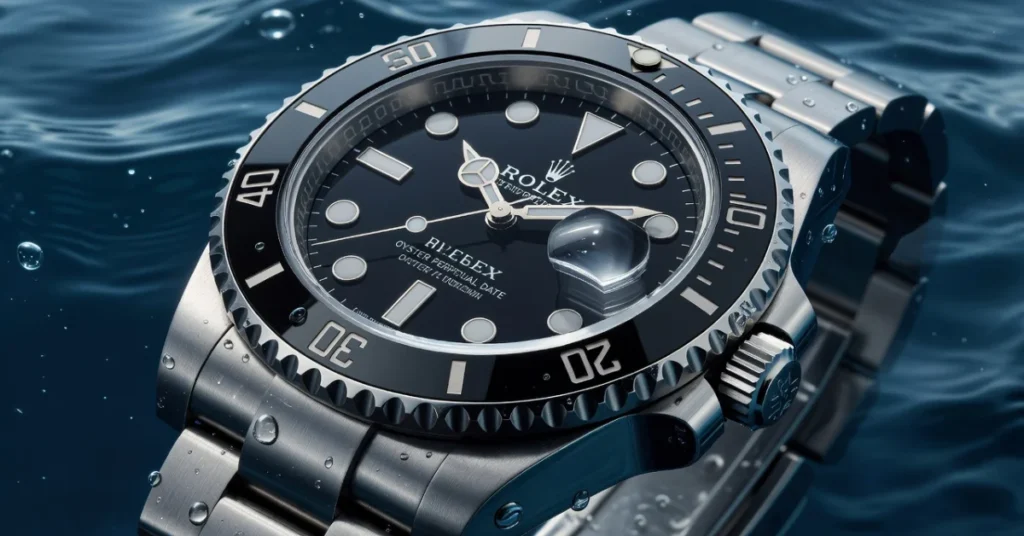
The Rolex Submariner remains the reference point the entire category gets measured against. First shown in the mid-1950s, it introduced the waterproof diver’s format that nearly every brand has borrowed from since. The watch was designed for diving and manufactured by Rolex, resistant to both water and corrosion.
Omega’s Seamaster Diver 300M tells a different story, one built on the back of decades of naval-testing partnerships and pop culture visibility through film. Tudor’s Pelagos leans harder into raw utility, favoring titanium cases and matte finishes over polish. And Blancpain’s Fifty Fathoms, arguably the true originator of the locking bezel, still gets cited by historians as the watch that started this entire category.
Then there’s the newer wave. Grand Seiko’s dive references bring a distinctly Japanese approach to case finishing, while Rado’s bronze-cased Captain Cook models develop a patina that changes the watch’s character over years of wear. Anyone shopping a diving watch luxury piece today has more genuinely different design philosophies to choose from than at any point in the category’s history.
Spotting A Fake Before You Pay
This is the part most buying guides leave out entirely, and it’s arguably the most important one.
Counterfeiters target this category harder than almost any other watch segment, precisely because demand outstrips authorized retail supply for certain references. A few checks catch most fakes before money changes hands:
- Weight test. Genuine models use dense alloys. A diving watch luxury piece that feels suspiciously light is a red flag on its own.
- Serial and reference number verification. Authorized dealers and brand boutiques can confirm a serial against factory records. Private sellers who refuse this step should be treated with caution.
- Bezel action. A real unidirectional bezel clicks with consistent resistance and never turns backward, even slightly. Loose or wobbly bezels are common on replicas.
- Movement sound and sweep. Mechanical seconds hands sweep smoothly rather than ticking, and the movement should be silent enough that you can’t hear it without holding the case to your ear.
Buying through an authorized dealer, brand boutique, or a certified pre-owned program removes most of this risk upfront, even if it costs slightly more than an unverified private sale.
Smaller Wrists And Women’s Options
Most coverage of this category defaults to 41mm-plus cases built for larger wrists, which leaves a real segment of buyers underserved.
Several brands now build genuinely capable smaller references rather than shrinking a men’s case and calling it a day. Rolex’s smaller Submariner references, Tudor’s Pelagos FXD in reduced case sizes, and select Omega Seamaster variants all sit in the 36 to 40mm range without giving up real water resistance or ISO-level durability. Anyone with a smaller wrist shouldn’t assume this category only works at oversized proportions. A diving watch luxury piece built at 37mm can meet the same 200 or 300 meter rating as its larger sibling.
Quartz Or Mechanical: The Trade-Off Nobody Explains Clearly
Most guides simply assume mechanical is the “real” choice and move on. That’s an oversimplification.
Mechanical movements offer heritage, visible craftsmanship through a sapphire caseback, and no battery dependency, but they lose a few seconds of accuracy per day and need servicing every five to ten years. Quartz and hybrid movements, like Grand Seiko’s Spring Drive, trade some of that romance for near-perfect timekeeping accuracy and lower long-term maintenance costs.
For working divers who need precise timing underwater, quartz or Spring Drive options genuinely make practical sense. For collectors buying a diving watch luxury piece primarily for heritage and resale value, mechanical still dominates the segment that appreciates over time.
The Pros And Cons Worth Weighing
There’s real appeal here, and real friction too.
What draws people in:
Heritage and provenance matter more in this category than almost any other consumer product. A Submariner or Fifty Fathoms carries decades of documented use by actual divers, explorers, and military units, and that story adds weight beyond the specs sheet.
Where it gets complicated:
Price appreciation isn’t guaranteed. Collectors who bought purely on resale speculation over the past few years have learned that lesson the hard way, since certain references have cooled after sharp run-ups. A diving watch luxury piece should be bought first for the wrist, second for any investment upside.
Servicing costs also add up. A mechanical movement needs attention every five to ten years, and that bill can run into the hundreds of dollars even before parts are involved.
What The Research Shows
Market data from 2026 points to a worldwide luxury watch category valued above sixty-three billion dollars, with continued single-digit annual growth projected through the next several years. Revenue in the luxury watches market has reached the tens of billions in 2026, with steady annual growth expected through 2031.
Industry analysts also note a shift happening below the surface of that headline figure. The pre-owned and secondary market for luxury watches has grown into a multi-billion-dollar segment in its own right, with major brands now formalizing certified pre-owned programs rather than leaving resale entirely to third parties. That shift matters directly for anyone weighing a diving watch luxury purchase, since it means resale value is becoming more transparent and less speculative than it used to be.
Analysts following the category also point to material innovation as a defining 2026 trend. Ceramic-carbon composites and grade 5 titanium have moved from niche use into mainstream product lines, cutting weight while improving scratch resistance. That’s a meaningful shift for anyone who’s ever felt wrist fatigue from an all-steel case worn daily.
Insurance And Appraisal — The Step Buyers Skip
A high-value diving watch luxury piece rarely sits under a standard homeowner’s or renter’s policy without a specific rider or scheduled item addition. Most standard policies cap jewelry and watch claims at a fraction of what a flagship reference actually costs, which means an uninsured watch is one lost overboard trip away from a total loss with no recovery.
Getting a current appraisal every few years, and keeping original box, papers, and purchase receipts, makes both insurance claims and future resale considerably smoother. This is a small step that costs little upfront and matters enormously if something ever goes wrong.
Buying Across Borders
International buyers face a practical wrinkle that rarely gets mentioned: customs duty and import tax on a diving watch luxury purchase can add a meaningful percentage to the final cost, depending on the destination country and where the watch was bought. Buyers traveling to purchase abroad should check their home country’s duty-free allowance before assuming a lower sticker price abroad is actually cheaper once landed costs are added.
Authorized dealers in major markets typically handle paperwork for tax-free export sales, but private and pre-owned purchases crossing borders usually don’t come with that same support.
Who Should Actually Buy One
Not everyone needs this category, and that’s fine.
Working divers and technical hobbyists still value a mechanical backup that doesn’t need batteries or a charge cycle, even with dive computers now standard equipment.
Collectors buying for heritage care most about production history, original box and papers, and provenance. This group tends to hold pieces for decades rather than flip them.
Everyday buyers who just like the aesthetic make up the largest slice of the market today. Most diving watch luxury owners never take their watch below a swimming pool, and that’s a completely normal way to enjoy the category.
Buying Smart In 2026
A quick comparison helps here: choosing a diving watch luxury piece is a lot like choosing a serious camera. Specs matter, but fit, feel, and how the tool actually gets used day to day matter more than any number on a page.
Before buying, check three things. First, confirm actual water resistance rather than assuming from looks alone, since plenty of dressy “diver-style” watches don’t meet real dive specifications. Second, try the watch on wrist for at least ten minutes in a shop, since case thickness and lug-to-lug length affect comfort more than case diameter alone. Third, ask about service intervals and authorized repair networks before committing, particularly for independent or smaller brands.
First-time buyers on a tighter budget shouldn’t feel locked out either. Several respected brands offer genuinely well-built dive watches in the low four figures, and buying pre-owned from an authorized or certified dealer can bring flagship references within reach without the full retail markup.
Where This Category Is Headed
Anyone who has watched this space over the past few years knows the pattern by now. Prices at the top keep climbing, the secondary market keeps formalizing, and younger buyers keep pushing brands toward more personalization and digital-first buying experiences. None of that changes the core appeal, though. A diving watch luxury piece still sells on the same promise it always has: a tool built for the harshest environment on the planet, refined enough to wear anywhere else.
That combination is exactly why the category refuses to fade, decade after decade.
FAQs
What water resistance rating counts as a real diving watch?
Most standards, including ISO 6425, set the floor at 100 meters, though genuine luxury dive models usually start at 200 meters and go up from there.
Is a diving watch luxury piece safe to actually wear diving?
Yes, provided it meets ISO 6425 or an equivalent in-house testing standard. Many high-end brands test to those specs without printing the certification on the dial.
Do dive watches hold their value over time?
Certain references do, particularly from Rolex, Omega, and Tudor, but appreciation isn’t guaranteed across the board and shouldn’t be the main reason to buy.
What’s the difference between a dive watch and a regular water-resistant watch?
A true dive watch adds a unidirectional timing bezel, enhanced legibility in darkness, and shock and magnetic resistance beyond a standard water-resistant case.
How often does a mechanical diving watch need servicing?
Roughly every five to ten years, depending on the movement and how often the watch gets worn.