
You’re driving along, windows cracked, and suddenly it hits you: a stink that smells exactly like a carton of bad eggs left in the sun. If you’ve caught yourself asking why does my car smell like rotten eggs, you’re not imagining things, and you’re definitely not alone. That smell has a specific chemical cause, and in almost every case, it’s your car telling you something needs attention before it turns into a bigger repair bill.
Here’s the short answer: that odor is hydrogen sulfide gas, and it’s usually escaping because a part of your exhaust or electrical system isn’t doing its job. Let’s break down exactly what’s happening under the hood.
Why Does My Car Smell Like Rotten Eggs? The Chemistry Behind It
Gasoline naturally contains trace amounts of sulfur. During combustion, that sulfur turns into hydrogen sulfide, a gas that smells unmistakably like rotten eggs. Under normal conditions, you’d never notice this because your catalytic converter converts it into odorless sulfur dioxide before it ever leaves the tailpipe.
When something interrupts that process, the raw, smelly gas escapes instead. That’s the moment you start Googling why does my car smell like rotten eggs at two in the morning, half-convinced something’s about to catch fire.
It’s worth being direct about one thing: this isn’t a smell you should just live with. Anyone who’s owned a car long enough knows a new smell almost always means a new problem, and this one’s a fairly reliable warning sign rather than a mystery.
The Most Common Cause: A Failing Catalytic Converter
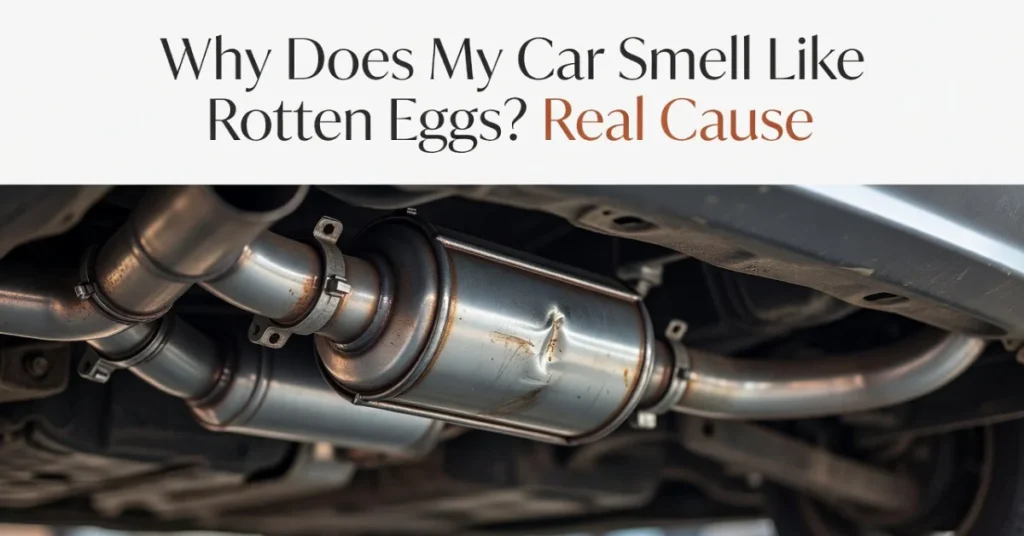
The catalytic converter sits in your exhaust system, roughly between the engine and the muffler, and its entire job is cleaning up combustion byproducts. When it’s working properly, hydrogen sulfide gets converted into water or sulfur dioxide, both of which are essentially odorless.
Mechanics who deal with this daily will tell you that a clogged or contaminated converter is the single most frequent reason cars start smelling like sulfur. Contamination can come from:
- Running a rich fuel mixture over a long period
- Using low-quality or high-sulfur fuel
- Oil or coolant leaking into the exhaust system
- General age and wear on the converter’s internal catalyst
A failing converter often comes with other symptoms too — reduced fuel economy, a check engine light, or even a failed emissions test. If the smell is strongest right at the tailpipe, this is almost certainly your answer.
Second Most Likely Culprit: Your Car Battery
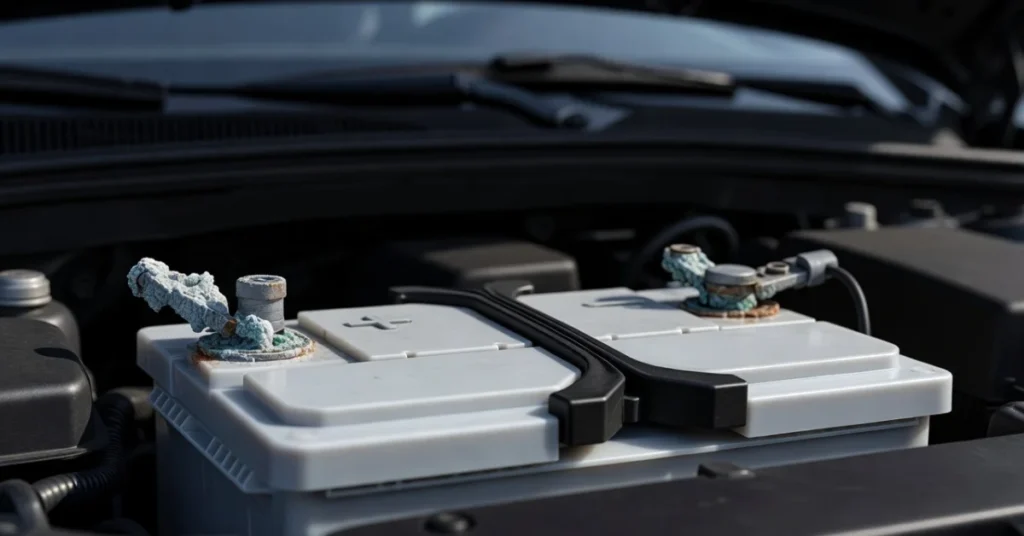
Lead-acid batteries store a mix of sulfuric acid and water. Under normal use, that’s completely contained and harmless. But if the battery is overcharging, aging, or physically damaged, it can start releasing hydrogen sulfide gas of its own.
You’ll usually notice this one under the hood rather than in the cabin, and it tends to show up alongside other battery warning signs — slow starts, dimming headlights, or visible corrosion around the terminals. A faulty alternator voltage regulator is often the root cause here, since it’s what controls how much charge the battery actually receives.
If you suspect the battery, don’t ignore it. Leaking battery acid can eat through nearby plastic and metal components, and that’s a repair that gets more expensive the longer it sits.
Other Reasons Your Car Might Smell Like Sulfur
While the catalytic converter and the battery cover most cases, a few other issues can produce a similar smell:
- A faulty fuel pressure sensor, which can let too much fuel reach the converter and overwhelm it
- An old or worn fuel filter, allowing contaminants through the system
- Transmission fluid leaks, which can produce a related but slightly different burnt odor
- Engine overheating, which throws off the whole exhaust process and can mimic converter failure
This is where the answer to why does my car smell like rotten eggs sometimes takes a bit of detective work, since more than one of these problems can overlap.
Why Does My Car Smell Like Rotten Eggs? Quick Reference Table
Here’s a side-by-side breakdown to help you narrow things down at a glance:
| Likely Cause | Where You’ll Smell It | Other Warning Signs | Typical Fix |
|---|---|---|---|
| Failing catalytic converter | Tailpipe, sometimes cabin | Check engine light, reduced fuel economy, failed emissions test | Converter replacement |
| Overcharging or aging battery | Under the hood | Slow starts, dim headlights, terminal corrosion | Battery or alternator repair |
| Faulty fuel pressure sensor | Under the hood, exhaust area | Rough idle, poor acceleration | Sensor replacement |
| Worn fuel filter | Under the hood | Sputtering engine, stalling | Filter replacement |
| Transmission fluid leak | Under the car, burnt-sweet undertone | Fluid spots on driveway, gear slipping | Seal repair or fluid top-up |
| Engine overheating | Under the hood, near the exhaust manifold | High temperature gauge, steam | Cooling system repair |
Not Every Bad Smell Is the Same: How to Tell Them Apart
Rotten egg smell gets confused with a few other common car odors, so it helps to know the difference before you assume the worst:
- Sweet, syrupy smell usually points to a coolant leak, not sulfur.
- Burning rubber smell typically means a slipping belt or hose touching something hot.
- Musty smell from the vents is almost always mold or bacteria buildup in the AC system, not the exhaust.
- Rotten egg or sulfur smell specifically points back to hydrogen sulfide, which narrows things down to the converter, battery, or fuel system covered above.
What This Costs to Fix
Nobody wants a surprise repair bill, so here’s what the numbers actually look like. Recent industry cost surveys put full catalytic converter replacement anywhere from roughly $900 on the low end to well over $4,000 for luxury or hybrid vehicles, with parts alone often running $1,200 to $2,200 depending on the metals inside. Labor typically adds another $150 to $250 on top of that.
Battery-related fixes are far cheaper by comparison. A standard replacement battery usually runs well under $300, though if a faulty alternator caused the overcharging in the first place, that repair adds to the bill.
Getting a second quote is genuinely worth it here. Independent shops are frequently less expensive than dealerships for this exact repair, and the price gap can be significant enough to justify shopping around before signing off on the job.
Does This Happen to Hybrids and Electric Cars Too?
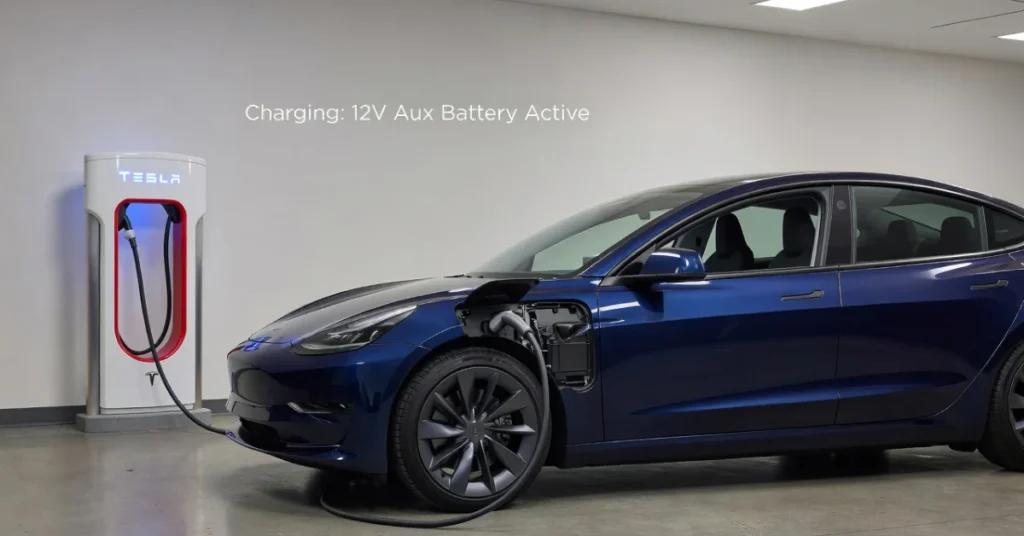
Fully electric vehicles don’t have a catalytic converter, so a sulfur smell from the exhaust simply isn’t possible on an EV. But EVs still run on a standard 12-volt lead-acid battery for their low-voltage electronics, and that battery can overcharge or fail just like in any gas-powered car. So if you’re driving an EV and catching that same rotten egg odor, the 12-volt auxiliary battery is almost always the source, not the main drive battery.
Hybrids are a different story. Since they still run a gasoline engine part of the time, they have a catalytic converter and are just as prone to this issue as a conventional car, sometimes more so, since their converters work under different temperature conditions.
Preventing It Before It Starts
A few habits go a long way toward avoiding this problem altogether:
- Stick to top-tier gasoline with lower sulfur content when it’s available at your local pumps.
- Keep up with routine oil changes, since dirty oil is one of the quieter contributors to converter contamination.
- Have your alternator tested during regular services, especially once your battery is past the three or four year mark.
- Address a rough idle or check engine light early, rather than waiting for it to affect the converter down the line.
What the Research Shows
Automotive researchers and emissions engineers consistently point to the same pattern: sulfur odor complaints track closely with catalytic converter age and fuel quality. Vehicles running consistently on low-sulfur or top-tier fuel report the complaint far less often, which lines up with what mechanics see in daily diagnostics.
Detailed analysis from repair shops also shows that battery-related sulfur smells cluster around vehicles with charging system faults, not just old batteries on their own. In other words, an aging alternator is frequently the hidden trigger, even when the battery itself still looks fine.
How to Diagnose It Yourself
You don’t need a mechanic’s toolkit to narrow this down. Try these steps first:
- Pop the hood and check whether the smell is stronger near the battery or near the exhaust.
- Look at the catalytic converter for discoloration or a glowing red tint while the engine runs — that points to overheating.
- Check the battery terminals for corrosion, swelling, or a cracked case.
- Watch your temperature gauge for signs the engine is running hotter than usual.
- Switch fuel stations temporarily and see if the smell changes with a different, low-sulfur fuel source.
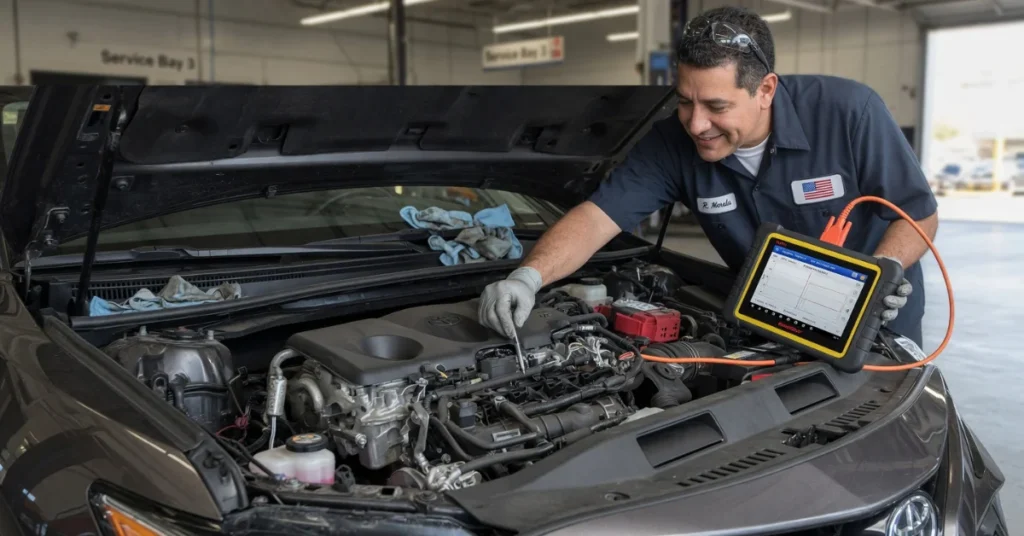
None of these steps guarantee a diagnosis, but they’ll usually point you toward the right technician conversation instead of a guessing game.
Is It Dangerous to Keep Driving?
Short trips with a mild smell generally aren’t an emergency, but this isn’t something to shrug off for months. Hydrogen sulfide is toxic in higher concentrations, and a failing catalytic converter can eventually affect performance and fuel efficiency. A battery leaking sulfuric acid is a more immediate concern, since the acid itself can damage surrounding parts and, in rare cases, cause a fire risk if left unaddressed.
If the smell is strong, sudden, or paired with smoke, unusual noises, or dashboard warning lights, get the car looked at right away rather than waiting for a routine service appointment.
Who Should Pay Attention to This Guide
- Daily commuters noticing a new smell that wasn’t there last month
- Owners of older vehicles, since converters and batteries both degrade with age
- Anyone who recently switched fuel stations and noticed a change shortly after
- Drivers prepping for an emissions test, since this smell often predicts a failed inspection
Conclusion
So, why does my car smell like rotten eggs? Nine times out of ten, you’re dealing with a struggling catalytic converter or a battery that’s overcharging, and both are fixable once you know where to look. Catch it early, and you’re looking at a straightforward repair. Ignore it, and you’re looking at a bigger bill down the road — and a car that never quite smells right until you deal with it.
FAQs
Is a rotten egg smell always the catalytic converter?
Not always, but it’s the most common cause by a wide margin. The battery, fuel sensors, and transmission fluid can all produce a similar odor.
Can I fix a sulfur smell without going to a mechanic?
You can rule out easy causes yourself, like checking the battery or switching fuel, but a full diagnosis and repair usually needs a professional, especially if the converter needs replacing.
Will changing my gas fix the smell?
Sometimes, if the cause is low-quality or high-sulfur fuel. Switching to a top-tier, low-sulfur fuel can reduce or eliminate mild cases, though it won’t repair a converter that’s already damaged.
How much does it cost to replace a catalytic converter?
Recent cost surveys put the full range around $900 to over $4,000 depending on your vehicle, with parts alone often costing $1,200 to $2,200. Getting quotes from more than one shop is worth the extra ten minutes.
Can electric or hybrid cars get this smell too?
Fully electric vehicles don’t have a catalytic converter, so the smell almost always traces back to the 12-volt auxiliary battery instead. Hybrids still have a converter and can develop the same issue as a regular gas car.
Is the smell harmful to breathe?
In small amounts from a quick whiff, it’s unpleasant rather than dangerous. Prolonged exposure to hydrogen sulfide in enclosed spaces is a different story and should be avoided.