
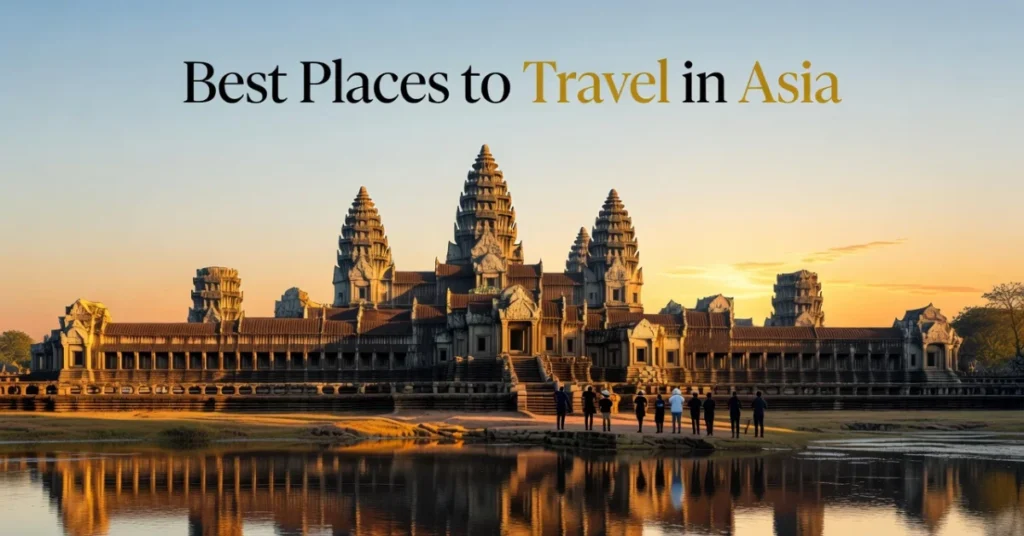
Standing at the edge of Angkor Wat’s moat just before sunrise, watching the towers turn from grey to gold, you understand almost instantly why this continent pulls travelers back again and again. If you’re trying to narrow down the best places to travel in Asia this year, the honest answer is that there isn’t one right list. There’s a right list for you, depending on whether you want temples, beaches, mountains, or noodle stalls at 1 a.m. This guide breaks it down by the kind of trip you’re actually planning, not just a generic top-ten.
Asia in 2026 is having a moment. Singapore, Malaysia, Taipei, Mongolia, Sri Lanka, and Okinawa all landed on Travel + Leisure’s list of the world’s 50 best destinations for the year, and Lonely Planet separately named Jaffna in Sri Lanka one of its top global picks for culture and coastal adventure. That’s a lot of attention for one continent, and it’s not hyped for nothing.
Best Places to Travel in Asia at a Glance
Here’s a quick comparison before the full breakdown below, useful if you’re short on time or just scanning for a fit.
| Destination | Best For | Best Time to Visit | Typical Trip Length | Budget Level |
|---|---|---|---|---|
| Tokyo & Kyoto, Japan | First-timers, culture | Late Mar–Apr, Oct–Nov | 7–10 days | Mid to high |
| Bangkok & Chiang Mai, Thailand | First-timers, food | Nov–Feb | 7–12 days | Budget to mid |
| Siem Reap, Cambodia | History, temples | Nov–Mar | 3–5 days | Budget |
| Jaipur & Agra, India | Culture, monuments | Oct–Mar | 5–7 days | Budget to mid |
| Hội An, Vietnam | Culture, slow travel | Feb–Apr, Aug–Oct | 3–4 days | Budget |
| Palawan, Philippines | Beaches, diving | Nov–May | 5–7 days | Mid |
| Bali, Indonesia | Beaches, wellness | Apr–Oct | 7–10 days | Budget to mid |
| Okinawa, Japan | Beaches, island culture | Mar–Jun, Sep–Nov | 5–7 days | Mid to high |
| Ha Giang, Vietnam | Adventure, motorbiking | Sep–Nov, Mar–May | 3–5 days | Budget |
| Sigiriya, Sri Lanka | Adventure, history | Dec–Mar | 2–3 days (part of longer trip) | Budget to mid |
What Makes a Destination One of the Best Places to Travel in Asia
Before diving into specific cities and countries, it helps to know what separates a genuinely great Asia trip from a rushed one. Three things tend to matter most: ease of travel between stops, a real mix of culture and nature, and food worth planning a day around.
Countries like Japan and Singapore score high on infrastructure. Trains run on time, English signage is everywhere, and getting lost rarely turns into a real problem. Others, like parts of Laos or northern Vietnam, ask more of you logistically but pay it back with scenery and encounters you won’t find on a packaged tour.
Anyone who has managed a multi-country Asia itinerary knows the biggest mistake first-timers make: trying to cram five countries into two weeks. Distances are bigger than they look on a map, and the richest experiences usually come from slowing down in three or four places rather than sprinting through eight.
Best Places to Travel in Asia for First-Timers
If this is your first trip to the continent, a handful of destinations consistently make the transition easy without watering down the experience.
- Tokyo and Kyoto, Japan: cutting-edge city life next to centuries-old temple districts, with a train system that makes car rentals unnecessary.
- Bangkok and Chiang Mai, Thailand: Bangkok for street food and nightlife, Chiang Mai for mountains, hill tribes, and a slower pace.
- Singapore: clean, safe, compact, and a genuinely excellent food scene packed into a city you can cross in under an hour.
- Seoul, South Korea: palaces and K-pop culture sitting comfortably next to some of the best late-night food in Asia.
Locals in Kyoto will tell you the city rewards early mornings. The famous bamboo grove in Arashiyama is a different place entirely before the tour buses arrive at nine. That kind of timing advice rarely shows up in a standard checklist, but it’s the difference between a photo everyone has and one that actually feels like yours.
Best Places to Travel in Asia for Culture and History
For travelers chasing history over hammocks, Southeast Asia and South Asia deliver some of the densest concentrations of heritage sites anywhere on earth.
Cambodia’s Angkor Wat complex remains the region’s single biggest draw, and for good reason: it’s the largest religious monument on the planet, and no photograph quite prepares you for the scale once you’re standing inside it. Nearby Siem Reap has grown into a proper base, with a lively night market and enough restaurants to keep a week-long stay interesting.
India’s Taj Mahal still earns its reputation as one of the most striking buildings anywhere, and pairing it with Jaipur’s pink-walled bazaars and a Chambal River safari turns a single monument visit into a full week of contrast, with Mughal architecture one day, wildlife tracking the next.
Hội An in Vietnam offers something quieter: a lantern-lit UNESCO town where Vietnamese, Chinese, and Japanese influences blend into narrow streets that feel frozen in the best possible way. Walk it after dark, once the lanterns are lit and the day-trippers have thinned out, and the town shows a completely different side of itself.
Best Places to Travel in Asia for Beaches and Nature
Not every trip needs a temple schedule. If saltwater and quiet mornings are the goal, a few spots stand out for 2026.
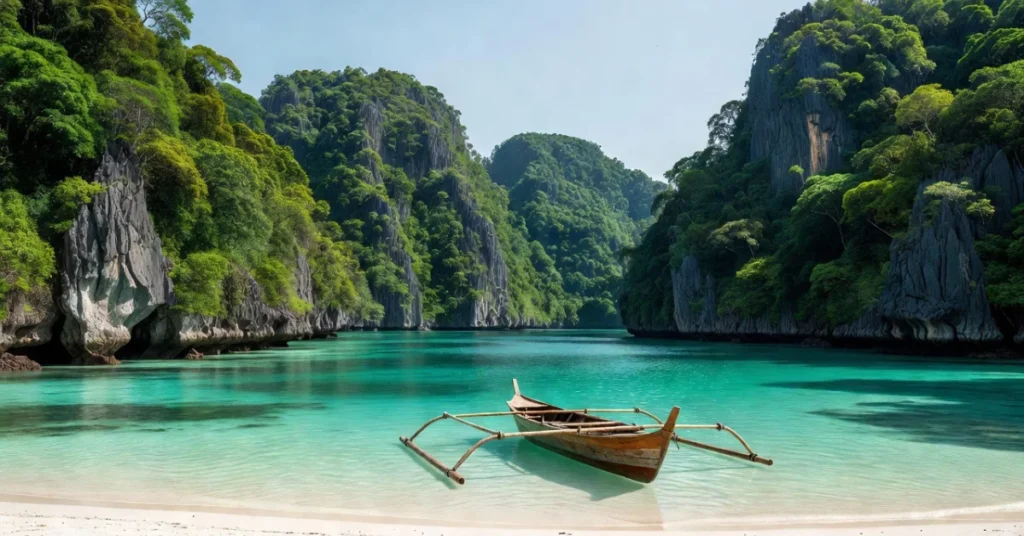
Palawan in the Philippines keeps turning up on “best islands” lists for a reason: lagoons, limestone cliffs, and some of Southeast Asia’s clearest water for snorkeling and diving. Bali still delivers on the classic mix of beaches, rice terraces, and wellness retreats, though staying outside the most crowded stretches of Canggu or Kuta makes a real difference to the pace of the trip.
Okinawa, Japan’s southern island chain, has quietly become one of the region’s most talked-about 2026 destinations, offering coral reefs and a slower island culture that feels distinct from mainland Japan. Sri Lanka’s Sigiriya rock fortress, meanwhile, gives adventurous travelers a rare combination: a genuine hike, ancient frescoes near the summit, and jungle views that stretch for miles once you’re at the top.
What the Research Shows
Industry data backs up what the search interest suggests. According to McKinsey’s global travel research, Asia-Pacific is projected to be the fastest-growing region for international tourism recovery and expansion through the back half of the decade, driven largely by intra-regional travel and rising demand from travelers in China, India, and Southeast Asia itself. That regional growth is part of why smaller, less-crowded spots such as Jaffna, Quy Nhon, and Ha Giang are showing up on more 2026 travel lists instead of the usual handful of capital cities.
Anyone who works in inbound tourism across the region reports the same shift: travelers are booking longer stays in fewer places rather than fast multi-country dashes, and that pattern is reshaping how tour operators build their 2026 itineraries.
Best Places to Travel in Asia on a Budget
Southeast Asia remains one of the best-value regions in the world for travelers watching their spending. Vietnam and Cambodia both offer street food meals for a couple of dollars, guesthouses well under fifty dollars a night in most cities, and buses connecting major stops for a fraction of what similar routes cost in Europe or North America. Laos, often skipped in favor of its louder neighbors, tends to be even cheaper and rewards travelers who slow down along the Mekong.
Thailand sits a notch above in cost but still delivers strong value, especially outside peak season in Phuket and Koh Samui, where prices for accommodation can drop noticeably in the shoulder months.
Best Places to Travel in Asia for Adventure Travelers
For those chasing something more physical, the Ha Giang Loop in northern Vietnam has become a rite of passage: a multi-day motorbike route through terraced mountains and switchback roads that locals describe as unlike anywhere else in the country. Nepal continues to draw serious trekkers to newly accessible Himalayan regions, and homestays in remote villages are opening up experiences that simply weren’t bookable a few years back.
Chiang Mai, again, earns a second mention here, this time for jungle trekking and access to genuine nature-based tourism rather than just its temples.
Choosing the Right Trip Length and Season
Weather matters more in Asia than most first-time planners expect, since the continent spans monsoon zones, dry seasons, and everything in between depending on latitude. Southeast Asia’s dry season generally runs from November through April, making it the most popular window for Vietnam, Cambodia, and Thailand, while Japan’s cherry blossom season in late March through April draws the heaviest crowds of the year to Tokyo and Kyoto.
A common mistake among newer travelers is booking a two-week trip and trying to hit four countries. A better approach, and one that seasoned Asia travelers consistently recommend, is picking one region, whether that’s Indochina, Japan and Korea, or the Indian subcontinent, and giving it the full trip rather than splitting attention across a continent that’s larger than it looks on a flat map.
Visa and Entry Basics for 2026
This is the part most best-of lists skip, and it’s often what actually decides how smooth your trip feels. Entry rules across the region have shifted quite a bit through 2026, and most of the shift is toward easier, more digital processes.
Thailand now grants a 60-day visa exemption for many nationalities, up from the old 30-day rule, though travelers must complete a free Thailand Digital Arrival Card (TDAC) online before landing. Vietnam has widened its e-visa program to cover all nationalities, offering a 90-day visa that can be applied for online in a few working days. Malaysia allows up to 90 days visa-free for most Western and Asian passport holders but now requires a mandatory Malaysia Digital Arrival Card (MDAC) submitted before arrival. Indonesia, including Bali, runs on a visa-on-arrival system priced around 500,000 rupiah (roughly $32 USD), extendable once for another 30 days.
A few practical points apply almost everywhere in the region:
- Passports generally need at least six months of validity remaining beyond your entry date.
- Airlines routinely check for an onward or return ticket at check-in, even if immigration doesn’t ask for one.
- Digital arrival cards like Thailand’s TDAC, Malaysia’s MDAC, and Singapore’s SG Arrival Card are free on official government sites; scam sites charging a “processing fee” are common and worth avoiding.
Rules change often enough that it’s worth confirming your specific nationality’s requirements on the relevant embassy or official immigration website a week or two before departure, rather than relying on a blog post from last year.

Conclusion
There’s no single correct answer to where you should go, but narrowing down the best places to travel in Asia gets a lot easier once you know what kind of trip you actually want. Temples and history point toward Cambodia, India, and Vietnam. Beaches and slower mornings point toward the Philippines, Bali, and Okinawa. First-timers who want an easy introduction do well starting in Japan, Thailand, or Singapore. Whichever direction you choose, 2026 is shaping up to be one of the stronger years yet to book that Asia trip you’ve been putting off.
This article discusses general travel planning information; always confirm visa rules, entry requirements, and safety advisories with official government sources before booking.
FAQs
What is the best time of year to visit Asia?
It depends on the region. Southeast Asia is generally driest and most comfortable from November to April, while Japan’s cherry blossom season peaks in late March and April.
Is Southeast Asia still affordable to visit in 2026?
Yes. Vietnam, Cambodia, and Laos remain some of the best-value destinations in the world for food, accommodation, and transport, even as overall regional tourism demand grows.
Which Asian country is best for a first trip?
Japan, Thailand, and Singapore are the most common recommendations for first-time visitors because of strong infrastructure, English-friendly signage, and easy transport between major sights.
How many countries should I try to visit in two weeks?
Most experienced travelers suggest sticking to one country or one closely connected region, since travel distances within Asia are often longer than they appear on a map.
Are there any new or trending destinations in Asia for 2026?
Yes. Okinawa, Jaffna in Sri Lanka, Mongolia, and Taipei have all gained attention on major 2026 travel lists as accessible alternatives to more crowded classics like Bali and Bangkok.