
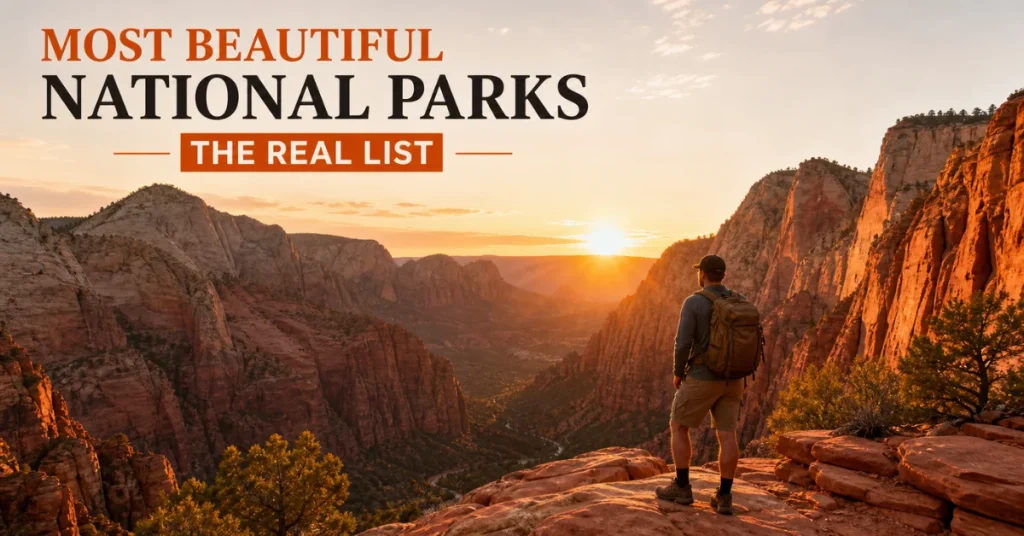
Standing at the rim of a canyon carved over six million years, you instantly understand why lists of the most beautiful national parks in the US never seem to agree on a single winner. Every ranking depends on what kind of beauty grabs you: red rock, alpine granite, misty ridgelines, or a valley full of waterfalls. This piece pulls together the parks that keep showing up at the top of those lists, backed by real visitation numbers instead of guesswork.
America’s park system pulled in roughly 323 million visits in 2025 alone, and 26 of its 433 sites set all-time visitation records that same year. That’s not a quiet corner of the tourism industry. It’s a full-blown migration of people chasing the same handful of landscapes, year after year.
What Makes These the Most Beautiful National Parks in the US
Beauty in a national park isn’t just a pretty photo. It’s the combination of geology, wildlife, accessibility, and that specific feeling you get when the scale of a place makes you stop talking mid-sentence.
Rangers and longtime visitors tend to agree on a few markers: dramatic elevation change, visible geologic history, healthy wildlife populations, and at least one moment on the trail that feels almost staged by nature itself. The parks below hit all four.
Locals near these parks will tell you the crowds have a purpose. People aren’t just checking a box. They’re showing up because the landscape genuinely earns the hype, season after season.
Quick Comparison: Top Parks at a Glance
Reading through six full park profiles takes time, so here’s the shortcut. This table lines up recent visitation, best season, signature feature, and general difficulty so you can scan and decide fast.
| Park | 2025-26 Visitors (approx.) | Best Season | Signature Feature | Difficulty |
|---|---|---|---|---|
| Great Smoky Mountains | 11.5 million | Fall (foliage) | Misty ridgelines, black bears | Easy to moderate |
| Zion | 4.98 million | Spring/Fall | The Narrows slot canyon | Moderate to hard |
| Yellowstone | 4.76 million | Summer | Grand Prismatic Spring, geysers | Easy to moderate |
| Grand Canyon | 4.43 million | Spring/Fall | Layered canyon rim views | Easy (rim) to hard (rim-to-rim) |
| Yosemite | ~4.3 million (2026 pace) | Spring (waterfalls) | El Capitan, Half Dome | Moderate to hard |
| Rocky Mountain | Growing steadily in 2026 | Summer | Trail Ridge Road, alpine tundra | Moderate |
Yellowstone: Where Geysers Meet Grizzlies
Yellowstone welcomed more than 4.76 million visitors, and once you’ve watched Old Faithful erupt on schedule, you get why. The park sits on top of a massive volcanic caldera, which is the reason it’s stuffed with geysers, hot springs, and mud pots found almost nowhere else on the planet.
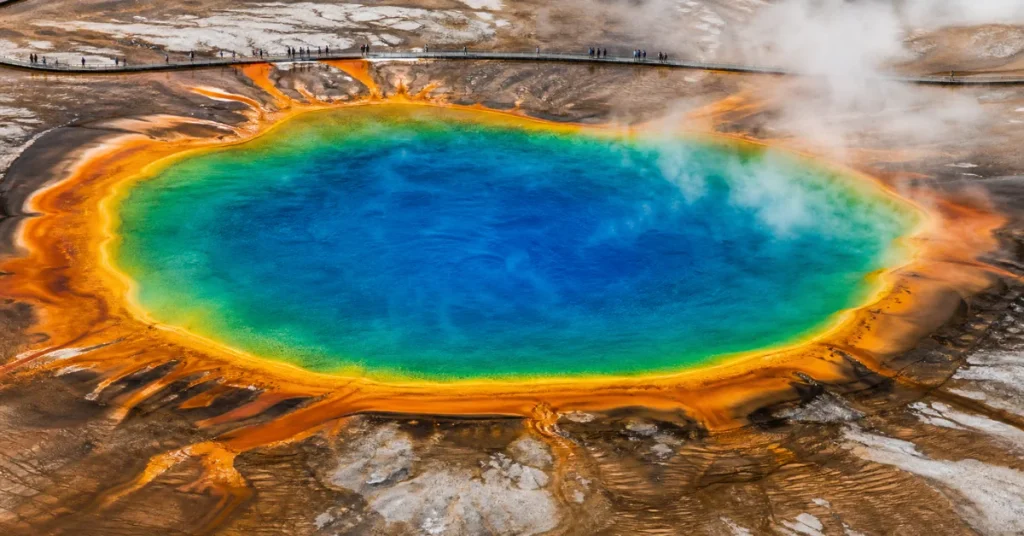
Bison herds wander right up to the roadside here. Wolves and grizzlies still roam the backcountry in numbers that make Yellowstone one of the last true wild ecosystems in the lower 48. The Grand Prismatic Spring, with its rainbow ring of bacteria mats, is the kind of sight that photos genuinely undersell.
Zion Canyon’s Red Rock Drama
Zion pulled in close to 4.98 million visits, putting it near the top of the busiest parks in the country. The Narrows, where hikers wade through the Virgin River between thousand-foot sandstone walls, is unlike anything else in the national park system.
Anyone who has hiked Angels Landing knows the chain-assisted final stretch isn’t for the faint of heart, but the payoff view over Zion Canyon makes the nerves worth it. The Emerald Pools trail offers a gentler version of that same red-rock magic for families and casual hikers.
Yosemite Valley’s Waterfalls and Granite Walls
Yosemite is having a genuine moment. Visitation climbed roughly 10% in the first half of 2026 compared to the same stretch the year before, driven partly by easier park access and renewed global interest in the valley.
El Capitan looms over the valley floor like a granite wall built for climbers who train their whole lives for one route. Half Dome’s silhouette is instantly recognizable, even to people who’ve never set foot in California. Spring brings the waterfalls to their fullest roar, while fall trades that drama for quiet trails and turning leaves.
Grand Canyon’s Layered Immensity
The Grand Canyon logged around 4.43 million visitors, and no amount of research prepares a first-time visitor for how the canyon actually feels from the rim. Two billion years of exposed rock layers stretch across a gap so wide that the far side blurs into haze on hot afternoons.
Sunrise and sunset here aren’t just pretty moments. They’re when the canyon walls shift through entire palettes of orange, pink, and violet within minutes. The South Rim stays open year-round, while the North Rim’s shorter season rewards travelers willing to plan around it.
Great Smoky Mountains’ Misty Ridges
The Smokies remain the busiest national park in the country by a wide margin, logging more than 11.5 million visits and recording growth of over 6% in early 2026 compared to the prior year. That’s more traffic than Yellowstone, Zion, and Yosemite combined.
The park’s name comes from the natural fog that settles over its ridgelines, especially at dawn. Old-growth forest, wildflower blooms in spring, and one of the densest black bear populations in the eastern US all add up to a park that earns its popularity honestly. Its location within a day’s drive of major Southeastern cities doesn’t hurt either.
Glacier and Rocky Mountain: The High Country
Rocky Mountain National Park has become one of 2026’s standout growth stories, pulling steady increases as travelers rediscover Colorado’s alpine tundra and elk herds. Trail Ridge Road, the highest paved through-road in any US national park, climbs above 12,000 feet and puts visitors eye-level with mountain goats.
Glacier National Park, further north in Montana, offers turquoise lakes fed by actual glacial melt and the legendary Going-to-the-Sun Road. Anyone who has driven it in a single afternoon knows it delivers more scenery per mile than almost any road in the country.
Crowd-Free Alternatives Worth Knowing
Not every stunning park makes the visitation headlines, and that’s exactly the point for travelers who want scenery without the parking-lot scramble. The National Park of American Samoa drew only about 43,258 visits in 2025, yet it offers untouched South Pacific coral reefs and volcanic ridgelines found nowhere else in the system.
Dry Tortugas National Park, reachable only by boat or seaplane roughly 70 miles off Key West, logged just 89,355 visits the same year. A 19th-century coastal fort surrounded by some of the clearest water in Florida makes it one of the quieter entries among the most beautiful national parks in the US.

Entry Fees and What They Actually Cost
Fee structures shifted at the start of 2026, and the changes matter for trip budgeting. US residents still pay $80 for the annual America the Beautiful pass, which covers entry to more than 2,000 federal recreation sites for 12 months. Non-US residents now pay $250 for the same pass, up from $80 previously.
Travelers without an annual pass face standard per-vehicle fees, often around $35 at parks like Yosemite and the Grand Canyon, plus a new $100 per-person nonresident surcharge at 11 of the most visited parks if they aren’t US citizens or residents. For anyone visiting more than two or three parks in a single trip, the annual pass pays for itself fast, regardless of residency status.
Accessibility and International Visitor Notes
Not every visitor comes for a strenuous hike. Yosemite Valley, Zion’s lower canyon, and several Grand Canyon rim viewpoints all offer paved, wheelchair-accessible trails with views that rival the harder routes. The America the Beautiful Access Pass is free for life for US citizens and residents with permanent disabilities.
International travelers should also build in extra planning time. Passport-based ID checks now apply at fee-free entrance days, and several parks, Yosemite included, have gone fully cashless at entrance stations, so a card or mobile payment method is essential before arrival.
Best Parks for Photography
Photographers chasing golden hour have their own unofficial ranking. Zion’s Narrows and the Grand Canyon’s South Rim both deliver dramatic side-lighting on canyon walls right around sunrise. Yellowstone’s geyser basins throw off steam that catches early light in a way few other landscapes can match.
A wide-angle lens covers most canyon and valley shots, while a mid-range zoom earns its keep for wildlife at Yellowstone and the Smokies. Tripods help in low light but aren’t required for casual shooting on any of these trails.
Planning Your Visit to the Most Beautiful National Parks in the US
Timing matters more than most first-time visitors expect. Summer brings full trail access but also the heaviest crowds and, at some parks, timed-entry reservation systems. Shoulder seasons, spring and fall, tend to offer a better balance of open trails and manageable traffic.
A few practical points worth knowing before booking a trip:
- Reserve lodging and campsites months ahead for Yosemite, Zion, and the Smokies during peak season.
- Check reservation requirements; several top parks now cap daily vehicle entries.
- Pack layers even in summer, since elevation swings temperatures fast in mountain parks.
- Confirm operating hours before arrival, since some parks have trimmed shoulder-season services in 2026.
What the Research Shows
Detailed analysis of recent visitation patterns points to a clear trend: interest in America’s most scenic public lands isn’t slowing down, even as overall park-wide numbers dipped slightly in 2025. Growth is concentrating in a smaller group of standout destinations, which lines up neatly with the parks people describe as the most beautiful national parks in the US.
Examining the numbers closely, the parks posting the strongest growth in 2026, Yosemite and Rocky Mountain among them, share a common thread. Each offers a signature, instantly recognizable landmark that photographs well and travels fast on social media, which appears to be reinforcing an already strong reputation.
Challenges Facing These Parks
Popularity has a cost. Overcrowded parking lots, trail erosion, and wildlife habituation to human presence are real problems at Zion, Yosemite, and the Smokies. Timed-entry systems exist specifically to slow that damage down without shutting visitors out entirely.
Wildfire risk and shifting snowmelt patterns have also changed how some parks manage access year to year. Reduced staffing and trimmed operating hours in 2026 mean it’s worth double-checking a park’s current schedule before any trip, especially outside peak summer months.
Final Thoughts
Ranking the most beautiful national parks in the US will always come down to personal taste, red rock versus granite, geysers versus glaciers. What the data makes clear is that these particular landscapes keep drawing millions of people back, year after year, for reasons that go well beyond a nice photo. Pick the one that matches the kind of beauty you’re chasing, plan around the fees and crowds, and the trip tends to take care of itself.
FAQs
What is generally considered the most beautiful national park in the US?
There’s no single official answer, but Yosemite, Zion, and Yellowstone consistently top most travel rankings for their combination of dramatic scenery and accessibility.
When is the best time to visit the most beautiful national parks in the US?
Late spring and early fall usually offer the best mix of open trails, mild weather, and lighter crowds compared to peak summer months.
Do I need reservations to visit parks like Yosemite or Zion?
Yes, several top parks now require timed-entry permits or vehicle reservations during peak season, so it’s worth checking each park’s official page before traveling.
How much does it cost to visit multiple national parks in 2026?
US residents pay $80 for an annual pass covering all fee-charging parks; non-residents now pay $250, plus a possible $100 surcharge per park without that pass.
Are these parks suitable for families with young kids or wheelchair users?
Most have easy boardwalk trails, scenic drives, and paved accessible viewpoints, alongside the more strenuous hikes serious backpackers seek out.