
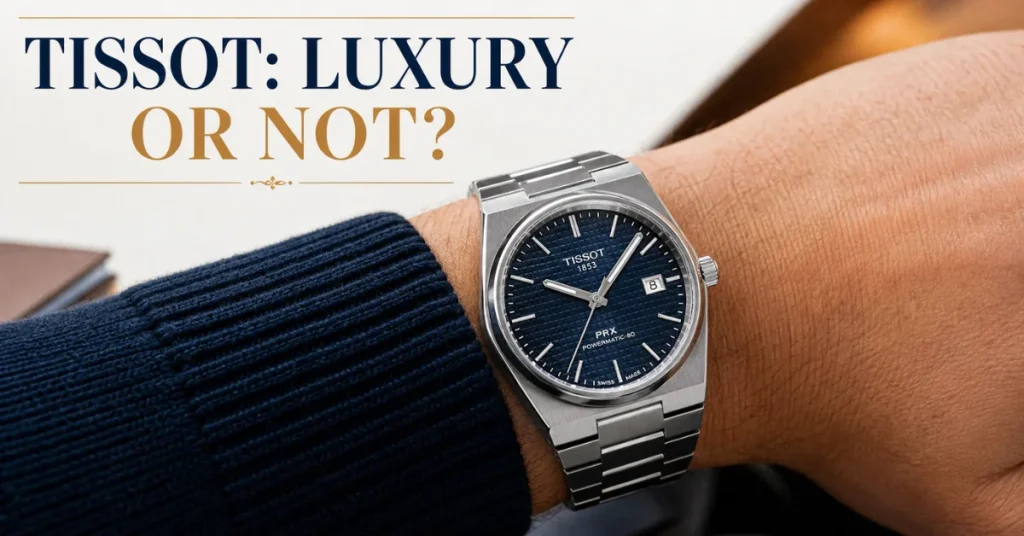
Type “is Tissot a luxury brand” into Google and you’ll get answers pulling in every direction. Some watch forums say yes without hesitation. Others insist a Swiss brand selling watches under $1,000 can’t earn that label at all. The truth sits somewhere more interesting than a flat yes or no, and it depends on what you actually mean by “luxury.”
Anyone who’s shopped for a Swiss watch knows the word gets thrown around loosely. A $50,000 Patek Philippe and a $400 Tissot both get called luxury by someone, somewhere. So let’s settle this properly, using the brand’s own history, its ownership, the actual law behind “Swiss Made,” and where it sits next to Rolex, Omega, and its own sister brands.
Is Tissot a Luxury Brand? The Short Answer
Yes, but with a catch. Tissot is a Swiss luxury brand in the technical sense: it’s made in Switzerland, uses genuine Swiss movements, and carries the heritage credentials that define the category. What it isn’t is a high-luxury or ultra-premium name in the way Rolex or Patek Philippe are.
Industry watchers typically place Tissot in a tier called “accessible luxury” or “entry-level luxury.” That’s not an insult. It’s a real segment of the Swiss watch industry, and Tissot happens to be one of its most recognized names. The brand delivers genuine Swiss craftsmanship at prices a much wider range of buyers can reach, which is exactly why it keeps showing up on best-value lists year after year.
Where Tissot Comes From, and Why That Matters
Founded in 1853 in Le Locle, a town nestled in the Swiss Jura Mountains, Tissot has been making watches for over 170 years. That’s not marketing fluff. Le Locle sits at the historic heart of Swiss watchmaking, and the brand’s early pocket watches were prized enough to reach French actress Sarah Bernhardt and Belgian royalty.
In 1983, Tissot became part of what would eventually be known as The Swatch Group, formed through the merger of two struggling Swiss watch conglomerates during the industry’s near-collapse against cheap quartz competition. That merger turned out to be one of the most consequential moments in Swiss watchmaking history, and it placed Tissot in the same family as Omega, Longines, Breguet, and Blancpain.
This is where a lot of the confusion starts. People assume shared ownership means shared pricing tier. It doesn’t. The Swatch Group runs a deliberately layered portfolio, ranging from mass-market Swatch watches all the way up to Breguet pieces that cost more than a car. Tissot sits in the middle of that ladder, a notch below Omega, several notches below the group’s true high-end names.
The Legal Side: What “Swiss Made” Actually Requires
This part rarely gets explained, and it’s the actual reason Tissot’s luxury claim holds up under scrutiny. “Swiss Made” isn’t a marketing phrase a brand can slap on a dial whenever it wants. It’s a legally protected term under Swiss law.
To carry the words “Swiss Made,” a watch must meet strict criteria set out under Swiss federal regulation:
- At least 60 percent of the manufacturing cost must be incurred inside Switzerland.
- The watch’s movement must itself be Swiss.
- The movement must be cased up inside Switzerland.
- Final inspection has to be carried out by the manufacturer on Swiss soil.
Tissot meets every one of these requirements across its current lineup. That’s a meaningfully different standard than a fashion brand slapping “Swiss inspired” on a watch assembled elsewhere. Anyone who’s compared a genuine Swiss Made piece against a look-alike from a non-Swiss brand notices the difference in finishing almost immediately, even before checking the caseback.
Is Tissot a Luxury Brand Compared to Rolex and Omega?
Here’s where the comparison gets useful. Rolex watches typically start around $6,000 to $8,000 and climb well past six figures for rare models. Omega, Tissot’s own sister brand, generally starts closer to $2,000 to $3,000. Tissot, by contrast, offers automatic Swiss-made watches starting under $600, with most of its popular collections landing between $400 and $1,200.
| Brand | Starting Price | Market Tier | Movement Type |
|---|---|---|---|
| Tissot | ~$400–$600 | Accessible / entry-level luxury | Swiss automatic & quartz |
| Omega | ~$2,000–$3,000 | Premium luxury | Swiss automatic (in-house) |
| Rolex | ~$6,000–$8,000 | High luxury | Swiss automatic (in-house) |
| Patek Philippe | $30,000+ | Ultra-luxury | Swiss automatic (haute horlogerie) |
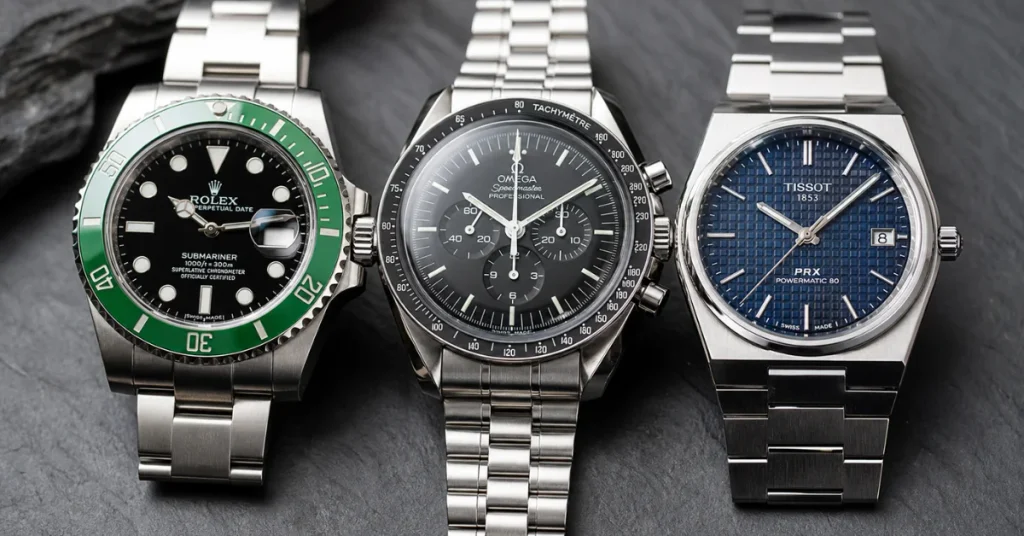
That price gap doesn’t make Tissot fake luxury. It makes it a different tier of the same industry. A Tissot PRX or Le Locle model still carries a genuine Swiss movement, a sapphire crystal, and the kind of finishing you won’t find on a mass-market fashion watch from a non-Swiss brand. What you’re not getting is the decades of waitlists, resale premiums, and cultural cachet that Rolex and Patek Philippe have built.
Think of it like the difference between a well-made tailored jacket and haute couture. Both involve real craftsmanship. Only one of them makes headlines when it sells at auction.
Tissot vs. Its Own Swatch Group Siblings
Comparing Tissot to Rolex answers one question. Comparing it to the brands it actually competes against day to day answers a more useful one. Inside The Swatch Group’s own portfolio, Tissot shares its accessible-luxury shelf with Certina, Mido, and Hamilton.
- Certina leans sportier, with a focus on durability testing and slightly lower average pricing than Tissot.
- Mido emphasizes architecture-inspired design and sits close to Tissot on price, often within a couple hundred dollars either way.
- Hamilton carries American watchmaking roots dating back to the 1800s and trades on that heritage angle, pricing itself slightly above Tissot on average.
None of these names carry the instant recognition of Omega or Rolex, and that’s precisely the point. They’re built to compete with each other, not with the group’s flagship brands. Anyone shopping this tier seriously ends up cross-shopping Tissot against exactly these three, not against Rolex.
What You Actually Get for the Price
Pick up a Tissot PRX Powermatic 80 and the first thing you notice is the weight. It doesn’t feel like a $500 watch. The integrated bracelet, the finished dial, the 80-hour power reserve — these are details normally reserved for pieces costing three or four times as much.
That value proposition is a big part of why the “is Tissot a luxury brand” question keeps coming up. People expect luxury to be gatekept by price alone, and Tissot breaks that assumption. A few things worth knowing before you buy:
- Most current Tissot models use genuine Swiss automatic or quartz movements, not outsourced generic parts.
- The T-Touch line, launched in 1999, was the first watch to bring touchscreen technology to a wristwatch, a real innovation credit rather than a marketing claim.
- Entry collections like Everytime and PR100 sit closer to $300 to $500, while heritage lines like Le Locle and the PRX Powermatic push past $700.
- Resale value is modest compared to Rolex or Omega, so buyers should think of Tissot as a wearing investment, not a flipping one.
Who Should Actually Buy One
If you’re chasing status recognition, walking into a room and having strangers clock the brand on your wrist, Tissot probably isn’t your watch. Few non-collectors will recognize the name the way they’d spot a Rolex crown or an Omega logo.
But if what you want is real Swiss engineering, a piece that’ll outlast a decade of daily wear, and a design that doesn’t scream for attention, Tissot earns its keep. Professionals buying a first proper watch, gift-givers working with a tighter budget, and anyone stepping into mechanical watches for the first time tend to land here for good reason.
What the Research Shows
Broader Swiss watch industry data helps put Tissot’s position into context. The Swatch Group, Tissot’s parent company, reported worldwide revenue of roughly 6.74 billion Swiss francs and a net income of 601 million Swiss francs in 2024, spread across its full portfolio of brands ranging from entry-level to ultra-high-end. Longines and Tissot are consistently ranked among the group’s top-selling names, sitting just behind flagship brand Omega in overall volume.
That scale matters. It means Tissot isn’t a boutique operation cutting corners to hit a price point. It’s backed by one of the largest watchmaking groups on the planet, with manufacturing infrastructure and quality control shared across brands that undeniably sit in the luxury category. Early buyers and long-time collectors both tend to describe the same pattern: consistent build quality across price points, year after year, model after model.
The Verdict
So, is Tissot a luxury brand? Based on its Swiss origin, its legal right to carry the “Swiss Made” label, genuine mechanical movements, and 170-plus years of watchmaking history, yes, it qualifies. It just occupies the accessible end of that spectrum rather than the exclusive top shelf where Rolex and Patek Philippe sit. For most buyers asking this question, that’s actually good news. It means real Swiss craftsmanship without the five-figure entry price.

FAQs
Is Tissot considered a high-end luxury brand like Rolex?
No. Tissot sits in the entry-level or accessible luxury tier. Rolex occupies a much higher price and prestige category, even though both are genuine Swiss watchmakers.
Does Tissot legally qualify as “Swiss Made”?
Yes. Tissot meets the legal criteria under Swiss federal regulation, including the requirement that at least 60 percent of manufacturing cost occur in Switzerland and that the movement be Swiss and cased domestically.
Is Tissot owned by Omega?
No. Neither brand owns the other. Both are owned by The Swatch Group, alongside brands like Longines, Breguet, and Blancpain.
How does Tissot compare to Certina, Mido, and Hamilton?
All four sit in the same accessible-luxury tier within The Swatch Group, competing on similar price points and design philosophy rather than against flagship brands like Omega or Rolex.
Is a Tissot watch a good investment?
Not for resale value specifically. Tissot watches hold up well for everyday wear and hold their function for decades, but they don’t appreciate in value the way collector-grade Rolex or Patek Philippe pieces sometimes do.