

Planning a trip that works for a six-year-old, a teenager, and two exhausted parents is its own kind of puzzle. The best family friendly vacation spots aren’t necessarily the flashiest ones — they’re the ones where nobody has to sacrifice their idea of a good time. Below are destinations that consistently deliver on that balance, along with what to actually expect once you’re there.
What Makes a Destination Genuinely Family Friendly
Not every “kid-friendly” label holds up once you arrive. A hotel with no pool, a restaurant with a two-hour wait and no high chairs, or an attraction that entertains for twenty minutes and then loses everyone’s interest — these are the details that separate a good trip from a stressful one.
Anyone who has traveled with a toddler and a teenager on the same itinerary knows the real test isn’t whether a place has “things to do.” It’s whether those things flex across ages, energy levels, and attention spans without constant renegotiation. That’s exactly the filter used to pick the family friendly vacation spots on this list.
Quick Comparison: Family Friendly Vacation Spots at a Glance
Before diving into details, here’s how these destinations stack up side by side. Use this to shortlist two or three options based on your kids’ ages and your budget.
| Destination | Best Age Group | Ideal Trip Length | Cost Level | Best Season |
|---|---|---|---|---|
| Orlando, FL | 3–16 | 4–6 days | High | Fall/Spring (avoid summer heat and crowds) |
| Yellowstone National Park | All ages | 3–5 days | Moderate | Late May–September |
| Hilton Head Island, SC | All ages | 5–7 days | Moderate | Spring/Fall |
| Washington, D.C. | 5+ | 3–4 days | Budget-friendly | Spring (cherry blossoms) or Fall |
| Costa Rica | 6+ | 7–9 days | Moderate–High | December–April (dry season) |
| Banff, Alberta | 5+ | 5–7 days | High | June–September (summer) or Dec–March (ski) |
| Maui, Hawaii | All ages | 6–8 days | High | April–May or Sept–Oct (fewer crowds, better rates) |
1. Orlando, Florida — For All-In-One Entertainment
Orlando remains one of the most reliable family friendly vacation spots in the country, largely because it removes decision fatigue. Walt Disney World and Universal Studios sit minutes apart, and both are built around single-ticket days where food, rides, and character interactions happen without leaving the park.
Universal’s Wizarding World and Despicable Me attractions pull in older kids and teens who’ve outgrown princess meet-and-greets, while Disney’s Magic Kingdom still anchors the trip for younger children. Families short on time can pick one park and go deep instead of park-hopping, which tends to reduce the meltdown risk that comes with overscheduling.
Both major parks offer stroller rentals on-site, so families flying in don’t need to check a stroller as luggage — a small detail that saves real hassle at the airport.
Best for: Kids aged 3 to 16, first-time theme park travelers, and multi-generational groups who want everything walkable or shuttle-accessible.
2. Yellowstone National Park — For Screen-Free Adventure
Yellowstone spans parts of Wyoming, Montana, and Idaho and offers more than 900 miles of trails, geysers, and wildlife-viewing routes that genuinely hold a child’s attention without a single screen involved. Watching Old Faithful erupt or spotting a bison herd from the car window tends to land better with kids than most curated attractions ever could.
Families who have done national park trips before know the trick is picking routes that match your group’s stamina — boardwalk paths near the geyser basins work for strollers and tired legs, while backcountry trails suit older kids who want a real hike. The National Park Service publishes updated trail conditions and ranger program schedules, which is worth checking before you go since seasonal closures are common.
One planning detail that trips up a lot of families: Yellowstone itself doesn’t require a timed-entry reservation, but several nearby parks families often combine it with, like Glacier, now require advance entry permits during peak summer months. Checking each park’s entry rules separately avoids an unpleasant surprise at the gate.
Best for: Families who want outdoor time over indoor entertainment, and groups spanning toddlers through teens who can handle a full day outside.
3. Hilton Head Island, South Carolina — For Low-Effort Beach Time
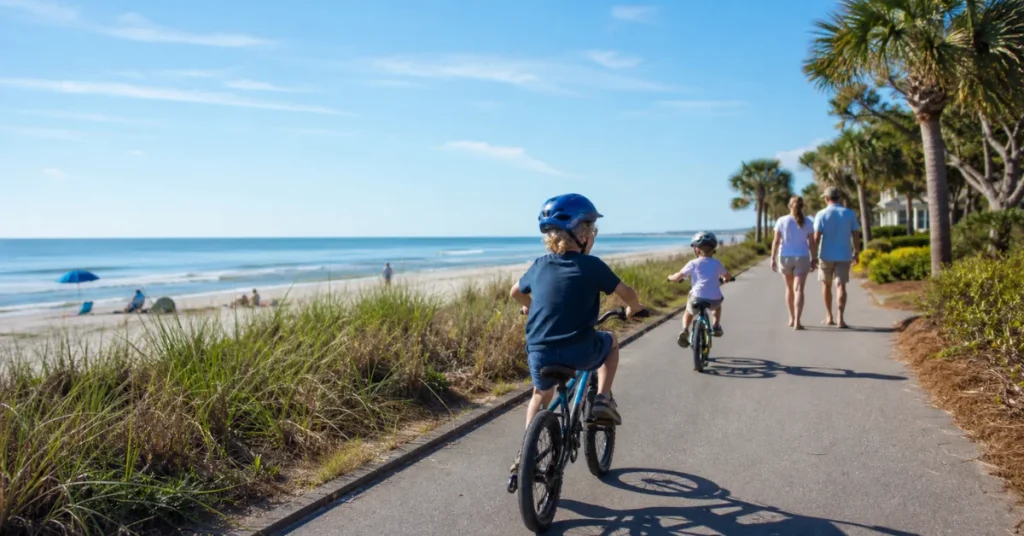
Beach vacations solve a specific family problem: they remove the need to plan every hour. Hilton Head’s calm Atlantic coastline, extensive bike paths, and family-sized rental homes make it one of the easier beach destinations to manage with young kids in tow.
Unlike some coastal towns built around nightlife, Hilton Head leans into quieter, structured fun — dolphin-watching tours, mini golf, and bike rides through Sea Pines Forest Preserve. Parents get relaxation; kids get sand, water, and enough activity options to avoid boredom by day three.
Many restaurants around the island run kids-eat-free promotions on weeknights, which is worth asking about at check-in since they’re not always advertised online.
Best for: Families with a wide age range who want a slower-paced trip with built-in flexibility.
4. Washington, D.C. — For Culture Without the Cost
Washington, D.C. is one of the few major cities where a family can fill an entire week without paying for admission. The Smithsonian museums, the National Zoo, and most monuments are free to enter, which matters for families managing a real budget rather than an unlimited one.
Older kids studying American history get to see it in person; younger ones tend to gravitate toward the Air and Space Museum or the zoo’s panda exhibit. Anyone who has managed a city trip with kids knows the real logistics challenge is distance between sights, and D.C.’s Metro system and compact National Mall layout make that easier than most capital cities.
D.C. is also one of the more accessible destinations on this list — most museums and monuments have step-free entrances and elevator access, which matters for families traveling with a mobility-limited grandparent or a child who uses a wheelchair.
Best for: School-age kids and teens, and budget-conscious families who still want a culturally rich trip.
5. Costa Rica — For Nature-Focused Adventure Travel
Costa Rica has built its tourism industry around family-accessible adventure — zip-lining canopy tours, volcano hikes near Arenal, and wildlife lodges where sloths and toucans are a near-daily sighting rather than a rare treat. It suits families who want their vacation to feel different from home without requiring a long-haul flight to somewhere entirely unfamiliar.
Roughly a five-hour flight from most U.S. East Coast cities, Costa Rica works well as a bridge between an easy domestic trip and a full international adventure. Many eco-lodges are specifically designed around family stays, with guided nature walks scaled to different age groups.
Since this is an international trip, every child needs their own valid passport, no exceptions for age. If only one parent is traveling with the kids, it’s worth carrying a notarized consent letter from the other parent — some countries request one at the border, and having it avoids delays even when it isn’t checked.
Best for: Families with kids aged 6 and up who are comfortable with more physical activity, and parents wanting an international trip without extreme jet lag.
6. Banff, Alberta — For Mountain Scenery Without the Extreme Terrain
Banff National Park pairs dramatic Canadian Rockies scenery with a genuinely walkable town center, which matters when you’re managing kids who need bathroom breaks and snack stops. Lake Louise and Moraine Lake offer short, stroller-friendly paths alongside longer trails for families who want a real hike.
Summer brings canoeing and gondola rides; winter turns the same landscape into a beginner-friendly ski destination. Families who split their trip between the town and the surrounding trails tend to get the best of both — structured comfort and genuine wilderness.
Like Costa Rica, this is a cross-border trip, so passports are required for every family member. Trail accessibility varies a lot here — the main lakeside paths are stroller and wheelchair friendly, but most trails beyond the first half-mile are not, so it’s worth checking a trail’s specific grading before committing to it with young kids or limited-mobility travelers.
Best for: Families who want mountain adventure without needing advanced hiking or ski experience.
7. Maui, Hawaii — For a Beach Trip With Built-In Culture
Maui distinguishes itself from other beach destinations by pairing calm, swimmable water with cultural experiences that go beyond a resort pool. A traditional luau, snorkeling trips to see sea turtles, and the Road to Hana scenic drive give families things to do beyond sunbathing, which matters once the novelty of the beach itself wears off around day four.
The island’s resort infrastructure is built heavily around families, with many properties offering supervised kids’ clubs that let parents get a few hours to themselves without guilt.
Timing this trip matters more than most people expect. Visiting a week or two outside peak spring break or Christmas dates can mean noticeably lower resort rates and thinner crowds at snorkeling spots, without any real difference in weather.
Best for: Families wanting a warm-weather trip with more cultural texture than a typical beach resort.
What the Research Shows
Industry surveys tracking post-pandemic travel behavior have consistently found that families are prioritizing trips with flexible itineraries over tightly packed schedules, a shift that shows up clearly in how destinations like national parks and beach towns have grown in family bookings relative to more rigid, single-attraction trips. Travel researchers have also noted that families increasingly favor destinations offering both structured activities and unscheduled downtime, since over-programmed trips tend to produce more fatigue-driven conflict among kids than under-programmed ones.
That pattern tracks with what shows up across every spot on this list: the ones that work best aren’t the busiest ones. They’re the ones that let a family choose their own pace.
How to Choose the Right Family Friendly Vacation Spots for Your Kids’ Ages
A few practical rules of thumb tend to hold up across most family trips:
- Toddlers (1–4): Prioritize shorter travel days, on-site childcare or kids’ clubs, and destinations with minimal walking between activities.
- Elementary age (5–10): Theme parks, national parks, and beach destinations tend to hold attention best.
- Tweens and teens (11–17): Cities, adventure travel, and international trips generally land better than resort-only itineraries.
- Multi-generational groups: Look for destinations with a mix of low-impact and active options, so grandparents and teenagers can each find their pace.
Conclusion
There’s no single best answer when it comes to family friendly vacation spots — the right one depends on your kids’ ages, your budget, and how much structure your family actually wants on a trip. What separates a genuinely good destination from an overhyped one is flexibility: places that offer both built-in entertainment and room to slow down tend to outperform anywhere over-scheduled. Whether that means a theme park week in Orlando, a hiking trip through Yellowstone, or a slower beach stretch on Hilton Head, the goal stays the same — a trip where every family member, not just the kids, actually gets a break.

FAQs
What is the most budget-friendly family vacation spot in the U.S.?
Washington, D.C. is one of the more affordable options since most major attractions, including the Smithsonian museums and the National Zoo, don’t charge admission.
Are national parks good for young children?
Yes, though it’s worth sticking to boardwalk and paved trails for toddlers and younger kids, since many backcountry routes involve steep or uneven terrain better suited to older children.
How far in advance should families book a summer trip?
Popular destinations like Orlando and national park lodges tend to book up months ahead for peak summer dates, so booking by early spring generally secures better availability and pricing.
Is Costa Rica safe for families with young kids?
Costa Rica is a well-established family travel destination with infrastructure built around eco-tourism, though as with any international trip, checking current government travel advisories before booking is a reasonable precaution.
What’s a good destination for families with both toddlers and teenagers?
Beach destinations like Hilton Head or Maui tend to work well for wide age ranges since toddlers can stay close to shore while teens can access water sports, snorkeling, or nearby hiking.