
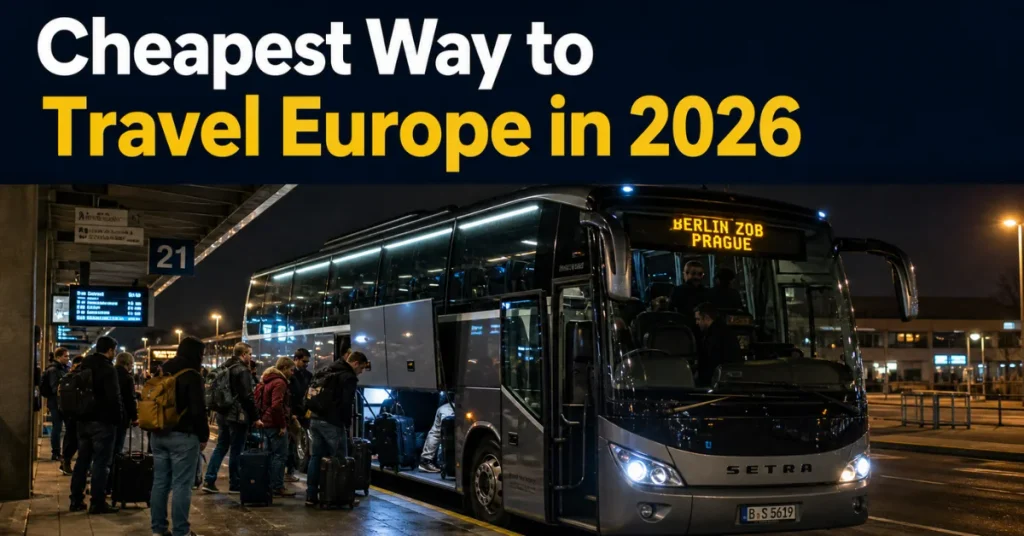
So what’s the cheapest way to travel across Europe right now? Coaches win on sticker price, and nothing else gets close. But that answer falls apart the second you count the rest of the trip. A €9 bus that eats fourteen hours and forces a hostel night isn’t cheap. It’s just cheap-looking.
Two things also changed this year that most budget guides haven’t caught up with: new biometric border checks, and the end of paper boarding passes at Europe’s largest airline. Both cost money. Here’s where the 2026 numbers actually sit.
The Short Answer, Then the Small Print
Intercity coaches sit at the bottom of the price ladder. Fares on the largest pan-European operator start as low as €5, with Wi-Fi, power sockets and one bag stored underneath included. Carpooling runs close behind. Shared-ride seats typically cost 30 to 50 percent less than the same coach route, with Berlin to Prague around €8 and Paris to Lyon around €12.
Now the small print. Those floor prices exist on booked-early, mid-week, unpopular departures. Nobody crosses a continent paying €5 every leg.
Anyone who’s actually done a month on the road knows the real cost splits three ways: the ticket, the bed, and the hours you burn. Cut one and the other two usually grow.
| Distance | Best value mode | Typical 2026 fare | When it stops being cheap |
|---|---|---|---|
| Under 300 km | Coach or carpool | €5 to €15 | Peak Friday and Sunday departures |
| 300 to 700 km | Regional rail or coach | €12 to €35 | Booking inside seven days |
| 700 to 900 km | Night train | €20 to €65 per berth | Solo cabin instead of a six-berth |
| Over 900 km | Budget flight | €15 to €60 | Checked bag plus airport transfer |
That table is the whole article in miniature. Everything below is the reasoning behind it.
The Cheapest Way to Travel Across Europe by Bus
Coaches stay unbeaten on short and medium hops, especially across the Balkans and central Europe where rail coverage thins out. Vienna to Budapest, Prague to Kraków, Zagreb to Belgrade: single-digit or low-teen euro fares when booked a fortnight ahead.
What makes buses the cheapest way to travel across Europe isn’t only the fare. It’s the pricing curve. Coach tickets climb gently as seats sell, while rail fares can triple in the final two weeks.
The costs people forget:
- Terminals are often peripheral, so add a metro fare at both ends
- A second checked bag usually costs extra at booking
- Night coaches save a hostel bed but wreck the next day
- Non-Schengen border stops add unpredictable time
One habit saves real money. Book the outbound leg the moment your dates firm up, then leave returns open. Coach networks nearly always have a same-week seat somewhere.
Rail Passes: When the Maths Works, and When It Doesn’t
Rail passes carry a reputation for being romantic and pricey. Half right. A second-class adult Global Pass in 2026 starts near €283 for four travel days inside a month, while travellers aged 27 and under pay 25 percent less and over-60s pay 10 percent less. Children aged four to eleven ride free alongside a paying adult.
One pass covers 33 European countries, which is where the value hides. Passes reward people who move often, cross borders, and refuse to lock dates in months ahead.
They punish everyone else. For two or three planned journeys booked early, point-to-point advance fares almost always win.
| Traveller | 4-day Global Pass, 2nd class | Roughly breaks even at |
|---|---|---|
| Youth, 12 to 27 | about €212 | Three cross-border legs |
| Adult, 28 to 59 | about €283 | Four cross-border legs |
| Senior, 60+ | about €255 | Three long legs |
| Child, 4 to 11 | Free with an adult | Immediately |
The Reservation Fee Nobody Budgets For
Here’s the trap. A pass isn’t a free-boarding card on fast trains. France, Italy and Spain charge between €3 and €23.50 per leg on top of a pass, while ordinary daytime trains in Germany, Austria and Switzerland carry no compulsory reservation at all.
Route yourself through the reservation-free countries and a pass looks brilliant. Route through French and Spanish high-speed lines and it quietly bleeds €20 a day.
The Home-Country Rule Most Guides Skip
With both pass types you can use your own country of residence for only one outbound and one inbound journey. So a pass won’t cover repeated domestic hops at home. If most of your travel sits inside one country, a domestic operator pass or advance tickets works out cheaper.
What Each Railway Actually Starts At
Floor fares exist, but only for early, fixed, non-refundable bookings. Published 2026 starting prices include €12.99 in Germany, €10 or €16 on France’s low-cost high-speed service, €19.90 in Italy and £52 on Eurostar. Miss the window and those numbers roughly quadruple.
Budget Flights and the True Cost of a €15 Fare
Low-cost carriers reshaped European travel long before rail passes got fashionable again. One carrier alone flew 182 million passengers in 2023, ahead of its nearest legacy rival at 123 million. That volume keeps headline fares brutally low on long diagonals: Lisbon to Warsaw, Dublin to Athens, Palermo to Riga.
Flying only stays cheap under strict conditions. Cabin bag only. No seat selection. Weekday departure. Airport reachable by public transport rather than a €35 shuttle.
Break any one of those and a €15 fare lands near €70. Plus three hours of dead time.
The rule most seasoned travellers settle on: fly anything over roughly 900 km, take ground transport below it. Bergamo is not Milan, and Beauvais is certainly not Paris.
Your Phone Is Now Your Boarding Pass
This one catches people out constantly. From 12 November 2025, Europe’s biggest budget airline permanently scrapped paper boarding passes across all routes, and every passenger must now check in online and pull the pass from the mobile app.
A dead battery at security now means a missed flight and a full-price replacement. So carry a power bank, download the pass while you still have Wi-Fi, and screenshot nothing: only the live app version scans reliably.
Check-in timings differ by airline too. Some open 60 days out, others 24 or 48 hours. Miss the online window and the airport desk fee alone can cost more than the seat.
Border Queues Now Cost More Than Tickets
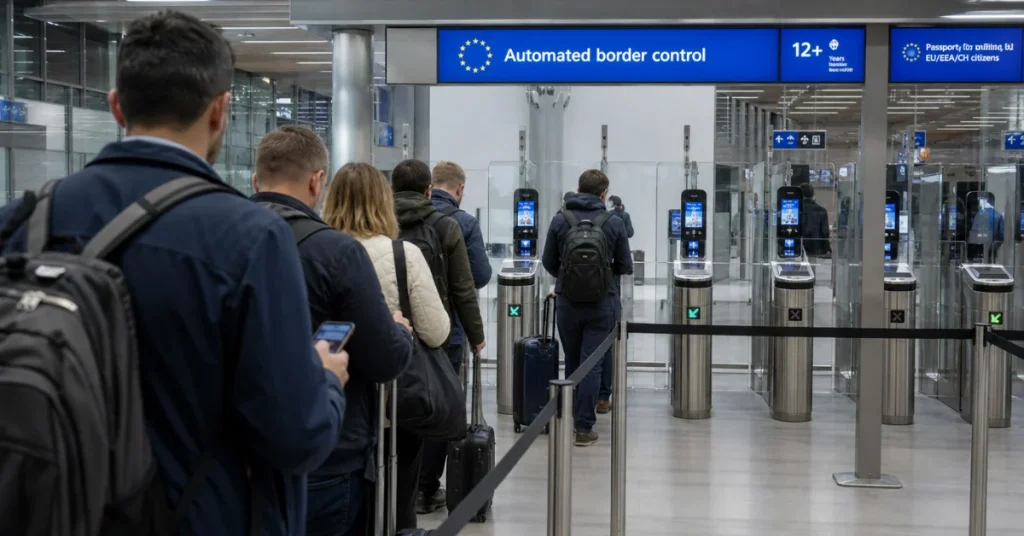
Nobody prices this in, and they should. The EU’s Entry/Exit System went live in phases from October 2025 and was declared fully operational across the Schengen area on 10 April 2026, replacing passport stamps for most non-EU nationals with automated biometric registration at external borders. Since launch, airports and airlines have warned of queues up to three hours at peak times, with some delays approaching five hours at busy southern European hubs.
Three hours at a border wipes out the saving on a €15 flight. Same logic applies to coaches crossing into and out of non-Schengen territory.
One correction worth making, because plenty of sites get it wrong. ETIAS is an online pre-travel authorization for visa-exempt nationals, costing around €7 for most adults and valid for three years or until passport expiry. It was planned for 2025, then late 2026, but border rollout delays pushed it back again. Check official government pages before paying any third-party site.
What the Research Shows About Europe’s Cheap Travel Economy
Budget transport stopped being a backpacker niche years ago. Low-cost carriers were already flying more than 30 percent of all flights in Europe by 2018, after gaining almost 20 percentage points of market share over the previous decade.
Two patterns show up consistently across real 2026 fares.
First, lead time beats mode. A coach booked late can cost more than a train booked early on the identical route.
Second, geography beats everything. Realistic daily budgets in 2026 run €30 to €50 across eastern Europe, €50 to €80 in the south, and €80 to €120 or more in the west.
Why the Cheapest Way to Travel Across Europe Changes by Region
Ask a traveller in Sofia and one in Zurich the same question, and you’ll get opposite answers. Both are right.
In the east and southeast, coaches dominate because rail runs slow and patchy. In Germany, Austria and Switzerland, regional trains plus a monthly pass beat almost everything. Around Iberia and Italy, advance high-speed fares undercut coaches and passes on the big city pairs. Across the Nordics, night trains beat short flights once airport transfers get counted.
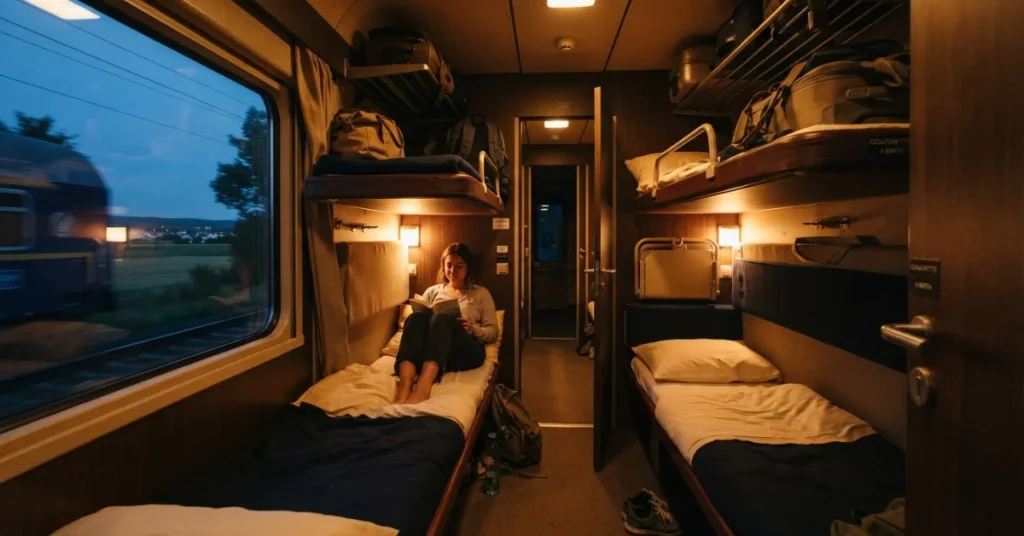
Night trains deserve their own mention. A six-berth couchette runs from €19.90 to €64.90 on the main Austrian sleeper operator, €41 on Italy’s Intercity Notte and €22 on Sweden’s SJ. You board tired, wake up somewhere new, and skip a hotel bill.
Germany’s nationwide regional pass sits at €63 per month from 1 January 2026, covering local and regional services countrywide but not high-speed trains. Buy it for one month, cancel, crawl across the country for the price of two restaurant meals.
That’s why the cheapest way to travel across Europe isn’t one mode. It’s knowing which mode owns which region, then switching without loyalty.
Non-Schengen legs work differently again. The UK, the western Balkans and Turkey sit outside the free-movement zone, so every crossing means a full check. Coaches handle these routes best, and budget flights into them often price oddly because competition is thinner.
Who Each Option Actually Suits
Not every traveller should copy the same playbook.
Students and under-27s. Youth pass pricing plus coaches for awkward legs usually wins outright.
Families. Free child rail travel flips the maths. Two adults plus two kids on a pass often beat four coach tickets.
Over-60s. Senior pass pricing plus off-peak regional fares beats budget flights, which charge hardest for comfort extras.
Non-European residents. Pass eligibility depends on where you live, and you’ll show ID when buying and on board. Buy the right version before flying in.
Travellers with reduced mobility. Station accessibility varies widely. Book assistance ahead, since small regional stops often have no staff at all.
Phone-only bookers. Passes, reservations and boarding passes now live in apps. Log in before you lose signal at a border.
The Verdict for 2026
Strip away the marketing and the cheapest way to travel across Europe in 2026 comes down to one discipline: match the mode to the distance, book early, and stop treating any single method as the answer. Coaches for short hops. Regional rail where passes are strong. Night trains to kill hotel bills. Flights only for long diagonals, with the border queue priced in.
My own take after comparing this year’s fares closely? Most people overpay not by choosing wrong, but by choosing late.
FAQs
Is a rail pass cheaper than buying tickets separately?
Only if you travel on three or more days and cross borders. For a few fixed journeys booked weeks ahead, separate advance tickets usually cost less once reservation fees get added.
Do the new EU border checks affect budget travel?
Yes. Biometric registration has caused queues of up to three hours at peak times, which can erase the saving on a cheap flight or coach.
Can I still print a boarding pass for budget flights?
Not with Europe’s largest budget carrier. Paper passes ended in November 2025, so the app version is the only one that scans at the gate.
How far ahead should I book for the lowest fares?
Two to eight weeks covers most routes. Rail prices climb in fixed tiers as cheap allocations sell out.
Which part of Europe is cheapest to travel across in 2026?
Eastern and southeastern Europe, where daily budgets sit well below western averages and coach networks run dense and frequent.