
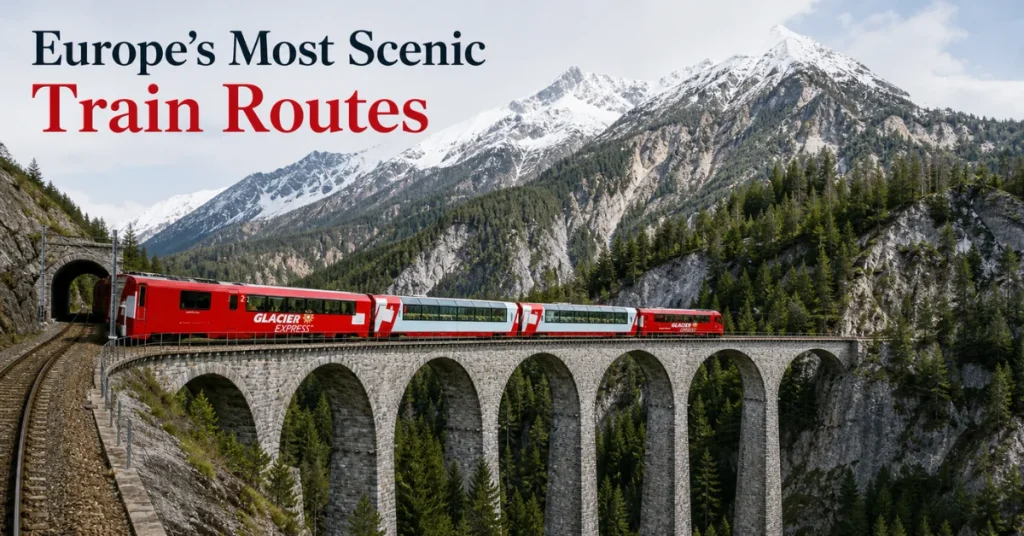
A red train inches along a viaduct with nothing but sky and rock on either side, and the whole carriage goes quiet for a second. That’s the pull behind the most scenic train routes in Europe: a window seat that does more work than any guidebook. From Alpine passes in Switzerland to fjord country in Norway, these lines turn the trip itself into the reason for going.
This isn’t a rehash of the same ten trains every travel site recycles. It’s a closer look at what actually makes a route worth the ticket price, who each ride suits, and the planning details (seasons, passes, seat sides) that most lists skip entirely.
What Makes These the Most Scenic Train Routes in Europe
Not every pretty ride earns a spot on this list. A genuinely great scenic route needs three things: consistent views for most of the journey, comfortable panoramic seating, and a landscape that actually changes as you go.
A commuter line with one nice river crossing doesn’t count. Neither does a route where the good part lasts ten minutes and the rest is warehouses.
The routes covered here were picked using a mix of engineering pedigree (tunnels, viaducts, elevation gain), UNESCO recognition where it applies, and honest traveler feedback gathered across booking platforms and rail forums. Two of the routes below carry UNESCO World Heritage status for their track and bridge work alone. That’s a rare bar to clear.
Here’s the thing: scenery is subjective, but engineering and elevation aren’t. Numbers ground the list, and the numbers on these routes are genuinely wild.
The Alpine Classics: Glacier Express and Bernina Express
Switzerland owns this category, and it isn’t close. The Glacier Express connects Zermatt to St. Moritz across roughly 291 kilometers, crossing 291 bridges and passing through 91 tunnels over about eight hours. It climbs to the Oberalp Pass at 2,033 meters before dropping back down through open valley farmland.
Standing at the window as the train crosses the Landwasser Viaduct, you get why people call this the world’s slowest express. Speed was never the point. Seats run from roughly CHF 52 with a rail pass discount, and panoramic carriages with oversized windows come standard, not as an upgrade.
Its sister route, the Bernina Express, runs from Chur or St. Moritz to Tirano in Italy, about 144 kilometers in four hours. This line, along with the Glacier Express’s shared Albula-Bernina track, holds UNESCO World Heritage status for its bridge and tunnel engineering. The Brusio Spiral Viaduct, where the train loops back over itself to manage the grade, is worth the trip on its own. A quick stop at Alp Grüm, sitting at 2,091 meters, gives passengers a few minutes to photograph the teal water of Lago Palü against the glacier behind it.
Norway’s Flåm Railway and the Fjord Country
If Switzerland does mountains, Norway does the meeting point between mountains and water. The Flåm Railway runs just 20 kilometers between Myrdal station and the fjordside village of Flåm, but it drops roughly 860 meters along the way, making it one of the steepest standard-gauge railways anywhere, at a gradient close to one in 18.
Built between 1923 and 1940, largely by hand, the line cuts through 20 tunnels and stops at the Kjosfossen waterfall for photos before continuing down. Sognefjorden, the fjord this route feeds into, is one of the longest and deepest in Europe, and the shift from bare mountain rock to green valley farmland happens in a single hour.
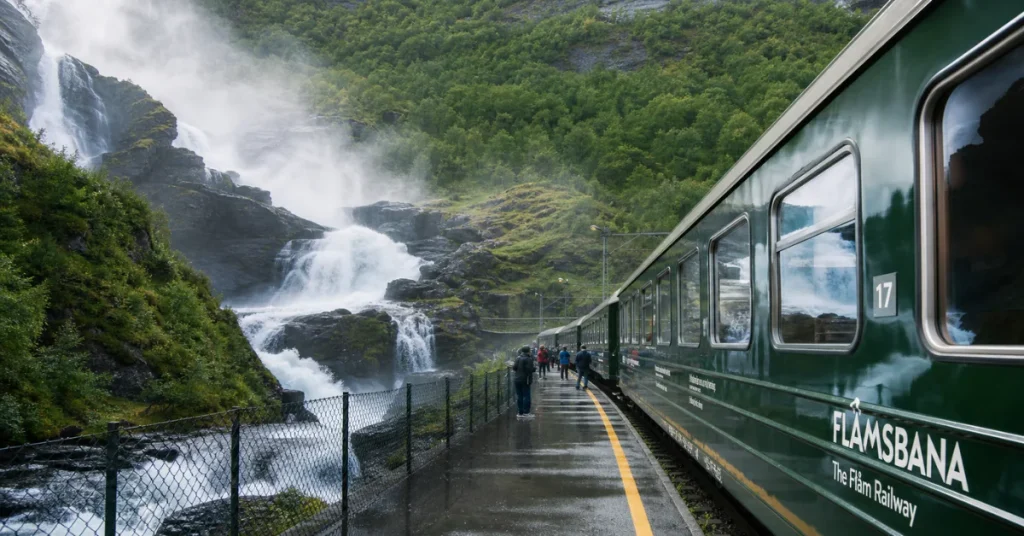
It’s now one of Norway’s most visited attractions, and locals will tell you the ride feels different depending on the season. Spring brings the waterfall to full volume, while winter strips the valley down to something quieter and starker.
Coastal Lines and Island-Hopping by Rail: Cinque Terre and the Scottish Highlands
Not every great ride runs through mountains. Italy’s Cinque Terre Express hugs the Ligurian coast, linking the five UNESCO-listed cliffside villages in short, cheap hops. Some legs take barely ten minutes, and the coastline does all the talking.
Scotland offers something different again. The West Highland Line, running through the Highlands toward Mallaig, crosses the Glenfinnan Viaduct and skirts lochs and moorland that shift color with the weather every ten minutes. Anyone who has ridden it in October, with mist sitting low over the hills, knows it doesn’t need Hollywood cameos to earn its reputation.
England’s Settle-Carlisle line deserves a mention here too. It includes the “long drag,” a 25.7-kilometer climb from Settle to Aisgill summit, the route’s highest point. Recent figures put annual ridership on this line at close to a million passengers, with the route marking 150 years of service in 2026.
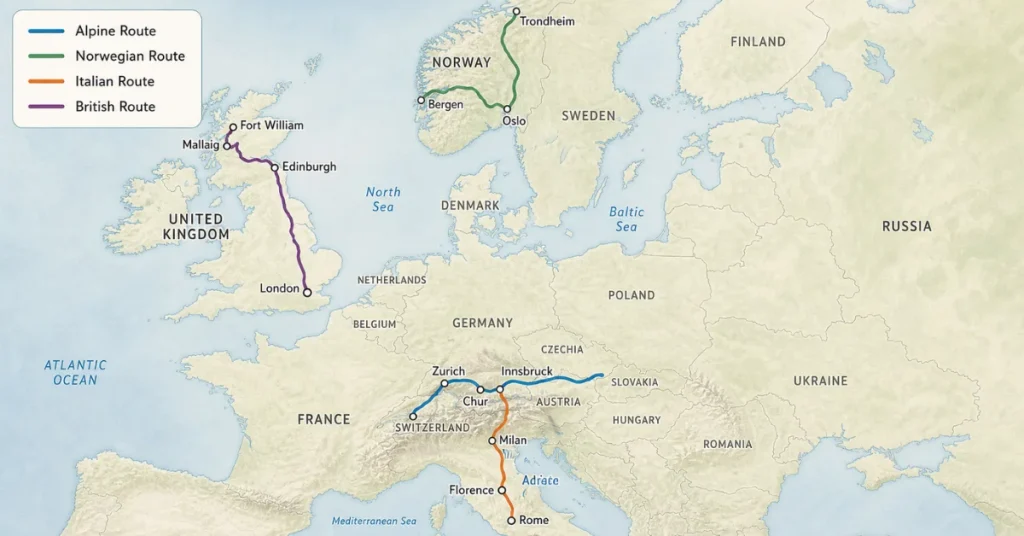
Ranking the Most Scenic Train Routes in Europe by Region
Grouping by region makes planning easier than a flat top-ten list. Here’s a practical breakdown:
- Alps (Switzerland/Austria): Glacier Express, Bernina Express, Semmering Railway
- Fjord Norway: Flåm Railway, Bergen Line
- Coastal Italy: Cinque Terre Express
- British Isles: West Highland Line, Settle-Carlisle Railway
- Rhine and Western Germany: Rhine Valley line, the reopened Eifel scenic line between Trier and Cologne
Ranking the most scenic train routes in Europe this way also helps travelers build a realistic itinerary instead of chasing disconnected routes across the continent in one trip. Pairing the Glacier Express with the Bernina Express, for instance, works because they share a station and a rail network. Mixing Norway and Scotland into the same week doesn’t.
A side-by-side view makes the planning easier still. Here’s how the main routes stack up on the numbers that actually affect a booking decision:
| Route | Distance | Duration | Price from | Best season | Runs in winter? |
|---|---|---|---|---|---|
| Glacier Express | ~291 km | ~8 hours | CHF 52 | May–Sept | Yes, year-round |
| Bernina Express | ~144 km | ~4 hours | Similar tier to Glacier Express | June–Sept | Yes, with heating cars |
| Flåm Railway | 20 km | ~1 hour | Around NOK 245–315 | May–Sept for waterfall volume | Yes, reduced schedule |
| Cinque Terre Express | Short hops, ~1 hour total | 10–40 min per leg | Regional rail fare, low cost | April–June, Sept–Oct | Yes, full schedule |
| West Highland Line | Full route ~264 km | ~5 hours | Standard UK rail fare | May–Oct | Yes, full schedule |
| Settle-Carlisle Railway | ~116 km | ~2 hours | Standard UK rail fare | April–Oct | Yes, full schedule |
Two things jump out here. First, only the Glacier Express and Bernina Express need serious advance planning for panoramic seating; the rest run on standard regional bookings. Second, winter riders shouldn’t assume a route is closed just because it’s mountainous. Most of these keep running all year, just with lighter timetables and shorter daylight for photos.
What the Research Shows About Scenic Rail Travel
Early demand data backs up what these routes already suggest anecdotally. A 2025 industry survey covering more than 11,000 travelers across the US, UK, EU, and several major cities found that 62% would give up a short-haul flight for train travel, given a decent alternative on the same route.
That preference lines up with what rail operators are seeing on the ground. Passenger counts on heritage lines like the Settle-Carlisle route are climbing toward record territory, and several new long-distance scenic connections, including a high-speed link between Prague and Copenhagen launching in 2026, are being built with the view, not just the timetable, in mind.
Detailed analysis of booking patterns across 2025 and into 2026 shows a clear shift: shorter, view-heavy regional lines are gaining ground faster than long-haul international routes, largely because they fit into weekend trips rather than requiring a dedicated multi-country itinerary.
How Much Greener Is the Train, Really?
Most travel roundups mention sustainability in passing and leave it there. The actual gap between modes is bigger than a vague nod suggests.
Independent research comparing per-passenger emissions puts national rail at roughly 35 grams of CO2 per passenger-kilometer, against roughly 246 grams for a domestic flight covering the same distance. That’s not a marginal difference. It’s the train producing around a seventh of the footprint for the same trip.
Electrified Alpine and Scandinavian lines, including the Glacier Express and Flåm Railway, run on grids with a heavy share of hydro and nuclear power, which pushes their real-world footprint even lower than the general rail average. A Zermatt-to-St. Moritz trip by train, in other words, isn’t just a better view than the equivalent short flight. It’s a measurably lighter one too.
Booking Tips, Passes and the Best Time to Ride
A few practical points that rarely make it into glossy travel roundups:
Seat side matters more than people expect. On the Glacier Express, the right-hand side going from Zermatt generally faces the better valley views; on the Flåm Railway, the left side going down from Myrdal lines up with the waterfall stop. Ask when booking, since most ticket desks know the answer immediately.
Multi-country trips usually make more financial sense with a rail pass than with individual tickets, especially if three or more scenic routes are planned. Peak summer months (June through September) bring the best weather but also the biggest crowds; late spring and early autumn offer a fair trade-off between clear skies and breathing room.
Booking four to six weeks ahead is enough for most routes in shoulder season, but summer travel on the Glacier Express and Bernina Express often sells out panoramic-car seats two months out.
Who These Routes Are Really For
These trains attract a wider mix of riders than the postcard photos suggest. Photographers chase the golden-hour light through the Alps. Families use routes like the Flåm Railway as a low-effort way to show kids real mountains without a hike. Retirees and travelers with mobility limits get a way to see remote terrain that would otherwise need serious physical effort.
Budget travelers can still make this work. The Cinque Terre Express costs a fraction of an Alpine panoramic ticket, and regional trains through the Rhine Valley or western Germany deliver strong scenery without reservation fees at all.
Non-hikers and city-based travelers benefit the most, honestly. A three-hour train window seat delivers views that would otherwise take a full day of driving and parking to reach on foot.
Travelers with mobility needs are often left out of scenic-train writeups entirely, which isn’t fair given how well-suited these routes actually are. The Glacier Express and Bernina Express both run wheelchair-accessible carriages with step-free boarding at major stations, and staff can arrange ramp assistance with advance notice. The Flåm Railway’s platforms at Myrdal and Flåm are level enough for wheelchair users to board without help in most cases. It’s worth calling the operator directly before booking, since accessible-carriage availability can be limited to specific departure times.
Challenges Worth Planning Around
None of this is entirely frictionless. Weather can shut down mountain passes with almost no warning, particularly in early spring or late autumn, and rail operators don’t always issue refunds for missed scenery on a cloudy day.
Popular panoramic cars sell out, and standard second-class seating on the same route won’t offer the same window size or unobstructed view. Language barriers are rarely a serious issue on major lines, but smaller regional connections in eastern Europe can still run without English announcements.
Cost adds up fast across multiple countries too. A single Glacier Express ticket is reasonable; three or four scenic routes across three countries in ten days is a real budget line item, not a rounding error.
Where Scenic Rail Travel Is Headed in 2026 and Beyond
New track is opening at a pace this category hasn’t seen in years. A high-speed route between Prague and Copenhagen via Berlin, Dresden, and Hamburg is set to begin service in 2026, and a previously flood-damaged scenic line between Trier and Cologne in Germany has reopened after repair work. Belgrade to Subotica is expected to extend toward Budapest as well.
None of this happens in a vacuum. Growing interest in slower, lower-impact travel is pushing rail operators to treat scenery as a selling point rather than an afterthought, and that shift shows no sign of slowing through 2026 and into 2027.
Final Take
Picking a favorite among the most scenic train routes in Europe depends entirely on what kind of traveler is doing the picking. Alpine drama, fjord stillness, coastal color, or Highland moodiness each deliver a different kind of payoff for roughly the same price as a decent hotel night.
Anyone building a 2026 trip around rail rather than flights will find these routes deliver more per hour than almost anything else on the continent. The window seat really is the point.
FAQs
What is the single most scenic train route in Europe to start with?
The Glacier Express is the most beginner-friendly pick among the most scenic train routes in Europe. It runs year-round, needs no hiking, and covers Alpine, valley, and mountain-pass scenery in one eight-hour ride.
Do you need a rail pass to ride these scenic trains?
No, but a multi-country pass usually pays for itself if three or more scenic routes are planned within a couple of weeks. Single point-to-point tickets work fine for a one-off trip.
What’s the best time of year to ride Europe’s scenic trains?
Late spring and early autumn balance good weather against smaller crowds. Summer brings the clearest skies but also the highest prices and the earliest sell-outs on panoramic cars.
Can families and non-hikers still enjoy these routes?
Yes. Routes like the Flåm Railway and Cinque Terre Express are built for exactly this. Short journey times, frequent stops, and minimal walking make them workable for kids and older travelers alike.
Are these scenic routes budget-friendly?
It varies widely. The Cinque Terre Express is genuinely cheap, while premium panoramic seating on the Glacier Express or Bernina Express costs more. Regional lines through Germany and the UK sit somewhere in the middle.