

Figuring out how to change date on Seiko watch models trips up more people than you’d think, and it’s rarely because the process is hard. It’s because the crown looks the same on every model, but the steps underneath it don’t always match. Get the sequence wrong and you can jam the date wheel or throw the calendar off by a full day. Here’s the good news: once you know which position does what, this takes about thirty seconds.
How to Change Date on Seiko Watch: Quick Steps
For most Seiko models with a date window, the process follows a familiar rhythm.
- Unscrew the crown counterclockwise first if it has a screw-down design (common on divers like the Seiko 5 or Prospex line).
- Pull the crown out to the first click, known as position one.
- Turn it clockwise until the correct date appears.
- If your model shows the day too, turn counterclockwise to set that first.
- Push the crown back in and screw it down if needed.
That’s the short version. Anyone who has handled a few different Seiko references knows the direction of the turn, and even the number of clicks, can shift slightly between calibers. A 1970s Seikomatic and a modern SNK series watch don’t always behave the same way, even though they look related on paper.
Crown Positions on a Seiko Watch, Explained
The crown is the small dial on the side of the case, and it does more than wind the watch.
Push it all the way in and you’re at position zero, the resting spot. Nothing happens here except keeping the watch water resistant. Pull it out one click and you’re usually in date-setting mode. Pull it further, to position two, and you’re adjusting the hands themselves.
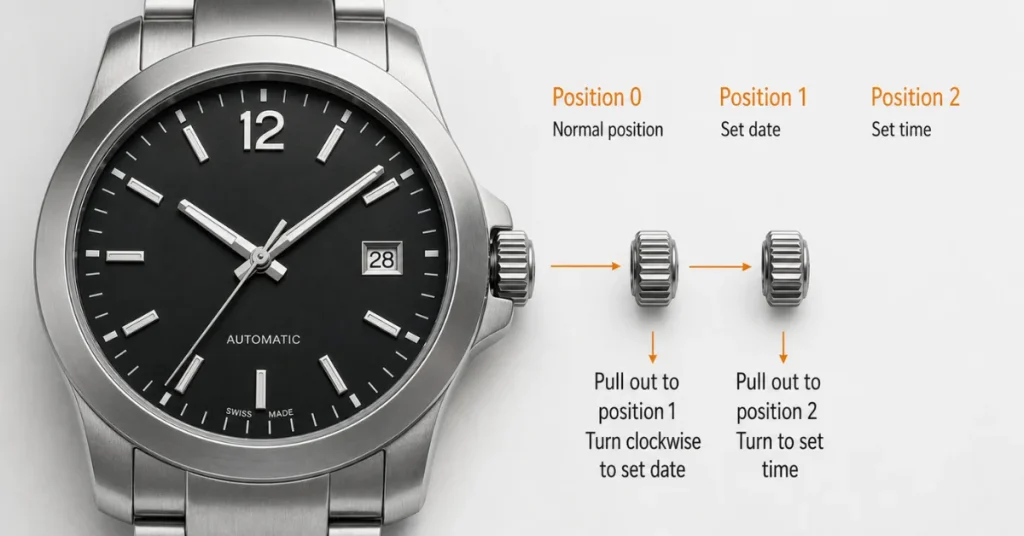
Here’s the part people miss: on some Seiko movements, particularly older ones, there’s no distinct “position one” at all. The date only advances by moving the hands forward through midnight, over and over. It’s slower, but it’s the correct method for those calibers, and forcing a quickset function that doesn’t exist can damage the gear train. Most people searching for how to change date on Seiko watch start right here, confused about which position actually does what.
How to Find Your Exact Seiko Caliber Before Setting the Date
This step gets skipped constantly, and it’s the one that actually prevents confusion later. Flip the watch over. The case back usually has a reference number stamped or printed on it, something like 7S26, NH35, or 4R36.
No case back marking? Check the original box, warranty card, or the inside of the strap near the lug. A quick search of that reference number tells you exactly which quickset behavior to expect, rather than guessing through trial and error on the crown.
Owners who skip this step are the ones who usually end up forcing a crown that was never built to quickset in the first place.
Automatic vs Quartz: Why the Process Isn’t Identical
A quartz Seiko and an automatic Seiko share a case shape, but the internals couldn’t be more different. Quartz movements run on a battery and a vibrating crystal. Automatic movements, sometimes called self-winding, get their power from the natural motion of your wrist instead.
That distinction matters here because automatic calibers, like the workhorse 7S26 found in countless Seiko 5 models, don’t include a quickset date function at all. Many newer automatic calibers do, and most quartz models offer it too, though budget quartz watches sometimes skip it, requiring the slower midnight-cycling method instead.
Think of it like the difference between a car with cruise control and one without. Both get you there, but one takes a more hands-on approach the whole way.
Quickset Date by Caliber: Which Seiko Movements Need Which Method
Different calibers behave differently enough that a quick reference table saves real time.
| Caliber | Movement Type | Quickset Date? | How to Set It |
|---|---|---|---|
| 7S26 | Automatic | No | Cycle hands through midnight repeatedly |
| NH35 / NH36 | Automatic | Yes | Crown to position one, turn clockwise |
| 4R35 / 4R36 | Automatic | Yes | Crown to position one, turn clockwise |
| 6R15 / 6R35 | Automatic | Yes | Crown to position one, turn clockwise |
| VX3 / VJ quartz | Quartz | Usually yes | Crown to position one, turn clockwise |
This isn’t a complete list of every caliber Seiko has ever made, but it covers the vast majority of watches people are wearing right now, whether that’s a budget Seiko 5 or a mid-range Prospex diver.
How to Change Date on Seiko Watch Without Damaging the Movement
This is the section that actually prevents repair bills. Every mechanical and automatic watch, Seiko included, has a stretch of hours when the internal gears are physically engaging to flip the date automatically. Turn the crown during that window and you can bend or strip a gear tooth.
For most Seiko calibers, avoid adjusting the date between roughly 9 p.m. and 3 a.m. watch time. If you need to fix the date during that stretch, move the hour hand forward past 4 or 5 a.m. first, correct the date, then set the time back to normal. It’s an extra step, but it’s a lot cheaper than a movement repair.
Watchmakers see this exact issue on a regular basis. A jammed date wheel from a late-night adjustment is one of the more common reasons a perfectly healthy Seiko ends up on a repair bench.
Setting the Date on Day-Date and International Dial Models
Some Seiko watches display both the day of the week and the date, and a handful of vintage and export models show the day in two languages, split by a small line on the dial.
On these dual-language versions, continuing to turn the crown clockwise past the day setting cycles through the language options before locking onto the date. It’s not a malfunction. It’s just how the wheel was designed decades ago, and Seiko never fully phased it out on certain reissues.
If your watch has this feature, expect one extra full rotation compared to a single-language model. Patience matters more than speed here.
Screw-Down Crown Steps for Divers and Sports Models
Sports and dive watches, including most Seiko 5 Sports and Prospex models, use a screw-down crown for extra water protection. Skip the unscrewing step and you’ll feel resistance, which some owners mistake for a stuck crown.
Hold the case steady with one hand. Turn the crown counterclockwise gently until it releases from the threads, usually one or two full rotations. From there, follow the normal position-one and position-two steps. Once you’re done, push the crown back against the case and turn it clockwise until it stops, snug but not forced.
This threaded design follows the same basic principle behind the ISO 6425 standard for diving watches, which requires reliable sealing at the crown to maintain water resistance at depth. Forgetting to re-screw it is one of the fastest ways to void that protection, even on a watch rated for 200 meters.
Vintage vs Modern Crown Feel
Owners moving from a modern Seiko to a vintage one, or the other way round, often notice the crown feels different. Older Seiko crowns from the 1960s through the 1980s tend to have a looser, almost softer click between positions. Modern crowns feel tighter and more defined.
Neither feel means something is wrong. It’s simply decades of manufacturing tolerance and design change, and it’s worth knowing before you assume a vintage piece needs repair just because the resistance feels lighter than a new watch.
What Watch Owners Consistently Report
There’s no single published statistic on how often people damage a Seiko’s date function through incorrect adjustment, since most of these fixes happen quietly at local repair counters rather than through any formal tracking. But the pattern among watchmakers and long-time collectors is consistent and worth repeating.
Owners who skip the manual entirely are far more likely to force the crown or adjust during the restricted overnight window. Those who take thirty extra seconds to identify their exact caliber, whether through the case back or a quick model lookup, rarely run into trouble at all. It’s a small habit with an outsized payoff.
Common Mistakes Worth Avoiding
A few missteps show up again and again, even among people who’ve owned a Seiko for years.
Forcing the crown past a resistance point is the big one. If it won’t turn smoothly, stop and check the position instead of pushing harder. Setting the date during the overnight danger zone is another frequent culprit, along with forgetting to screw the crown back down on diver models, which quietly compromises water resistance.
And here’s a smaller one nobody mentions: months with 30 days, plus February, need a manual date correction on the first of the following month. The watch itself has no idea June only has 30 days.
Quick Troubleshooting Guide
| Symptom | Likely Cause | What to Do |
|---|---|---|
| Date won’t change at all | Crown not fully at position one | Push crown in, pull out again, confirm click |
| Date changes at noon, not midnight | Time set 12 hours off | Advance hour hand 12 hours, recheck |
| Crown feels stuck at rest | Screw-down crown still locked | Unscrew counterclockwise before pulling out |
| Date skips or repeats a number | Worn date jumper spring | Have a watchmaker inspect the movement |
| Day shows wrong language first | Dual-language day wheel | Keep turning clockwise past the day setting |
When to Let a Professional Handle It
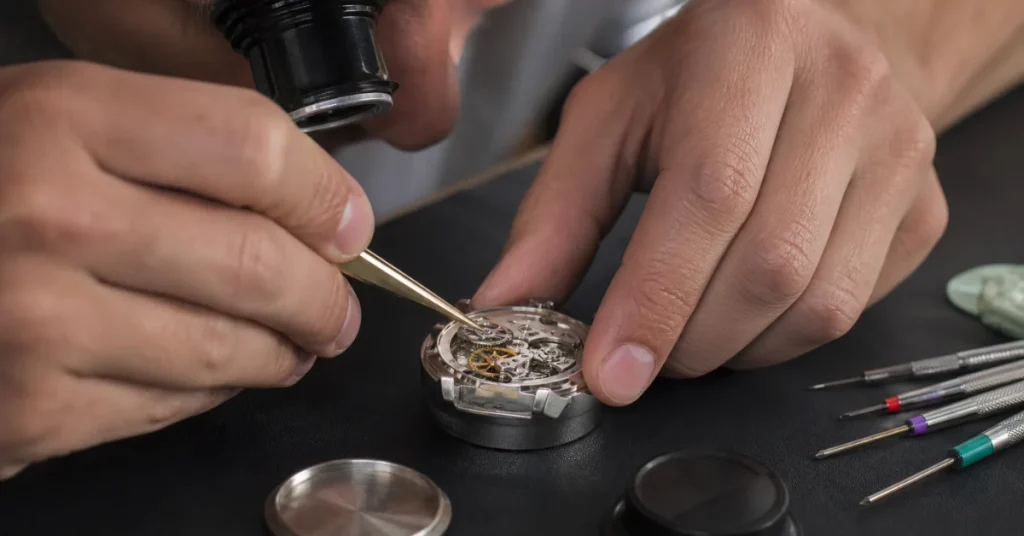
If the date wheel is skipping, stuck between two numbers, or not advancing at midnight the way it should, that’s not something to force through with more crown turning. It usually points to a worn setting lever or a misaligned date jumper spring inside the movement.
A local watchmaker can typically diagnose this in minutes. It’s a minor repair when caught early, and a far pricier one if the crown keeps getting cranked against a jammed mechanism.
Final Thoughts
Learning how to change date on Seiko watch models really comes down to a few basics: knowing your crown position, identifying your caliber, and respecting the overnight window when the gears are already mid-cycle. Once that clicks, the whole process becomes second nature, whether you’re wearing a fifty-dollar quartz field watch or a well-loved automatic that’s been through a few battery-free decades. Get to know your specific caliber, keep adjustments outside the restricted hours, and your date window will keep doing its job without a fuss, well into 2026 and beyond.
This article is for informational purposes only. For persistent mechanical issues, consult a qualified watch repair professional.
FAQs
Q: Why does my Seiko date change at the wrong time, like noon instead of midnight?
A: This usually happens if you set the time in the wrong AM/PM cycle. Move the hour hand forward 12 hours and recheck.
Q: Can I turn the crown counterclockwise to change the date faster?
A: On most Seiko calibers, only clockwise rotation advances the date at position one. Counterclockwise is typically reserved for the day display.
Q: My crown won’t pull out to the first click. What’s wrong?
A: Check whether it’s a screw-down crown first; unscrewing it counterclockwise is required before it will pull out on divers and sports models.
Q: Is it safe to set the date on a brand-new Seiko right out of the box?
A: Yes, as long as you avoid the overnight danger zone mentioned above. New watches follow the same rules as older ones.
Q: How do I know if my Seiko has a quickset date function?
A: Check the caliber number on the case back and compare it against the quickset table above. If unlisted, pull the crown to the first click and test it; if the date jumps instantly, quickset is present.