
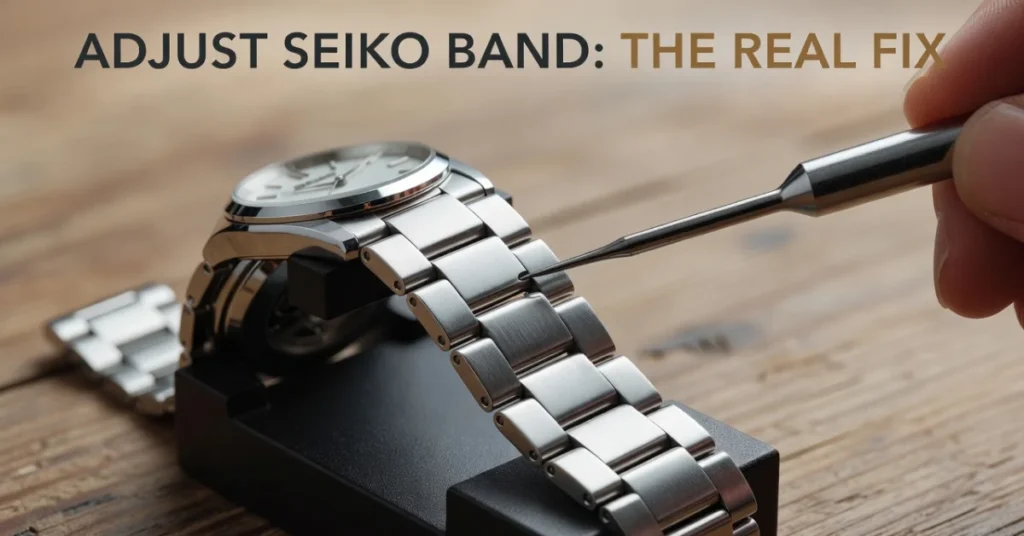
So your new Seiko slides around like a bracelet three sizes too big, or it’s pinching your wrist by the third hour of wear. How do you adjust a Seiko watch band without paying a jeweler forty dollars for a five-minute job? The short answer: it depends on what kind of band is sitting on your wrist right now, and once you know that, the fix usually takes less time than boiling an egg.
Seiko doesn’t use one universal system across its lineup. A budget Seiko 5 uses a different link mechanism than a Prospex diver, and a Presage dress watch on a mesh bracelet works nothing like either one. Get the type wrong and you’ll be poking at the wrong spot with the wrong tool for twenty minutes. Get it right and the whole job is done before your coffee gets cold.
Which Type of Seiko Band Do You Have?
Flip your watch over and look closely at the band before you touch a single tool.
- Metal bracelet (pin-and-collar or screw-link): Individual links joined by tiny pins or screws. This is the most common setup on Seiko 5 and Prospex models.
- Leather or synthetic strap: A buckle closure with a row of pre-punched holes, similar to a belt.
- Rubber or silicone strap: Usually a pin buckle, though newer Prospex diver models increasingly use quick-release spring bars.
- Mesh or Milanese bracelet: No removable links at all. Length is set entirely by a sliding clasp.
Anyone who has handled a few different Seiko models knows the fastest way to waste an afternoon is skipping this step and guessing. Confirm the type first, then move to the matching method below.
| Band Type | Adjustment Method | Tools Needed | Difficulty |
|---|---|---|---|
| Metal (pin-and-collar) | Remove links | Pin-removal tool, hammer | Moderate |
| Metal (screw-link) | Remove links | Precision screwdriver | Easy |
| Leather / synthetic | Move buckle hole | None | Very easy |
| Rubber / silicone | Buckle hole or quick-release | None, or press a lever | Very easy |
| Mesh / Milanese | Slide the clasp | None | Very easy |
How Do You Adjust a Seiko Watch Band With Metal Links?
This is the version most people searching for this actually need, since it’s the standard setup on the brand’s best-selling steel models.
What you’ll need:
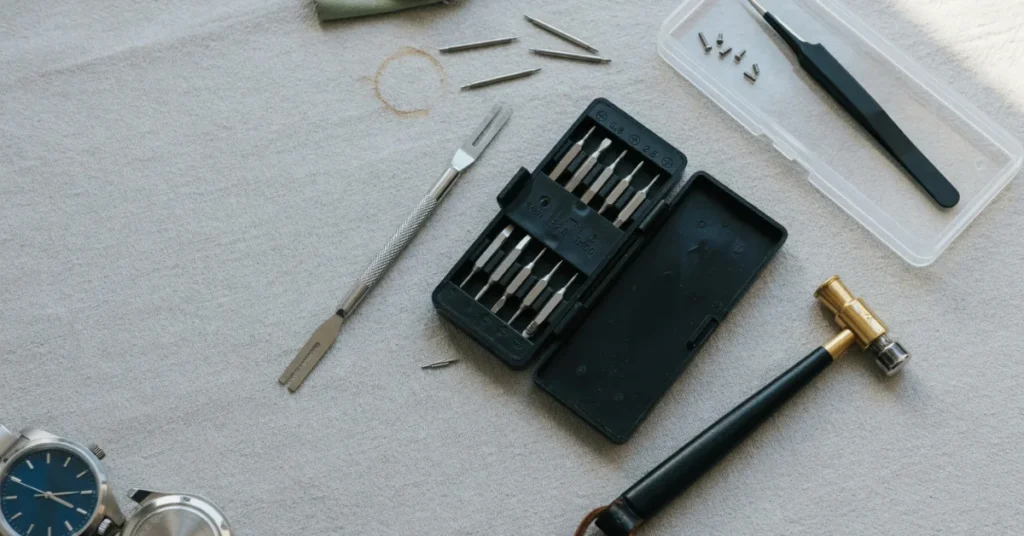
- A pin-removal or spring bar tool
- A watch holding block, or a folded towel to protect the case
- Small needle-nose tweezers
- A dish or tray to hold loose pins
The process:
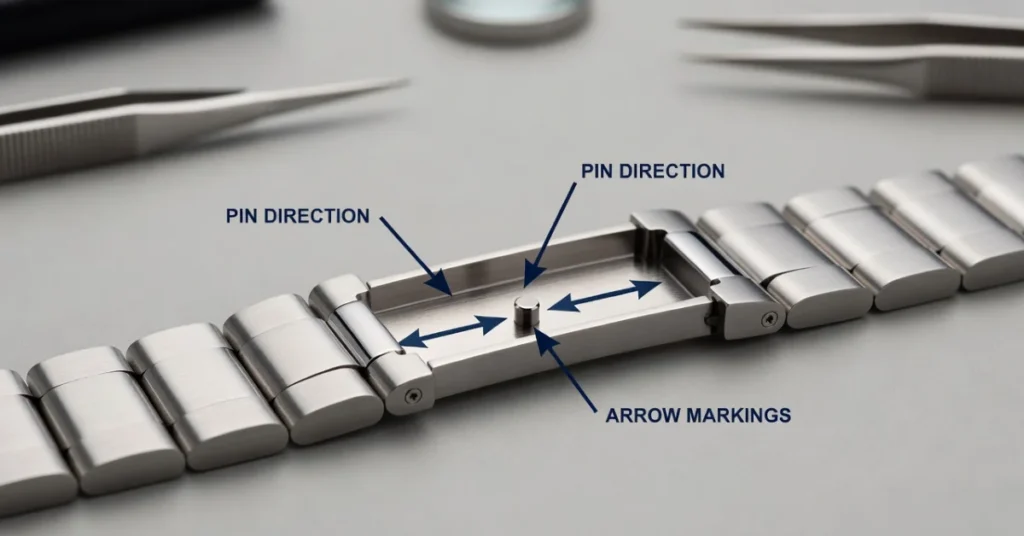
- Turn the bracelet over and find the small engraved arrows on the inside of the links. They mark which links can be removed and which direction the pin travels.
- Set the bracelet in the holding block with the arrows facing down, so the pin has somewhere to go.
- Line the pin-removal tool up with the hole and apply steady, even pressure. Don’t force it sideways. A light tap with a plastic-headed hammer is usually enough if it’s stuck.
- Slide the link off once the pin is clear, and drop both pieces into your dish. Keep them; you may need to add the band back to full size later, for a different wrist or if you sell the watch.
- Remove links evenly from both sides of the clasp, not just one. This keeps the clasp centered under your wrist instead of pulling toward one edge.
- Reconnect the remaining links by lining them up and pushing the pin back in from the opposite direction it came out.
How many links should you actually remove? This is the part most guides skip, and it’s usually the first question people have. Start by wrapping a piece of string or a soft tape measure around your wrist, just past the wrist bone, and note the number in centimeters. Average men’s wrist size runs from about 16 to 20 cm, and women’s typically falls between 14 and 18 cm. Each removable link on a standard Seiko metal bracelet adds roughly 0.8 to 1 cm of length, so subtract your wrist measurement from the current band length and divide by that figure to estimate the number of links to pull.
A simpler check works just as well once the bracelet is back together: slide one finger between the closed clasp and your wrist. If your index finger fits snugly with a little room to spare, the fit is right. Too tight and you can’t get a finger under it at all; too loose and two fingers slide through with space left over.
Screw-link models, found on some higher-end Seiko references, skip the hammer entirely. A small precision screwdriver backs the screws out, and there’s no spring-loaded pin to worry about losing across the room.
How Do You Adjust a Seiko Watch Band Without Removing Links?
Sometimes the fit is close but not quite there, and pulling a whole link would make the band too loose. Here’s how do you adjust a Seiko watch band when you only need a few millimeters, not a full link.
Many Seiko clasps include a small micro-adjustment mechanism built into the folding clasp itself. Depress the spring bar inside the clasp holes with the pointed end of your tool, then slide it into the neighboring hole while it’s compressed. This tightens or loosens the fit in tiny steps, and it takes about thirty seconds once you’ve done it once.
Leather and synthetic straps don’t need tools at all. Move the pin to a different pre-punched hole on the buckle, same as adjusting a belt. Rubber and silicone straps generally work the same way, though check the underside of newer dive models for a small lever near the spring bar, which is a quick-release fitting. Press it and the whole strap end pops free for a full swap rather than a hole-by-hole fit.
Mesh and Milanese bracelets skip removable links entirely. Slide the small sliding clasp along the mesh to the tension you want, then fold the locking arm down. There’s genuinely nothing to remove or add on this style, which is part of why collectors like it for travel.
Tools You Actually Need
You don’t need a professional watchmaker’s bench for any of this. A basic three-piece kit covers nearly every home adjustment:
- Spring bar or pin-removal tool (roughly $8–15)
- Small precision screwdriver set, for screw-link bands
- Plastic-headed hammer, only needed for stubborn pins on older or tightly assembled bracelets
Skip the paperclip-and-thumbtack approach you’ll see suggested online. It technically works once or twice, but it also scratches the finish and rounds off the pin heads, making the next adjustment harder than it needs to be.
What the Research Shows
Aftermarket watch tool sales and DIY repair searches have climbed steadily as more buyers shop for watches online rather than through a jeweler who fits the band at purchase. Industry coverage of the watch accessories market points to steady year-over-year growth in strap and bracelet-related purchases, much of it driven by owners who now expect to size and swap bands themselves instead of scheduling a store visit.
That trend lines up with what shows up in watch forums and repair communities: first-time buyers increasingly ask about home sizing before they ask about anything else, and the pattern is even stronger among people who bought their Seiko online rather than in person. Detailed looks at community discussions on the topic consistently point to the same handful of sticking points: losing a spring bar, pushing a pin the wrong direction, or removing links unevenly so the clasp sits off-center.
Common Mistakes That Ruin a Band Adjustment
- Ignoring the arrows. Pushing a pin against the marked direction can bend or snap the link.
- Removing links from one side only. This throws the clasp off-center and looks obviously wrong on the wrist.
- Skipping eye protection. Spring bars are, well, spring-loaded, and a flying pin has a habit of vanishing into carpet or finding an eye.
- Using metal tools with no padding on the case. A stray slip scratches the caseback in half a second.
- Forcing a screw-link band like a pin-link band. Trying to hammer out a screw strips the threads fast.
Who Should Do This at Home vs Visit a Jeweler
Most owners can handle a standard metal bracelet, leather strap, or rubber band adjustment at home with the right eight-dollar tool. It’s genuinely a beginner-friendly job once you’ve watched the process once.
Where it gets trickier: vintage Seiko models from before 2010, where spring bars often sit inside the lugs rather than accessible from the case back, and gold-tone or two-tone bracelets, where a slipped tool leaves a mark that’s expensive to buff out. If your watch falls into either category, or if you’re adjusting a band on a piece with real sentimental or resale value, a jeweler charging a small fee is often worth the peace of mind.
Conclusion
So, how do you adjust a Seiko watch band? Figure out the bracelet type first, use the right small tool for that specific mechanism, and work evenly from both sides of the clasp. Metal links come off with a pin-removal tool, leather and rubber straps just need a different buckle hole, and mesh bracelets adjust with nothing more than a sliding clasp. None of it requires a workshop, and most people get it right on the very first try once they know which system they’re working with.
FAQs
Do all Seiko watches use the same band adjustment method?
No. Metal bracelets use pins, collars, or screws depending on the model, leather and rubber straps use buckle holes, and mesh bracelets rely on a sliding clasp with no removable links at all.
Can I adjust a Seiko watch band without any tools?
Leather, synthetic, and most rubber straps need no tools since they just move to a different buckle hole. Metal bracelets do need a small pin-removal or spring bar tool for a clean result.
Will removing links damage my Seiko warranty?
Removing links yourself typically doesn’t touch the movement warranty, since it’s a band adjustment rather than a repair to the watch itself. Check your specific warranty card if you’re unsure.
What if I lose a link after resizing my band?
Keep every pin and link you remove in a small dish or bag. Most Seiko dealers and third-party sellers also stock replacement links for common models if one goes missing.
How do I know if my Seiko has a micro-adjustment clasp?
Open the folding clasp and look for a row of small holes rather than a single fixed loop. If you see multiple holes, you can fine-tune the fit without removing a link at all.