
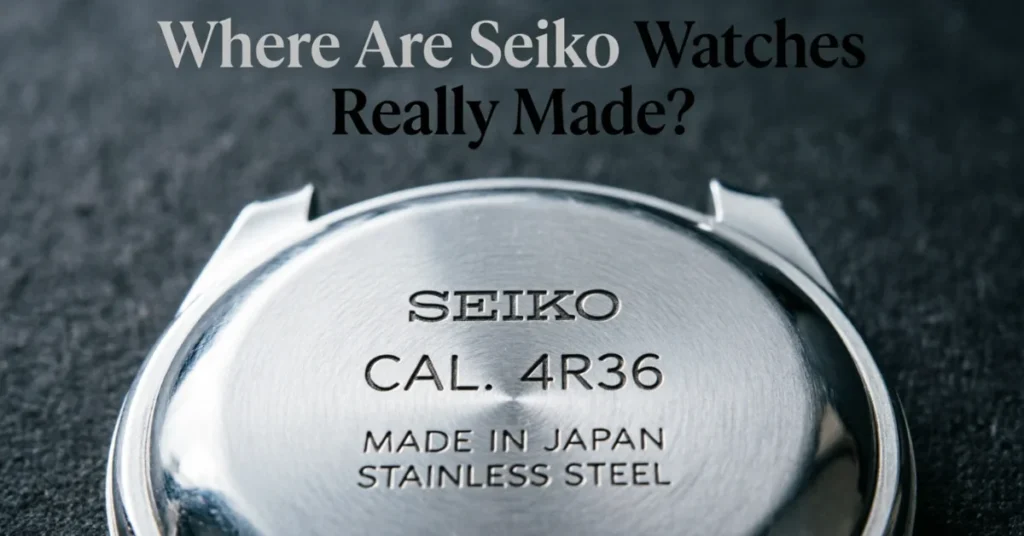
If you’ve ever flipped a Seiko over and squinted at the caseback, you already know the brand doesn’t give you one tidy answer. Where are Seiko watches manufactured? Mostly Japan, but not only Japan — and the specific country behind your watch says a lot about which tier it belongs to.
Seiko has been building timepieces since 1881, and it’s grown into one of the only watchmakers on earth that designs, manufactures, and assembles nearly everything in-house, from movements to cases to dials. That scale means production isn’t confined to one factory or even one country.
Where Are Seiko Watches Manufactured? A Country-by-Country Breakdown
Seiko runs a genuinely global production network, and each location has a distinct job. Here’s the quick version before we go deeper:
| Country | Price Tier | Focus | Example Models | Key Facility |
|---|---|---|---|---|
| Japan | Luxury / flagship | Full hand-assembly, movement design, finishing | Grand Seiko, Credor, Prospex LX | Grand Seiko Studio Shizukuishi (Iwate) |
| China | Entry-level / budget | High-volume assembly, cost efficiency | Basic Seiko 5, budget quartz lines | Dalian Seiko Instruments Inc. (est. 1989) |
| Malaysia | Mid-range | Quartz + mid-tier mechanical assembly | Seiko 5 Sports, mid-range divers | Instruments Technology (Johor) Sdn Bhd |
| Singapore | Components | Movement and parts manufacturing | Feeds quartz calibers to other plants | Seiko Manufacturing (Singapore) Pte Ltd |
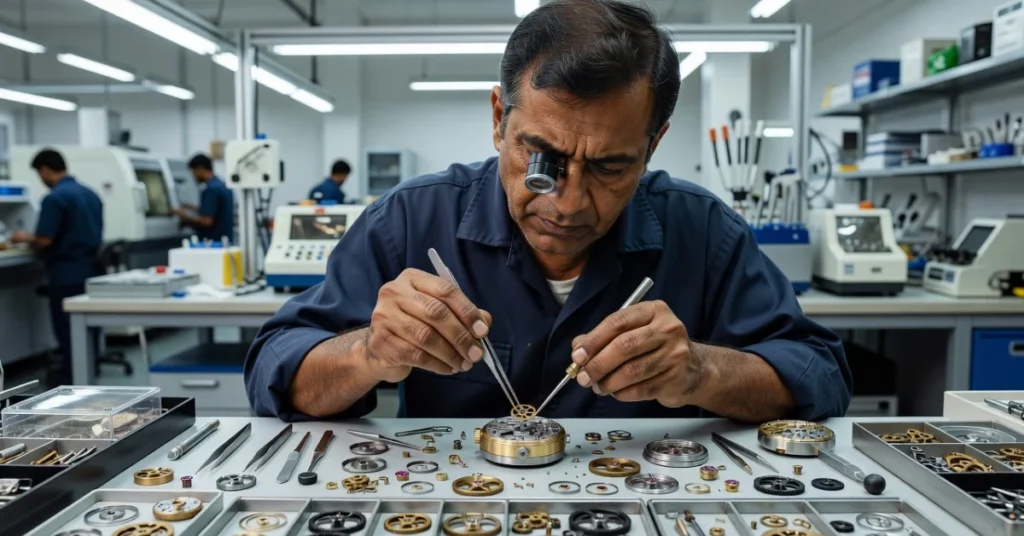
Japan is where the brand’s reputation was built, and it’s still where the finest watches come from. Japan primarily focuses on the production of Seiko’s high-end or luxury models, like Grand Seiko and Prospex LX. The Grand Seiko Studio Shizukuishi in Iwate Prefecture is where much of that top-tier work happens, and the models to come out of it include serious haute horlogerie pieces.
China handles a large share of the affordable end of the lineup. Production there is aimed at entry-level and budget-friendly models, using the same design specs and quality checks Seiko applies everywhere else. Seiko’s production activities in mainland China appear to have started between the late 1980s and early 1990s with the opening of the Dalian Seiko Instruments Inc. factory, which was founded in 1989 and has expanded steadily since.
Malaysia sits in the middle of the lineup. Facilities there are located in Johor, at the southern tip of the Malay peninsula, right above the border with Singapore, and that positioning isn’t accidental — it keeps the plant close to Seiko’s Singapore component operations. The Malaysian entity itself, Instruments Technology (Johor) Sdn Bhd, founded in 1990, is a subsidiary of Seiko Manufacturing (Singapore) Pte Ltd. Watches built here specialize in entry-level quartz and mid-range mechanical models, giving Seiko a price point between the Japan-made pieces and the budget China-made line.
Singapore plays a quieter but important role: it’s a hub for watch movements and other crucial components used in quartz watches that then get shipped to assembly plants elsewhere in the network, including Malaysia.
Real Model Numbers and Where They’re Built
One thing most guides skip: you can actually match specific reference numbers to their production origin. Watches produced under Seiko Manufacturing (H.K.) Ltd. — the Hong Kong-linked arm of the China/Malaysia network — include models like SRPD51K1, SRPD53K1, SRPD57K1, SRPD59K1, SRPD61K1, SRPD63K1, SRPD65K1, SRPD76K1, SRPE53K1, SRPL11K1, SRPL13K1, and SRPL29K1. If your reference number matches one of these, you’re looking at a watch built through that regional manufacturing arm rather than a Japan-only line.
Does the Manufacturing Location Actually Affect Quality?
This is the question most buyers really care about, and it’s more nuanced than “Japan good, elsewhere worse.”
Seiko applies the same engineering standards across every facility. A Seiko NH35 automatic movement — one of the most widely used calibers in the watch world — performs the same whether it’s assembled in Japan or fitted into a case in Malaysia. Movement quality is standardized; what changes by country is typically the finishing, the complexity of the watch, and the price bracket it’s built for.
Where Seiko watches are manufactured tends to track directly with what you’re paying. A $70 Seiko 5 built in China or Malaysia isn’t trying to compete with a $6,000 Grand Seiko hand-assembled in Iwate — they’re different products serving different buyers, not the same watch made cheaply in one place and expensively in another.
What “Japan Movt” Actually Means
This label trips up a lot of first-time buyers, so it’s worth breaking down properly. A caseback that reads:
- “Japan” — the entire watch, movement and case, was assembled in Japan
- “Japan Movt” — only the movement was made in Japan; the case, dial, and final assembly happened elsewhere, often Malaysia or China
- No Japan reference at all — movement and assembly both took place outside Japan
None of these labels indicate a defective or inferior watch. “Japan Movt” watches still run on Japan-engineered calibers; they’re simply cased overseas to keep production costs down. Collectors sometimes pay slight resale premiums for fully “Japan”-stamped pieces, but functionally there’s no performance gap tied to that label alone.
How to Tell Where Your Seiko Was Made
If you’re still trying to figure out where are Seiko watches manufactured for your specific piece, a few practical ways to check:
- Look at the caseback — many models stamp “Japan,” “Made in Japan,” or “Japan Movt”
- Check the reference number against Seiko’s official documentation or catalog listings
- Grand Seiko pieces almost always specify Japan origin clearly, given the prestige tied to that label
- Entry-level Seiko 5 and budget dive watches are more likely to carry Malaysia or China origin markings, often falling under the SRPD/SRPE/SRPL number ranges noted above
What the Research Shows
Industry analysis of watch manufacturing consistently points to the same pattern across major brands: high-complexity, low-volume pieces stay close to headquarters, while high-volume, price-sensitive lines move to lower-cost regions without sacrificing core engineering standards. Seiko fits that pattern closely, and it’s part of why the brand has stayed competitive at both the entry-level and luxury ends of the market at the same time — something few watchmakers manage.
Why Seiko Spread Production Across Multiple Countries
There’s a practical business logic here, not just cost-cutting. Spreading manufacturing across Japan, China, Malaysia, and Singapore lets Seiko:
- Keep entry-level pricing genuinely competitive against Citizen, Casio, and fashion-watch brands
- Protect the exclusivity and craftsmanship of Grand Seiko by keeping it Japan-only
- Scale production to meet global demand — Seiko produces roughly five million watches a year
- Localize component sourcing through subsidiary entities like Seiko Manufacturing (Singapore) Pte Ltd, which shortens supply chains for regional markets
The Bottom Line
Where are Seiko watches manufactured? Japan for the flagship and luxury lines, China and Malaysia for the accessible and mid-range models, and Singapore for key components that feed the rest of the network. None of that is a downgrade — it’s how Seiko manages to sell both a $60 field watch and a hand-finished $30,000 Credor under the same name. For most buyers, the country stamped on the caseback matters less than the model tier it belongs to.
FAQs
Are Seiko watches made in Japan better than ones made elsewhere?
Not automatically. Movement quality is standardized across facilities; Japan-made pieces tend to be higher-tier models with more hand-finishing, which is why they cost more — not because overseas assembly is inferior.
How can I check if my Seiko was made in Japan?
Check the caseback text and the reference number. “Japan Movt” means the movement was made in Japan but the watch was cased elsewhere; SRPD/SRPE/SRPL prefixes typically point to the China/Malaysia manufacturing arm.
Is Grand Seiko always made in Japan?
Yes. Grand Seiko production is concentrated at Japanese studios, including Shizukuishi in Iwate Prefecture.
Why are some Seiko watches made in China or Malaysia?
To keep entry-level and mid-range pricing competitive while maintaining the same core manufacturing standards used across the brand, through subsidiary facilities like Dalian Seiko Instruments and Instruments Technology (Johor).
Does a Seiko 5 made in Malaysia use the same movement as a Japan-made model?
Often yes for shared calibers like the NH35 — the difference tends to be in casing, finishing, and price tier rather than the movement’s core engineering.