
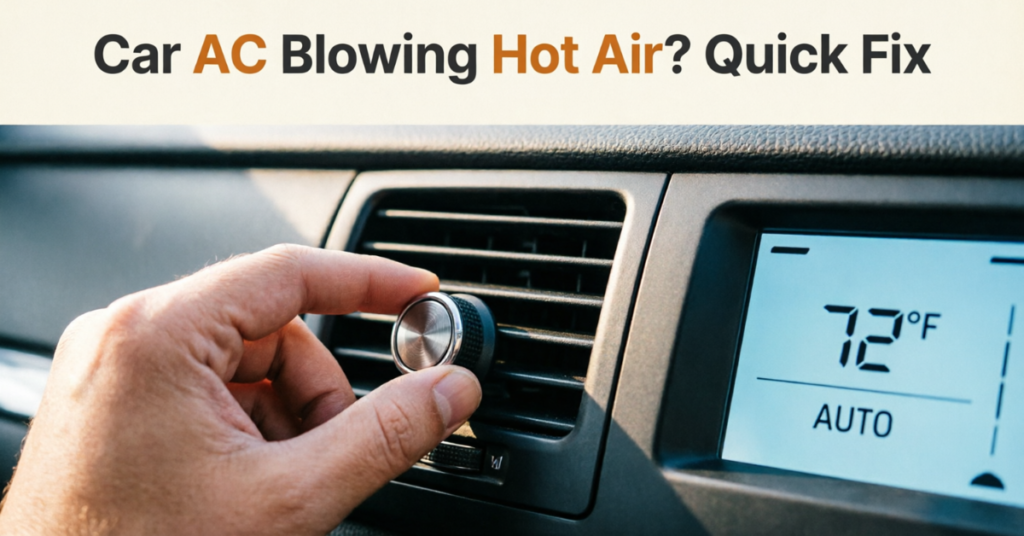
You crank the dial to full cold, point every vent at your face, and still get a lungful of warm air. It’s one of the most common complaints shops hear once summer heat kicks in, and there’s a reason it happens so often. Why does my car AC blow hot air in the first place? In almost every case, it comes down to one of six things: low refrigerant, a leak somewhere in the system, a failing compressor, a blocked condenser, an electrical fault, or a stuck blend door actuator. Some of these are ten-minute fixes. Others need a trained technician with the right gauges.
This guide walks through each cause, how to tell them apart, and what a reasonable repair actually looks like in 2026.
How Your Car’s AC System Actually Works
Before chasing the problem, it helps to know what’s supposed to happen when you flip that switch.
Refrigerant runs through a closed loop. The compressor squeezes it into a hot, high-pressure gas. That gas moves through the condenser, mounted right up front near the radiator, where outside air pulls the heat out of it. From there it passes through an expansion valve, drops in pressure, and turns cold as it enters the evaporator inside the dash. A fan blows cabin air across that cold evaporator, and that’s the chilled air hitting your face.
Break any single link in that chain and the whole cycle stalls. That’s the short version of why a car AC blowing hot air rarely has just one possible explanation.
The Most Common Reasons Your Car AC Blows Hot Air
Low Refrigerant or a Slow Leak
This is the one technicians mention first, and for good reason. Refrigerant doesn’t get “used up” the way gasoline does. If the level is low, something let it escape, usually through a tiny crack in a hose, a worn O-ring, or a corroded fitting.
Anyone who’s dealt with this knows the pattern: the AC works fine for a week, then cools less each day, then finally gives up and blows warm. A shop can pressure-test the system with UV dye to find the exact leak point rather than guessing.
Faulty Compressor
The compressor is the pump that keeps everything moving. When its internal clutch fails to engage, or the unit itself seizes from years of wear, refrigerant simply stops circulating. Drivers usually notice a loud clicking, grinding, or a burning smell right before it quits completely.
Compressor failure is one of the pricier repairs on this list, mostly because a failed compressor tends to send metal shavings through the rest of the system, meaning the condenser and expansion valve may need flushing or replacing too.
Clogged or Blocked Condenser
Road grime, leaves, bugs, and plastic bags all end up wedged against the condenser fins over time. Since the condenser depends on outside airflow to shed heat, a blocked one can’t do its job even with a full refrigerant charge.
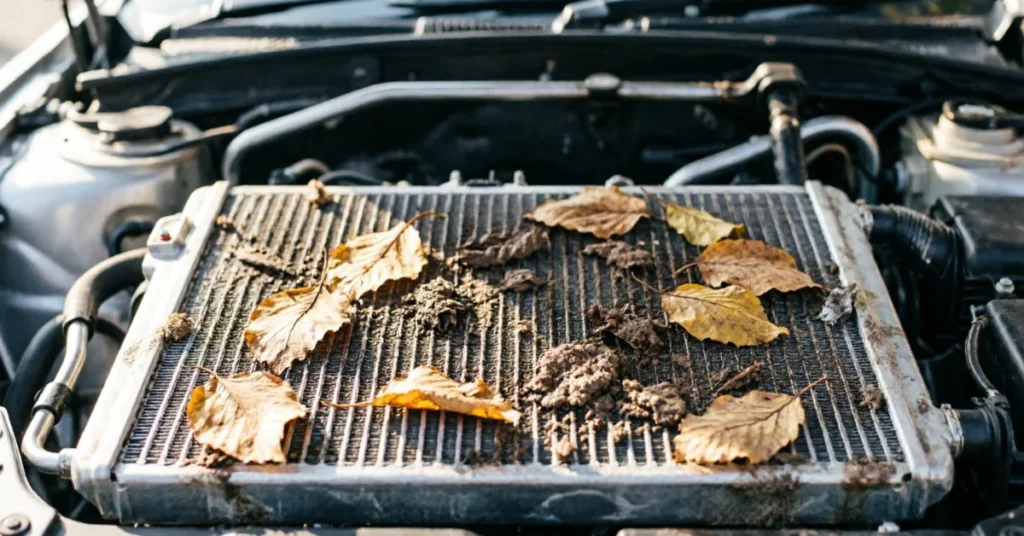
This is genuinely one of the easiest problems to check yourself. Pop the hood, look at the thin finned unit in front of the radiator, and see if it’s caked in debris. A gentle rinse with a garden hose, never a pressure washer, often restores airflow immediately.
Electrical Faults
A blown fuse, a corroded relay, or a failed pressure sensor can all stop the compressor clutch from ever engaging, even when refrigerant levels are perfectly normal. Heat makes this worse, since hot weather puts extra load on wiring and connectors that are already marginal.
An OBD2 scanner can often flag the exact circuit at fault, which is why more drivers now keep one in the glovebox rather than guessing at fuses one by one.
Broken Blend Door Actuator
This one surprises people. The blend door controls how much air passes over the heater core versus the evaporator. If the small motor that moves that door fails, or the door itself snaps off its mount, the system can get stuck pulling warm air from the heater core no matter what the dial says.
A telltale sign is a faint clicking noise from behind the dash every time you adjust the temperature setting.
Weak Blower Motor
Sometimes the AC is cooling refrigerant just fine, but the fan pushing air across the evaporator is too weak to move much of it. This shows up as warm-ish, low-volume airflow rather than a hard stop to cooling, and it’s easy to mistake for a refrigerant problem at first.
Quick Diagnostic Table
Anyone who’s short on time can use this as a first-pass reference before digging deeper into any single cause.
| Symptom | Likely Cause | DIY or Pro Fix |
|---|---|---|
| Cooling fades gradually over days or weeks | Low refrigerant or slow leak | Pro (pressure test and recharge) |
| Loud clicking, grinding, or burning smell | Faulty compressor | Pro (diagnosis and likely replacement) |
| Weak cooling, worse in stop-and-go traffic | Blocked condenser or weak cooling fan | DIY check first, then pro if needed |
| AC never engages at all, no clutch sound | Electrical fault (fuse, relay, sensor) | DIY check fuses, then pro scan |
| Clicking behind the dash when adjusting temperature | Broken blend door actuator | Pro (dash disassembly usually required) |
| Cooling present but airflow is weak or low-volume | Weak blower motor or clogged cabin filter | DIY filter check, then pro if unresolved |
Hybrid and Electric Vehicle AC: A Different Setup
Most of the causes above apply to any gasoline car, but hybrid and electric vehicles use a meaningfully different AC compressor design, and it changes both the diagnosis and the stakes.
Conventional cars spin the compressor off the engine’s drive belt. Hybrids and EVs instead use an electrically driven compressor, often called an eCompressor, since there’s no engine constantly turning to power a belt. On many hybrids, this electric unit works alongside or instead of a belt-driven one, particularly during idle-stop moments when the engine shuts off at a red light.
This matters for another reason too. On a fully electric vehicle, the AC system doesn’t just cool the cabin, it also helps regulate the temperature of the high-voltage battery pack. A failure here isn’t only a comfort problem the way it is in a gasoline car; it can affect the vehicle’s ability to manage battery temperature properly.
It also changes what’s safe to try at home. Store-bought recharge kits and oil-based fluorescent leak-detection dye, both common DIY tools on belt-driven systems, aren’t appropriate for high-voltage electric compressor systems, since some of those additives can conduct electricity. Anyone driving a hybrid or EV with a car AC blowing hot air is generally better off skipping the DIY refrigerant top-off and going straight to a shop familiar with high-voltage AC service.
What the Research Shows
Detailed analysis of shop repair data from multiple auto-care providers points to the same pattern year after year: refrigerant leaks and compressor issues account for the large majority of AC service visits, with condenser blockages and electrical faults trailing behind. Independent repair chains that track seasonal service volume consistently report a sharp jump in AC-related visits as soon as outdoor temperatures climb, which lines up with what any shop manager will tell you about early summer.
That seasonal spike matters for another reason. High heat doesn’t just make a broken AC more noticeable, it actually accelerates failure. Elevated under-hood temperatures push more pressure through an already-weak seal or a tired compressor, which is exactly why so many of these problems surface on the first truly hot day of the year rather than gradually.
Why Does My Car AC Blow Hot Air Only at Idle?
If cooling is fine at highway speed but drops off in stop-and-go traffic or while sitting at a light, the pattern usually points somewhere specific. A weak or failing cooling fan can’t move enough air across the condenser without highway wind to help it, so heat backs up right when you need cooling most. A marginal refrigerant charge shows the same symptom, since airflow at speed briefly compensates for a system that’s already borderline.
This is also a case where the exact keyword “why does my car AC blow hot air” points to a narrower diagnosis than most drivers expect, since idle-only symptoms usually rule out a total refrigerant loss and point instead toward the cooling fan circuit.
Quick Checks Before You Call a Shop
A few minutes of troubleshooting can save a wasted trip:
- Check that the compressor clutch actually engages when the AC is switched on. You should hear or see it click in near the front pulley.
- Inspect the condenser for visible debris and rinse it gently if needed.
- Listen for unusual noises when adjusting the temperature dial, which can point to the blend door actuator.
- Check the cabin air filter, since a clogged one reduces airflow enough to feel like weak cooling.
- Note whether the problem only happens at idle, since that narrows the list considerably.
None of these checks require special tools, and they can rule out the cheapest fixes before anyone reaches for a wrench.
When to See a Professional
Refrigerant work legally requires certified equipment in most regions, since venting refrigerant into the atmosphere is restricted. Compressor replacement, leak detection with UV dye, and electrical diagnostics also go faster and more accurately in a shop with the right gauges and scan tools.
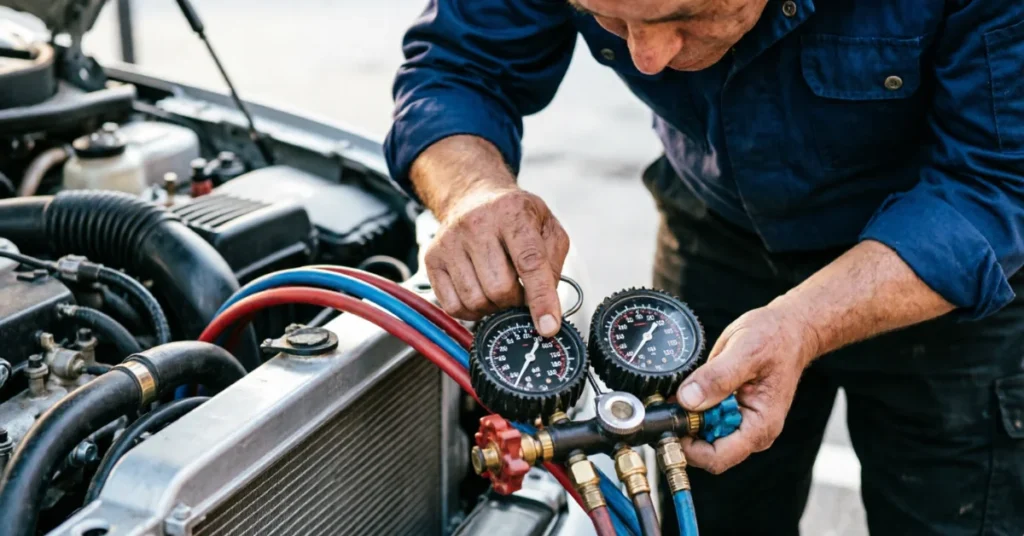
A reasonable rule of thumb: DIY the visual checks above, then let a certified technician handle anything involving the refrigerant loop itself.
Different Drivers, Different Situations
Not every case looks the same. Drivers in stop-and-go city traffic tend to see condenser and cooling-fan problems first, since there’s less natural airflow to compensate. Highway commuters more often notice a gradual refrigerant leak, since the symptom creeps in slowly over weeks rather than showing up all at once. Owners of older vehicles, especially those past 100,000 miles, should treat a failing compressor as the more likely suspect simply because rubber seals and bearings wear out with age.
Conclusion
A hot blast from the vents on a warm afternoon is frustrating, but it’s rarely a mystery once you know where to look. Why does my car AC blow hot air? Nine times out of ten it traces back to refrigerant, the compressor, a blocked condenser, an electrical glitch, or a stuck blend door. Work through the checks above, and you’ll walk into any repair conversation already knowing roughly what’s wrong, which tends to make the whole visit faster and considerably less stressful.
FAQs
Can low refrigerant really cause a car AC to blow hot air?
Yes. It’s the single most common cause, since refrigerant is what actually removes heat from cabin air during the cooling cycle.
Is it safe to drive with the AC blowing hot air?
It’s safe to drive, but ignoring the underlying cause can let a small issue, like a slow leak, turn into a bigger repair involving the compressor.
How much does it typically cost to fix a car AC that blows hot air?
Costs vary widely by cause and vehicle, ranging from a simple recharge to a full compressor replacement, so a shop diagnosis is the only reliable way to get an accurate number.
Why does my car AC only blow hot air when I’m stopped at a light?
That pattern usually points to a weak cooling fan or a borderline refrigerant charge, both of which rely on airflow that highway speed normally provides.
Can I recharge my car’s AC myself with a store-bought kit?
It’s possible for minor top-offs, but it won’t fix an underlying leak, and overcharging the system can cause its own damage, so a professional diagnosis is usually worth the cost first.