
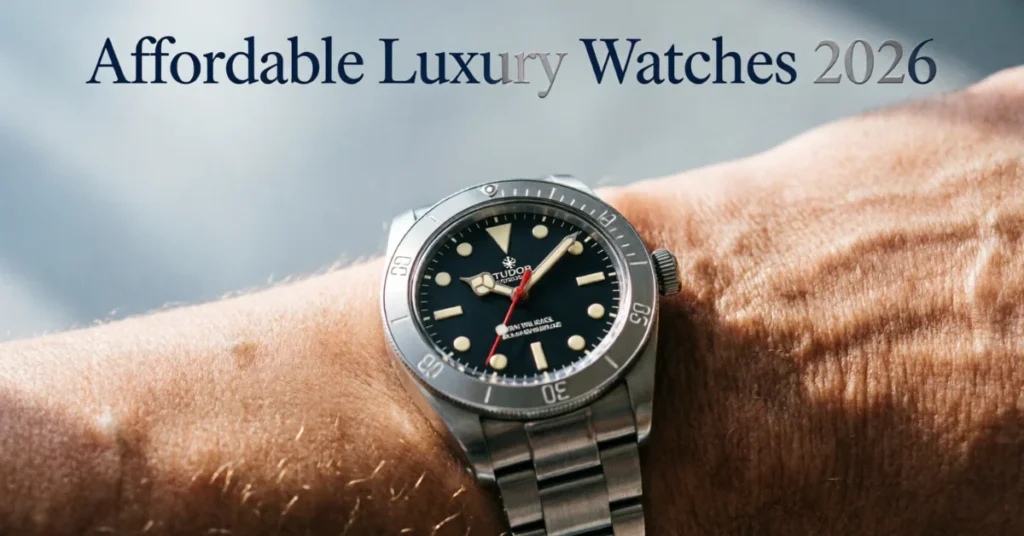
Ten years ago, walking into a boutique and asking for a “serious” watch under $1,500 would have gotten you a polite smile and a catalog for something twice the price. That’s no longer true. Affordable luxury watches have quietly become one of the fastest-growing corners of the entire watch industry, and the shift caught even longtime collectors off guard.
Buyers aren’t settling for less. They’re getting genuinely more for their money, and the brands making that happen aren’t obscure names either.
What Affordable Luxury Watches Actually Means
The term gets thrown around loosely, so it helps to pin it down. Affordable luxury watches generally sit between $300 and $5,000, built with Swiss or Japanese automatic movements, sapphire crystal glass, and finishing that used to be reserved for five-figure pieces.
They aren’t fashion watches. Fashion brands lean on logos and appearance. A true affordable luxury watch focuses on the movement inside, the case construction, and long-term durability. That distinction matters more than most buyers realize when they first start shopping.
For first-time buyers, three price bands tend to define the space: entry Swiss and Japanese automatics under $1,000, the $1,000 to $2,500 range where in-house movements start appearing, and $2,500 to $5,000, where brands like Tudor deliver near-flagship quality.
Quick Comparison: Best Affordable Luxury Watch Brands
| Brand | Price Range | Movement Type | Best For |
|---|---|---|---|
| Hamilton | $500–$1,500 | Swiss automatic (ETA-based) | First mechanical watch |
| Tissot | $400–$1,200 | Automatic (Powermatic 80) | Everyday wear, long power reserve |
| Seiko | $300–$900 | Automatic | Budget-conscious first buyers |
| Longines | $1,500–$2,500 | In-house automatic | Style-focused upgraders |
| Oris | $1,800–$3,500 | Independent mechanical | Dive watch enthusiasts |
| Tudor | $3,000–$5,000 | In-house, METAS certified | Near-flagship quality seekers |
Best Affordable Luxury Watch Brands Right Now
A handful of names keep showing up whenever collectors compare notes, and each earns its spot for a different reason.
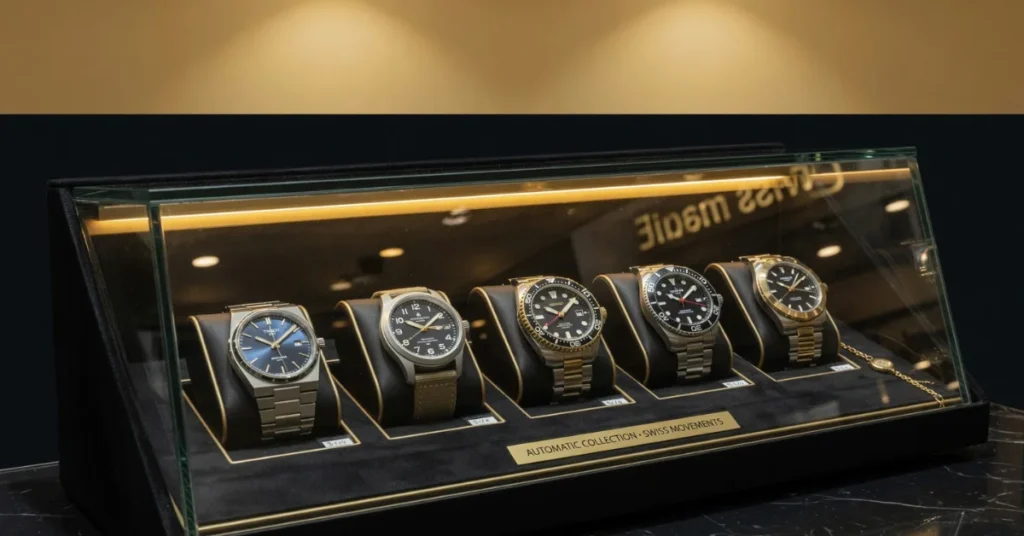
Tudor sits closest to Rolex-adjacent quality without the waiting lists. The Black Bay family, including the Black Bay 58 and Pelagos, uses in-house movements and METAS-certified chronometers, with an average sale price around $4,300.
Longines brings a genuine aviation and sports heritage. Its Spirit collection offers movement quality that punches well above its price tag, typically landing between $1,500 and $2,500.
Oris stays fiercely independent and mechanical-only. The Aquis diver has a bracelet that feels far pricier than its actual cost, thanks to ceramic bezels and tight tolerances.
Hamilton blends American design roots with Swiss manufacturing under the Swatch Group. Prices usually run $500 to $1,500, making it one of the easiest entry points into mechanical watchmaking.
Tissot and Seiko round out the entry tier. The Tissot PRX Powermatic 80 and Seiko Presage Cocktail Time both deliver automatic movements and sapphire crystal well under $1,000, which explains why they’re constant recommendations for new buyers.
TAG Heuer deserves a mention too. Its Carrera and Formula 1 lines bridge the gap between accessible pricing and genuine Swiss horology credentials.
Affordable Luxury Watches for Women
The segment isn’t just a men’s conversation anymore, and most guides on this topic skip right past it. Orient’s Bambino line, sized around 38mm, sits in what collectors call the Goldilocks zone: comfortable on smaller wrists without looking undersized.
Tissot’s smaller PRX cases and Longines’ PrimaLuna collection follow the same logic. Automatic movements, sapphire crystal, and cases scaled specifically for women who want mechanical credibility, not just a smaller dial fitted onto a men’s design.
Case size matters more than most first-time buyers expect. A 42mm dive watch can look oversized on a smaller wrist, while a 34mm to 38mm case tends to sit comfortably across most body types, men and women alike. That single detail changes the shopping experience more than brand name does.
What the Research Shows
Global demand for this category isn’t a niche trend anymore. Worldwide revenue in the luxury watches market reaches roughly $63.44 billion in 2026, with annual growth projected at 2.92% through 2031. That growth is being driven heavily from the middle of the market, not just the ultra-premium tier. Statista
Industry analysts have pointed to a specific reason for this. As entry-level luxury pricing climbed past $9,000 for many established houses, buyers who still wanted craftsmanship and prestige simply moved sideways into brands offering comparable engineering for a fraction of the cost.
Retailers who carry these brands report the same pattern from the ground level. Warranty-backed automatic watches in the $500 to $2,000 range have become the most consistent sellers across authorized dealers, not the flagship pieces collectors assume dominate the conversation.
Pros and Cons of Buying Affordable Luxury Watches
No purchase is without trade-offs, and being upfront about both sides matters here.
Pros:
- Genuine mechanical or automatic movements instead of basic quartz
- Sapphire crystal resists scratches far better than mineral glass
- Full manufacturer warranties through authorized dealers
- Strong resale value on models like the Tudor Black Bay and Oris Aquis
- Swiss or Japanese manufacturing standards at accessible price points
Cons:
- Fewer complications compared to flagship pieces
- Limited exclusivity since production runs are larger
- Grey market listings can carry voided warranties
- Some models see long wait times as demand outpaces supply
Anyone who has shopped this category for more than a season knows the grey market warning is worth repeating. Authorized dealers matter here every bit as much as the brand name on the dial.
How to Verify Authenticity Before Buying
A few concrete checks matter more than brand loyalty when it comes to protecting a purchase.
- Match the serial number on the case back against the manufacturer’s official verification tool. Most Swiss brands offer one directly on their site.
- Buy only through dealers listed on the brand’s official authorized retailer page, not third-party marketplaces with no listed affiliation.
- Ask for the original warranty card and box, not just the watch itself. A missing warranty card is often the first sign of a grey market sale.
- For pre-owned pieces, use platforms that authenticate before sale rather than open listings with no verification step.
What Watch Experts Say
People who work in retail watch sales describe the $1,500 to $3,000 range as a genuine turning point. That’s where buyers stop compromising and start owning something built with real intent, not just a good story for the price.
Collectors who’ve moved through several tiers of ownership tend to say the same thing in different words. The jump from a $300 fashion-adjacent piece to a true $1,200 Swiss automatic feels larger than the price difference suggests, mostly because of how the movement, weight, and finishing come together on the wrist.
Buying Online Versus In a Boutique
First-time buyers often assume online shopping is riskier, and in some cases it is. Grey market sellers can list watches without disclosing that the manufacturer’s warranty no longer applies.
Authorized dealer websites solve this. Brands including Seiko, Hamilton, Tissot, and Tudor all list authorized online retailers directly on their official sites, and buying through those channels preserves the full warranty. In-person boutique purchases still offer one advantage online shopping can’t replicate: trying the exact weight and bracelet fit before committing.
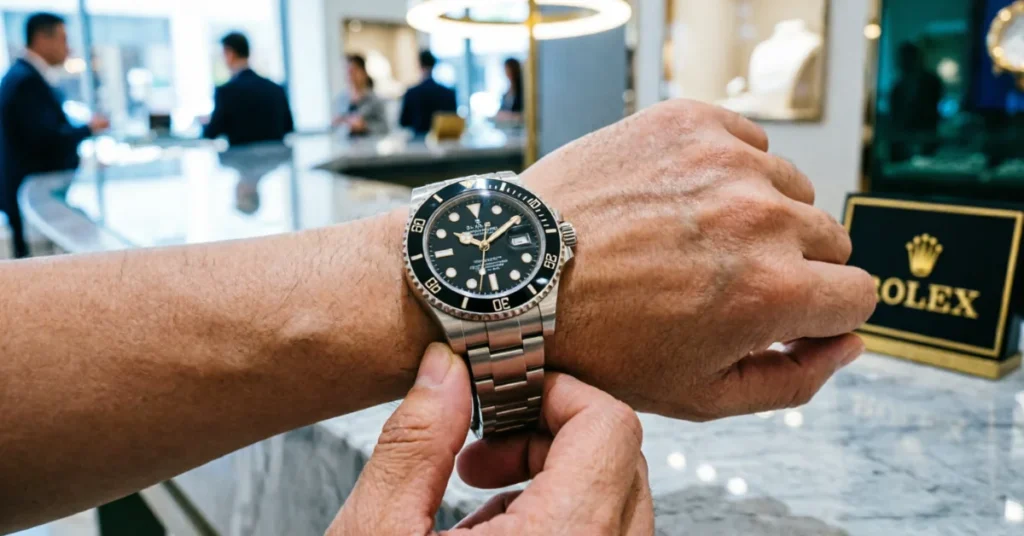
Gift buyers face a slightly different calculation. A dated leather strap or a versatile steel bracelet tends to hold broader appeal than a niche complication, which is why field watches and simple three-hand automatics remain the safest gifting choice inside this category.
Worth flagging honestly for anyone shopping right now: exchange rate swings between the US dollar and Swiss franc have nudged retail prices upward on several models through 2026, so a watch that listed near $1,200 last year might sit closer to $1,350 at some retailers today. Checking current pricing directly with an authorized dealer before assuming last year’s figure still holds is a smart step.
Who Should Consider This Category
Affordable luxury watches aren’t only for first-time buyers stepping away from fashion brands. Collectors who already own a flagship piece frequently add one of these as a daily beater, something they don’t worry about scratching on a hike or at the gym.
Professionals building a first serious watch collection tend to start here too, since the resale value on brands like Tudor and Oris holds up well enough to trade toward a higher-tier piece later if they choose to.
Affordable luxury watches have earned their place in the conversation through consistent quality rather than marketing alone. Whether the goal is a first automatic under $1,000 or a near-flagship piece under $5,000, the segment now delivers genuine Swiss and Japanese craftsmanship without the price tag that used to gatekeep it. As 2026 continues, that value gap between accessible and ultra-premium pricing shows no sign of closing.
FAQs
What counts as an affordable luxury watch?
Generally, anything from $300 to $5,000 with a genuine automatic or mechanical movement, sapphire crystal, and Swiss or Japanese manufacturing standards, rather than a purely fashion-driven design.
Which brand offers the best value in 2026?
Tudor and Oris consistently rank highest among collectors for balancing in-house engineering with accessible pricing, though Hamilton and Tissot remain the easiest entry points under $1,000.
Do affordable luxury watches hold their resale value?
Certain models do well, particularly the Tudor Black Bay line and Oris Aquis, both of which see steady demand on the secondary market.
Is it safe to buy these watches online?
Yes, as long as the purchase goes through an authorized dealer listed on the brand’s official site. Grey market listings can carry voided warranties.
What’s the difference between these and fashion watches?
Fashion watches prioritize appearance and branding, while affordable luxury watches focus on movement quality, case construction, and long-term durability, the same engineering priorities as far pricier pieces.