
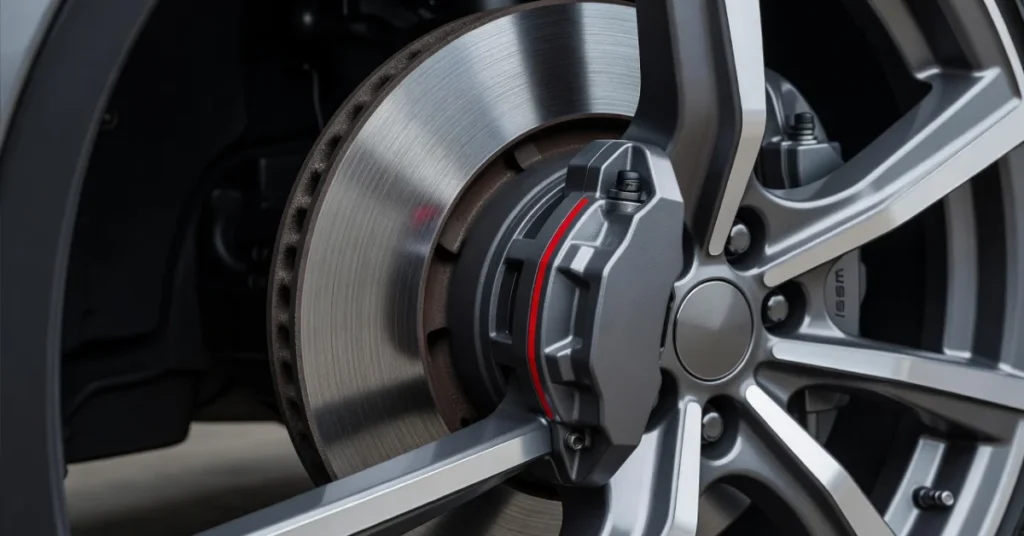
You press the pedal, the car starts to slow, and then it happens. A pulse. A shudder through the steering wheel. Maybe a shake you can feel in your seat. If you’ve typed “why does my car vibrate when i brake” into a search bar today, you’re dealing with one of the most common complaints mechanics hear. It’s not random, and it’s rarely mysterious once you know what to check. Below is a full breakdown of what’s actually going on under your car, why it happens more in 2026 as vehicles carry heavier battery packs and regenerative braking systems, and what you can do about it.
Why Does My Car Vibrate When I Brake? The Short Answer
In most cases, the vibration comes from an uneven contact surface between your brake pads and rotors. Heat builds up unevenly across the rotor face during hard stops, and over hundreds of cycles that uneven heating leaves the metal slightly thinner in some spots than others. When the pad clamps down, it grabs unevenly. That grabbing translates into pulsing you feel in the pedal or wheel.
That’s the headline cause. But it isn’t the only one. Worn suspension parts, sticking calipers, bad wheel bearings, and even simple tire imbalance can produce a nearly identical sensation. Here’s the deal: the fix depends entirely on which part is actually failing, so guessing costs you money.
Warped Brake Rotors: The Most Common Culprit
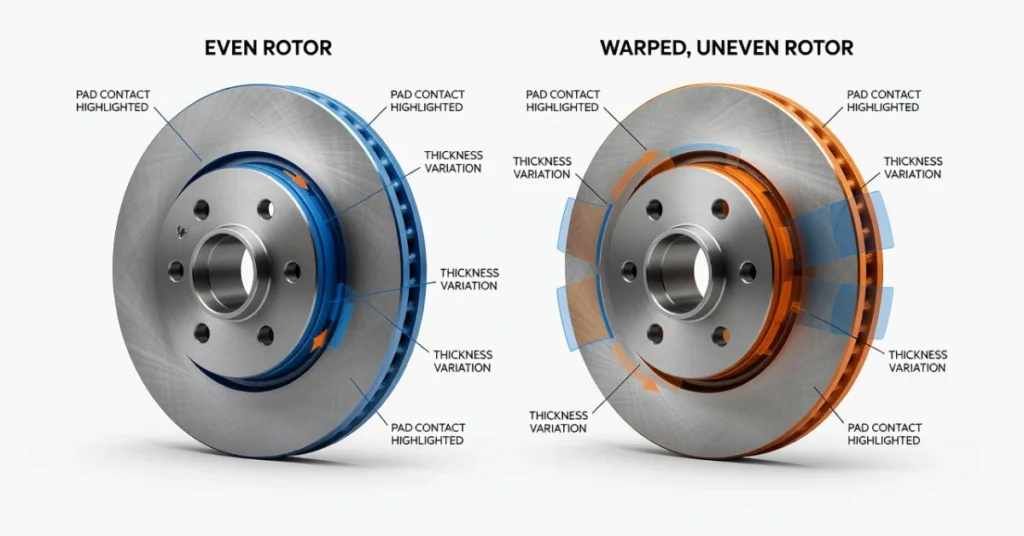
Rotors are the flat metal discs your pads squeeze against every time you slow down. They’re built to handle heat, but not infinite heat cycling without consequence.
Aggressive city driving, towing, mountain descents, or riding the brakes down a long hill all push rotor temperatures higher than normal. When a hot rotor cools unevenly, tiny variations in thickness develop across its surface. Mechanics call this disc thickness variation, and it’s the technical term behind what most drivers call a “warped rotor.”
Anyone who has replaced a set of rotors after a long road trip knows the pattern. The vibration usually starts small, maybe just a light shimmy at highway speed, then grows worse over a few weeks as the surface degrades further. Front rotor problems tend to show up as a shaking steering wheel. Rear rotor issues are more often felt through the seat or the brake pedal itself.
Worn or Contaminated Brake Pads
Pads wear down every time you use them, and they don’t always wear evenly. A pad with uneven material left on its surface won’t sit flush against the rotor, and that gap creates chatter under pressure.
Contamination adds another layer. Oil, grease, or road grime on the pad surface changes how it grips. Some pads also leave a thin transfer layer of material on the rotor if they overheat, which can mimic rotor warping even when the rotor itself is fine. This is why a mechanic will often check pad thickness and surface condition before ever touching the rotor.
Sticking Brake Calipers
The caliper is the clamp that forces your pads against the rotor. When it works correctly, pressure applies evenly on both sides. When a caliper slide pin seizes from rust or old grease, one side of the pad presses harder than the other.
That uneven pressure doesn’t just cause vibration. It also wears the pad and rotor unevenly, drags on that wheel constantly, and can produce a faint burning smell after a long drive. A seized caliper needs attention fast, since it can also pull the car to one side during a stop, which is a genuine safety concern, not just a comfort issue.
Worn Wheel Bearings and Hub Assemblies
The hub assembly keeps your wheel spinning true and centered. Once it wears out, the wheel develops slight play, wobbling almost imperceptibly until you apply the brakes and load shifts onto it.
Drivers dealing with a failing hub often notice a low humming or grinding noise that changes pitch with speed, along with the vibration. If you press the brake and the shake gets noticeably worse the harder you push, a hub or bearing issue is worth ruling out alongside the rotors.
Suspension and Alignment Problems
Struts, control arm bushings, tie rods, and ball joints all keep your wheels planted and aligned. When any of these wear out, braking forces shift the car’s weight in ways the suspension can no longer control smoothly.
A car with worn suspension components often feels fine at steady speed but develops a shimmy or wobble specifically under braking, since that’s the moment weight transfers hardest onto the front end. Poor alignment adds to this by causing uneven tire contact patches, which then feed vibration back through the chassis.
Tire Wear and Balance Issues
Out-of-balance tires or uneven tread wear rarely cause vibration at a steady cruising speed but can become far more noticeable the instant you brake, since the car’s weight shifts forward and puts extra load on the front tires.
A quick way to separate tire-related shake from brake-related shake: if the vibration is present even without braking, especially at certain speeds, tires or wheel balance are the more likely suspects. If it only shows up when your foot hits the pedal, the brake system itself is the stronger lead.
What About Drum Brakes?
Most of the causes above focus on disc brakes, but plenty of older vehicles, trucks, and even some newer economy cars still use rear drum brakes. Anyone asking why does my car vibrate when i brake and driving one of these vehicles needs a slightly different answer, since drum brake vibration works differently and it’s a gap most articles on this topic skip entirely.
Inside a drum brake, curved shoes press outward against the inner surface of a spinning drum instead of a flat pad clamping a rotor. When that drum wears unevenly, a condition mechanics call “out-of-round,” the shoes make inconsistent contact as the drum rotates. The result feels similar to a warped rotor: a pulsing sensation, usually milder and felt more in the pedal or floor than the steering wheel.
Rust buildup on the drum’s inner surface, especially after sitting in humid weather or after a car wash, can also mimic this same shudder for the first few stops. Anyone who drives a truck or an older sedan with rear drums knows this pattern shows up more in winter and after long periods of parking. If your car vibrates only from the rear and it’s an older or budget model, checking drum condition and shoe wear belongs on the same inspection list as the rotors.
Can a Brake Job Itself Cause Vibration?
Here’s something drivers rarely expect, and it directly answers a version of why does my car vibrate when i brake that most guides miss: a fresh brake job can introduce the very vibration it was meant to fix. Improper installation torque on wheel lug nuts or rotor hardware can slightly distort a rotor even before it sees real-world use.
When lug nuts are tightened unevenly, or in the wrong sequence, they can pull a rotor just enough out of true that it develops a subtle warp within the first few hundred miles. This is why a reputable shop always torques lug nuts to the manufacturer’s spec, in a star pattern, rather than just running an impact wrench around the wheel in a circle.
New pads add another wrinkle. They need a proper bedding-in process, several moderate stops from around 40 mph without coming to a complete halt, to transfer an even layer of pad material onto the rotor surface. Skip that step, and the uneven transfer layer can produce the same pulsing feeling as a genuinely worn rotor, even though the parts themselves are brand new. Anyone who has had brakes replaced and noticed the shake return within weeks should ask the shop about torque specs and bedding procedure before assuming the parts themselves are faulty.
Brake Vibration in Hybrid and Electric Vehicles
This is a genuinely underreported angle for 2026, and it’s worth its own section rather than a passing mention, especially for EV and hybrid owners typing why does my car vibrate when i brake for the very first time after switching from a gas vehicle. Hybrid and electric vehicles rely heavily on regenerative braking, which uses the electric motor to slow the car and recharge the battery, instead of the friction brakes, for a large share of everyday stops.
That’s great for pad and rotor lifespan, but it creates an unexpected side effect. Rotors that go weeks without firm friction contact can develop a thin layer of surface rust, especially in humid or coastal climates. That rust layer isn’t a sign of failure. It’s simply oxidation sitting on metal that isn’t being scraped clean as often as it would be in a traditional gas car.
Drivers switching from a gas vehicle to an EV or hybrid often feel a pulsing vibration during the first hard stop of the day and assume the worst, when normal friction braking over the next few stops wears the light rust off entirely. Professionals servicing EVs increasingly recommend an occasional firm stop from higher speed, purely to keep the rotor surface clean, even when regenerative braking handles most daily driving. If your hybrid or EV vibrates briefly first thing in the morning but smooths out after a stop or two, this is very likely the explanation, not a mechanical fault.
Why Does My Car Vibrate When I Brake at Highway Speeds?
Speed-dependent vibration tells you something specific. Rotor and hub problems tend to intensify as speed climbs, since the wheel is spinning faster and any thickness variation or wobble completes more cycles per second. That’s why a shudder that’s barely noticeable at 30 mph can feel alarming at 65 mph.
Front-end shake felt through the steering wheel at highway speed usually points to front rotors, front wheel bearings, or front suspension. A pulse felt in the seat or floor, rather than the wheel, more often traces back to the rear brakes. Paying attention to exactly where you feel it, and at what speed it starts, gives a mechanic a real head start before the car even goes on a lift.
What the Research Shows
Detailed analysis of brake complaint patterns from repair shops consistently points to the same short list of causes: rotor thickness variation, pad wear, caliper drag, and suspension wear, in roughly that order of frequency. Professionals working in brake diagnostics report that speed and inspection habits matter more than vehicle age. Cars driven mostly on flat highways with light braking tend to go far longer between rotor issues than cars used for repeated stop-and-go city driving or mountain descents.
Detailed analysis of this reveals another pattern worth noting for 2026: newer vehicles with regenerative braking, especially hybrids and EVs, rely less on friction braking at low speeds, which can actually cause light surface rust to build up on rotors that go unused for long stretches. That rust layer can itself create a temporary pulsing sensation until it wears off during the first few firm stops.
How to Diagnose the Vibration Yourself
You don’t need a full shop visit to narrow down why does my car vibrate when i brake. Try this before booking an appointment:
- Note the speed where vibration starts and whether it worsens as you brake harder
- Feel where the shake is strongest: steering wheel, pedal, or seat
- Check if it happens with steady cruising too, not just braking
- Look at tire tread for uneven wear patterns
- Listen for grinding, humming, or squealing alongside the shake
A car that vibrates only under hard braking and gets progressively worse over a few weeks is telling a very different story than one that’s shaken since a recent tire rotation. Anyone who has diagnosed this before knows the details matter as much as the symptom itself.
Causes at a Glance: DIY Check or Professional Fix?
| Cause | Can You Check It Yourself? | Urgency Level |
|---|---|---|
| Warped rotors | Visual check only, repair needs a shop | Moderate, plan repair soon |
| Worn or contaminated pads | Thickness check possible at home | Moderate to high |
| Sticking caliper | Not safely, needs a lift and tools | High, book promptly |
| Worn wheel bearing or hub | Not safely, needs proper diagnostics | High, book promptly |
| Suspension or alignment wear | Visual bushing check only | Moderate |
| Tire wear or imbalance | Tread and pressure check at home | Low to moderate |
| Drum out-of-round | Not safely, drum must come off | Moderate |
| New rotor rust (EV/hybrid) | Self-resolving after a few stops | Low, monitor only |
When to See a Mechanic
If you’re still wondering why does my car vibrate when i brake after checking the basics above, mild vibration that’s stayed the same for months isn’t usually an emergency, but it also won’t fix itself. Book an inspection soon if you notice any of the following alongside the shake: pulling to one side, a burning smell, longer stopping distances, or a pedal that feels soft or sinks lower than normal.
Don’t wait if the vibration gets suddenly worse or the pedal feels different overnight. That kind of rapid change can point to a caliper or hydraulic issue rather than gradual rotor wear, and it directly affects how well the car stops.
Brake Vibration vs Other Types of Car Shake
| Symptom | Likely Source | Felt Where |
|---|---|---|
| Shake only when braking | Rotors, pads, calipers | Wheel or pedal |
| Shake at all speeds | Tires, wheel balance | Whole car |
| Worse at highway speed | Rotors, hub bearings | Steering wheel |
| Grinding sound + shake | Worn pads, hub bearing | Wheel area |
| Pulling to one side | Sticking caliper, alignment | Steering wheel |
Conclusion
So, why does my car vibrate when i brake? Nine times out of ten it comes down to a rotor, pad, caliper, or suspension component that’s worn unevenly and needs attention. It’s rarely something to ignore, since braking performance and your safety on the road depend directly on these parts working smoothly together. Catching it early, whether that’s a quick pad swap or a rotor resurface, almost always costs less than waiting until the problem spreads to other components.
FAQs
Is it safe to keep driving if my car vibrates when I brake?
Light vibration usually isn’t an immediate emergency, but it signals wear that will get worse. Get it checked within a week or two, sooner if you notice pulling, grinding, or a soft pedal.
Can I fix brake vibration myself?
Simple checks like tire pressure, tread wear, and lug nut torque are doable at home. Rotor and caliper repairs need proper tools and torque specs, so most drivers leave that part to a shop.
Does resurfacing rotors fix the vibration?
It can, as long as the rotor still has enough thickness left after machining. If it’s already near the minimum spec, replacement is the safer and often cheaper long-term choice.
Why does my car only vibrate when braking hard, not lightly?
Light braking generates less heat and pressure, so minor thickness variation or pad unevenness doesn’t show up as strongly. Hard stops expose the same flaw under much higher clamping force.
Can new brake pads cause vibration?
Yes, temporarily. New pads need a proper bedding-in process to transfer an even layer of material onto the rotor. Skipping that step can cause pulsing that improves after a few normal stops.