
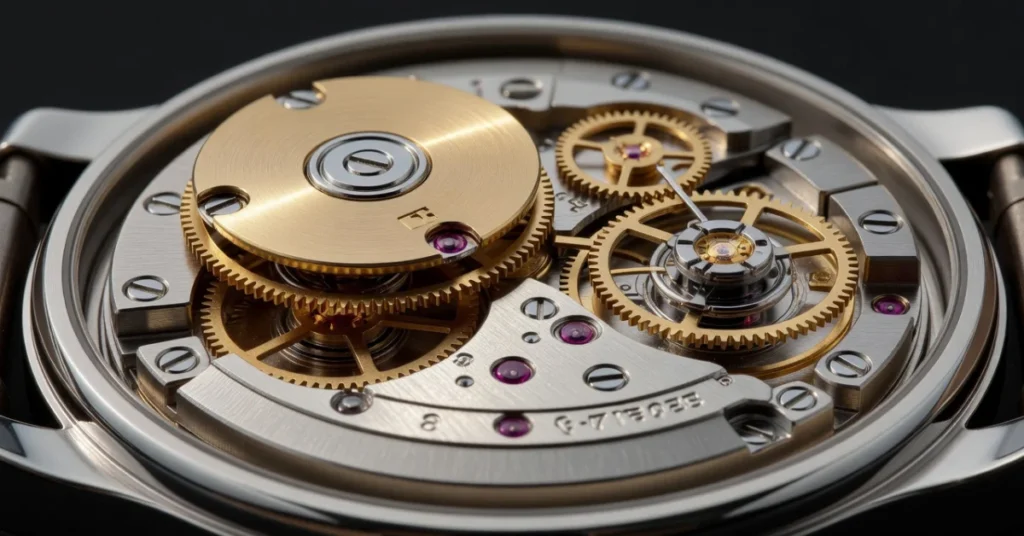
Wind it once, wear it daily, and it never stops moving on its own. That’s the quiet magic behind swiss automatic watches, and it’s why collectors keep coming back to them even in an age of smartwatches and quartz precision. There’s no battery, no charging cable, just a rotor spinning with your wrist and a mainspring doing the rest.
For a lot of first-time buyers, the appeal starts with the name on the dial. But the real story sits underneath the case back, in a tiny engine of gears, jewels, and springs that hasn’t changed much in over a century. Understanding how that engine works, and what actually makes a watch “Swiss,” is the difference between buying something meaningful and buying a logo.
What Are Swiss Automatic Watches, Exactly?
An automatic watch, also called a self-winding watch, powers itself through the natural motion of the wearer’s arm. A weighted rotor inside the case swings with movement and winds the mainspring, which then releases energy gradually to keep the gear train running.
Swiss automatic watches specifically refer to timepieces whose movement, assembly, and inspection meet the legal criteria set for the word “Swiss” to appear on the dial. This isn’t a marketing term brands can slap on casually. It’s a protected designation with real legal weight behind it.
Anyone who has handled both a quartz and an automatic side by side notices the difference immediately. The automatic has a smooth, sweeping second hand instead of a tick, and it carries a certain heft that comes from dozens of tiny mechanical parts working in sync.
How the Movement Inside Actually Works
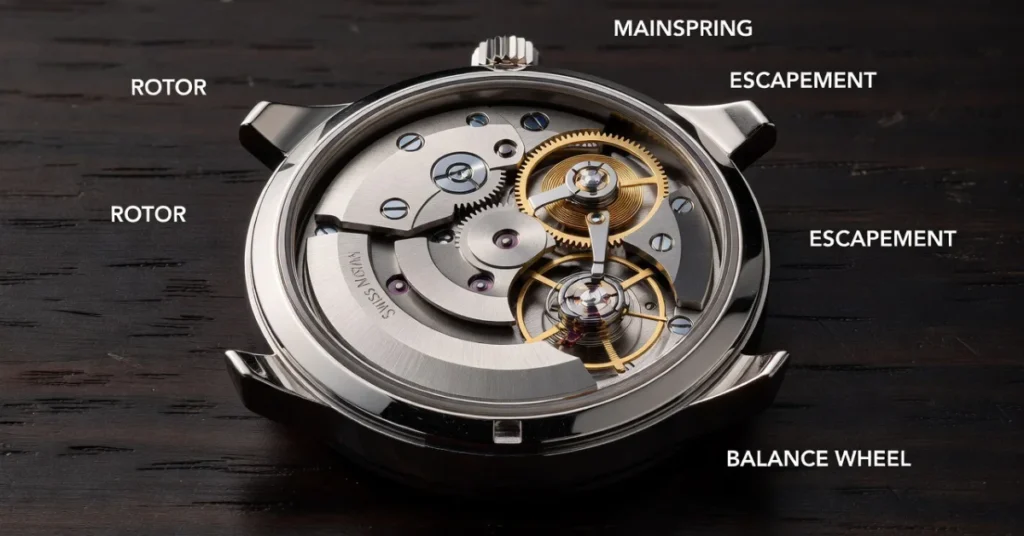
Open the case back of a mechanical piece and you’ll find a small orchestra of components. Here’s the basic sequence:
- The rotor spins with wrist motion and winds the mainspring
- The mainspring stores energy and releases it slowly through the gear train
- The escapement regulates that release, ticking at a controlled rate
- The balance wheel oscillates back and forth, acting as the watch’s heartbeat
- The dial train translates all of this into the movement of the hands
Most modern calibers run at a frequency of 4 Hz, or 28,800 vibrations per hour, though some brands push higher for smoother sweep and finer accuracy. Power reserve, meaning how long the watch keeps running once you take it off, typically ranges from 38 to 70 hours depending on the caliber.
Anyone who has worked with watchmakers knows accuracy in a mechanical piece isn’t measured the same way as in a quartz model. A well-regulated automatic might gain or lose a few seconds a day, and that’s considered excellent for a purely mechanical instrument.
The “Swiss Made” Label: What It Really Guarantees
This is where a lot of confusion creeps in. Buyers assume “Swiss Made” means every screw was machined in a Geneva workshop. That’s not quite the standard.
Under the ordinance regulating the term, a watch is considered Swiss made if its technical development is carried out in Switzerland, its movement is Swiss, the movement is cased up in Switzerland, the final inspection happens in Switzerland, and at least 60 percent of the manufacturing costs are incurred in Switzerland. The rule tightened in 2017, shifting the value calculation from just the movement to the entire finished watch.
So no, a Swiss automatic watch doesn’t have to be 100 percent built on Swiss soil. But it does have to clear a genuinely strict bar of value creation, technical origin, and final quality control, all happening inside the country. That’s a meaningfully higher standard than most consumer goods labeled with a country of origin.
This label matters because it protects buyers from vague marketing. A typical breakdown at brands that meet this bar looks like Swiss-designed calibers, Swiss casing, and Swiss final testing before the watch ever reaches a retailer.
Swiss Automatic Watches vs Quartz and Manual-Wind Models
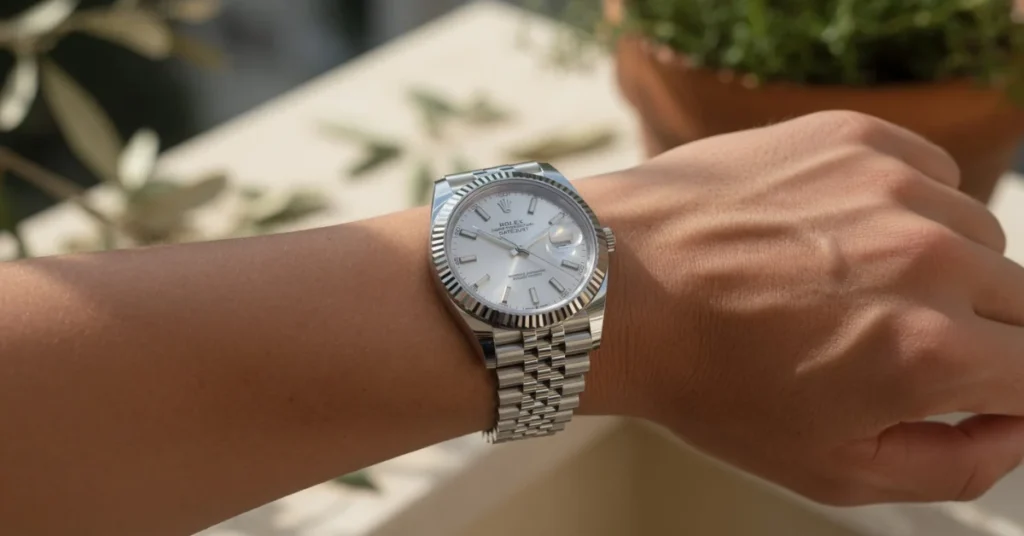
Not every watch fan needs a self-winding movement, and it helps to know where each type actually fits.
Quartz watches run on a battery and a vibrating crystal, offering near-perfect timekeeping accuracy for a fraction of the price. Manual-wind mechanicals need daily winding by hand through the crown, appealing to purists who enjoy the ritual. Automatics sit in the middle: mechanical charm without the daily winding chore, as long as you wear the watch regularly.
Think of it like the difference between a manual and automatic car. Both get you where you’re going, but one asks a little more engagement from the driver, and plenty of people genuinely prefer that involvement.
The tradeoff with automatics is that they need consistent wrist time or a watch winder to stay powered when not worn. Leave one in a drawer for a week and it’ll stop, requiring a manual reset of time and date.
Here’s how the three types stack up on the points that matter most to a buyer:
| Feature | Automatic | Quartz | Manual-Wind |
|---|---|---|---|
| Power source | Wrist motion (rotor) | Battery | Hand-winding via crown |
| Typical accuracy | A few seconds per day | A few seconds per month | A few seconds per day |
| Daily maintenance | None if worn regularly | None | Winding required daily |
| Second-hand motion | Smooth sweep | Ticking | Smooth sweep |
| Typical price entry point | Mid to high | Low to mid | Mid to high |
| Best suited for | Daily wearers who want mechanical feel | Buyers prioritizing precision and low upkeep | Purists who enjoy hands-on ritual |
Why Swiss Automatic Watch Prices Shifted in 2025 and 2026
Anyone shopping for a Swiss automatic watch in the US over the past year noticed pricing move around more than usual, and there’s a clear reason behind it.
In August 2025, the United States imposed a steep 39 percent tariff on Swiss imports, among the highest rates applied to any developed trading partner at the time. Brands absorbed part of the hit and passed some of it on through price increases on new watches sold in the US.
That changed in December 2025. The United States and Switzerland announced a framework trade agreement that included Washington slashing its tariffs on imported Swiss products to 15 percent from 39 percent, alongside a pledge by Swiss companies to invest 200 billion dollars in the US by the end of 2028. The reduced rate applied retroactively to mid-November 2025.
The ripple effect reached beyond new retail pricing. With the tariff only applying to watches crossing the border after the increase took effect, pieces already sitting in US dealer inventory or owned by private sellers carried no extra import cost. That pushed noticeably more attention toward the pre-owned Swiss automatic watch market through late 2025 and into 2026, a shift that professionals in the resale trade describe as more structural than temporary.
For buyers today, the practical takeaway is straightforward: retail prices on new pieces reflect the 15 percent rate baked into 2026 catalogs, while the secondary market remains a genuine value option for anyone comparing total cost before committing to a purchase.
Who Actually Buys Swiss Automatic Watches in 2026
The buyer profile has shifted noticeably. Professionals in this field know the customer base used to skew almost entirely toward older, established collectors. That’s changing.
Younger buyers are entering the category earlier, often drawn in by social media coverage of vintage references and independent watchmakers. At the same time, established collectors continue treating certain references as long-term holds rather than pure fashion purchases.
Regional demand is shifting too. Markets across the Middle East and Asia-Pacific have become increasingly important for Swiss manufacturers, with younger, affluent buyers in these regions showing strong interest in both entry-level and high-complication pieces. Meanwhile, mature Western markets remain steady, anchored by long-standing brand loyalty.
What the Research Shows
Industry monitoring bodies tracking the mechanical watch sector have consistently noted a revival of interest in traditional movements, particularly among younger buyers who might otherwise have gravitated toward smartwatches. That’s a notable reversal from predictions made a decade ago, when many assumed connected devices would push mechanical watches into pure luxury-collector territory.
Detailed analysis of recent industry reporting also points to fragmentation in demand: established heritage brands continue holding steady value, while some mid-tier references have seen softer resale pricing as buyers become more selective about specific models rather than brand names alone. That pattern rewards research over impulse buying, especially for anyone treating a purchase as a long-term piece rather than a quick flip.
Common Mistakes First-Time Buyers Make
A first-time buyer without guidance often runs into the same handful of problems.
Skipping the movement check is the biggest one. Two watches can look nearly identical from the front while housing very different calibers underneath, one in-house and finely finished, another an off-the-shelf module. Buyers also underestimate service costs. A mechanical movement typically needs professional servicing every four to eight years, and that isn’t optional maintenance, it’s what keeps the gear train from wearing down.
Another common gap is ignoring authorized dealer networks. Buying gray-market or secondhand without verifying papers and serial numbers opens the door to counterfeits, which remain a persistent problem across the luxury watch industry.
The 2026 Outlook for Swiss Automatic Watches
Heading further into 2026, the picture for swiss automatic watches looks like a market recalibrating rather than shrinking. Tariff shifts and trade policy changes across major export markets have pushed some manufacturers to rethink pricing and distribution, while demand from emerging wealth centers continues to offset softer growth in traditional strongholds.
What hasn’t changed is the underlying appeal. A well-made mechanical movement still represents something a mass-produced electronic device can’t replicate: decades of accumulated craft, passed down through generations of watchmakers, contained in a case small enough to fit on a wrist.
Conclusion
Swiss automatic watches aren’t just status pieces sitting behind glass counters. They’re small mechanical instruments built on a genuinely strict legal and technical standard, powered entirely by the wearer’s own movement. Whether someone’s buying a first entry-level piece or chasing a specific vintage reference, understanding the movement, the Swiss Made criteria, and the realistic maintenance costs makes for a far smarter purchase than chasing a brand name alone. That knowledge is what separates a satisfied long-term owner from someone who gets talked into buying a logo.
FAQs
Do Swiss automatic watches need batteries?
No. They’re powered entirely by wrist motion through a rotor that winds the mainspring, storing mechanical energy instead of relying on a battery.
How accurate are Swiss automatic watches compared to quartz?
Quartz movements are generally more accurate, often within a few seconds per month. A well-regulated Swiss automatic typically runs within a few seconds per day, which is considered strong performance for a purely mechanical movement.
What happens if I stop wearing my automatic watch?
It will gradually wind down and stop once the mainspring’s stored energy runs out, usually within 38 to 70 hours depending on the caliber. You’ll need to reset the time and date manually or use a watch winder to keep it running.
Is every watch labeled “Swiss Made” fully built in Switzerland?
Not entirely. The legal standard requires the movement, casing, and final inspection to happen in Switzerland, along with at least 60 percent of manufacturing costs, but it doesn’t require every single component to originate there.
How often should a Swiss automatic watch be serviced?
Most manufacturers recommend servicing every four to eight years, depending on the caliber and how frequently the watch is worn, to keep the lubrication and gear train in proper working condition.