
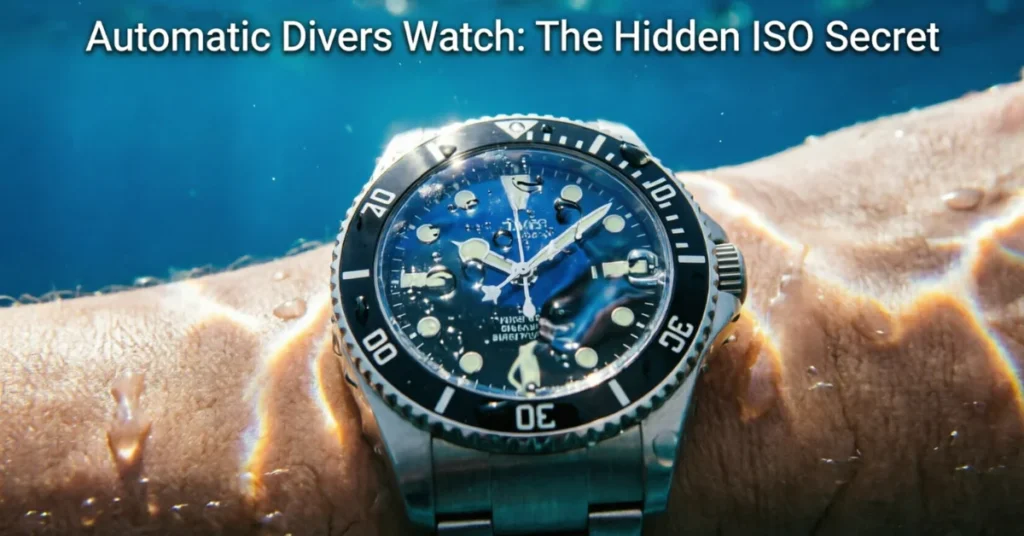
Drop a battery-powered watch in the ocean for good and it stops the moment the cell dies. An automatic divers watch never has that problem, because the only thing keeping it alive is the motion of your own wrist. That single mechanical fact is why serious divers, collectors, and everyday buyers keep circling back to this style of watch even in an age of dive computers and smartwatches.
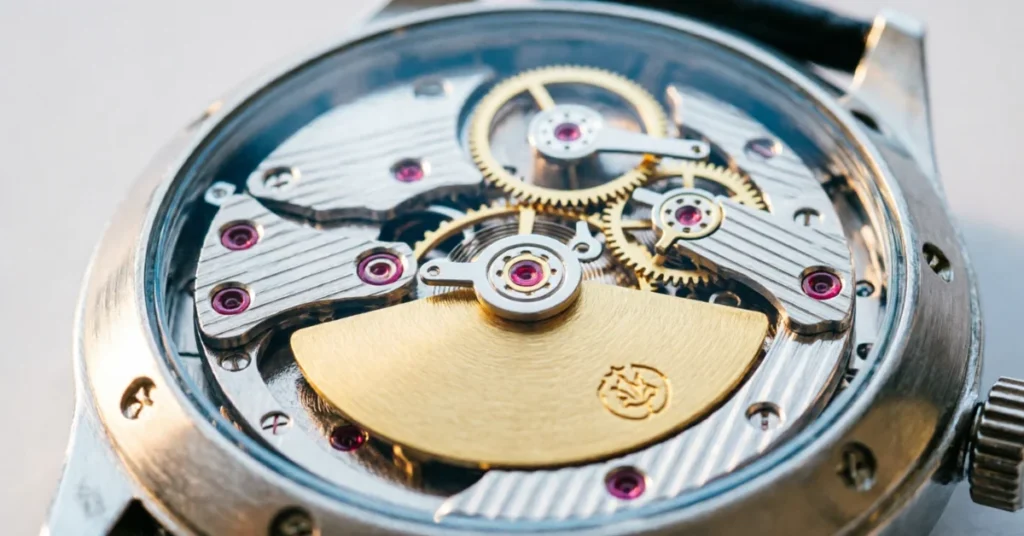
An automatic divers watch is a self-winding mechanical timepiece built to survive real underwater pressure, not just splashes at the sink. It uses a rotor inside the case that spins with natural arm movement, winding the mainspring and storing energy without a crown, a charger, or a single battery.
Why an Automatic Divers Watch Still Beats a Smartwatch Underwater
Smartwatches track dives well on paper. Screens dim in daylight, batteries drain mid-trip, and touchscreens misbehave with wet gloves or thick neoprene. None of that touches a mechanical automatic.
An automatic divers watch has no software to freeze and no charging cable to forget on a liveaboard boat. The mainspring stores enough energy from daily wear to run for roughly 38 to 70 hours depending on the caliber.
Divers who still strap on a mechanical piece as backup timing gear say the same thing again and again: it’s the one instrument on their wrist that has never once needed a reset.
What Makes an Automatic Divers Watch ISO 6425 Certified
Not every watch with a rotating bezel deserves the word “diver.” To carry the DIVER’S label under that standard, a watch has to clear several hurdles:
- Minimum 100 meters of water resistance, tested at pressure beyond the stated depth
- A unidirectional, lockable timing bezel so accidental bumps only shorten a dive estimate, never extend it
- Legibility in complete darkness from at least 25 centimeters away
- Shock resistance equal to a one-meter drop onto a hardwood surface
- Anti-magnetic performance, capped at 30 seconds a day deviation after exposure
- Resistance to 24 hours in room-temperature saltwater without corrosion or malfunction
Here’s how a genuinely certified piece stacks up against a watch that merely looks the part:
| Feature | ISO 6425 Diver’s Watch | Standard Water-Resistant Watch |
|---|---|---|
| Depth rating | 100m minimum, tested beyond stated depth on every unit | Often untested past a sample batch |
| Bezel | Unidirectional, lockable, luminous | Bidirectional or decorative only |
| Dark legibility | Readable from 25cm in total darkness | Not required |
| Shock resistance | Survives a 1-meter drop onto hardwood | No formal shock standard |
| Magnetic resistance | Max 30 seconds/day deviation after exposure | Not tested |
| Saltwater resistance | 24-hour saline soak test on every watch | Rarely tested |
| Dial marking | Carries “DIVER’S” text | No such marking permitted |
A related mix-up worth clearing up: ISO 6425 is not the only water-resistance standard on the market. ISO 22810 covers general water-resistant watches, fine for swimming or showering but never tested for actual diving. A dial that just says “200m water resistant” without the DIVER’S text is almost always following the lighter 22810 standard, not 6425.
Serious depth also brings up the helium escape valve, or HEV, used during saturation diving. When divers spend days in a pressurized chamber breathing helium-mixed gas, helium molecules seep into the watch case — without a release valve, that trapped gas can pop the crystal off during decompression. Recreational divers never need this feature, but it’s worth knowing why the valve exists.
Real Brands Building These Watches Right Now
Seiko practically built its reputation on affordable, genuinely capable dive pieces, with models like the Prospex line still popular with working divers. Omega’s Seamaster Planet Ocean line pairs extreme depth ratings with co-axial movements. Rolex’s Submariner remains the reference point most other divers get compared against.
Oris has carved out a niche among enthusiasts who want mechanical purity without a luxury price tag, while newer independents like Doxa keep chasing the vintage orange-dial look.
The bezel insert material matters more than most buyers realize. Aluminum inserts, common on entry-level pieces, scratch easily and fade under sun exposure. Ceramic inserts resist scratching and hold color far longer, which is why most mid-range and luxury automatic divers watch models switched to ceramic over the past decade. A handful of premium references now use sapphire inserts — nearly scratch-proof but costly and easy to chip on sharp impact.
The Pros and Cons Divers Actually Talk About
What people like:
- No battery to replace or charger to pack
- Movements can be serviced and kept running for decades
- Mechanical craftsmanship has genuine resale and collector value
- Works reliably in cold water, where some batteries and touchscreens struggle
What people don’t like:
- Costs more upfront than a quartz or digital equivalent
- Needs servicing roughly every four to eight years to stay accurate
- Slightly less precise timekeeping than quartz, typically a few seconds a day
- Heavier on the wrist due to the steel case and movement components
Servicing cost is one number competitor guides rarely put in writing. A full movement service on a mainstream automatic typically runs $150 to $300 at an independent watchmaker. Brand-authorized service centers charge more, often $400 to $600 for the same work on Swiss pieces.
Case Size and Fit Nobody Talks About
Most automatic divers watch models run 40mm to 44mm across the case. A 44mm case on a 6-inch wrist tends to overhang the edge and can catch on wetsuit cuffs or gear straps. Lug-to-lug length, the distance from tip to tip on the case, matters more than the diameter number alone.
Smaller-wristed buyers increasingly gravitate toward the 38mm to 40mm range now offered by Seiko, Longines, and a handful of Swiss brands.
Spotting a Counterfeit Before You Buy
The secondhand dive watch market runs hot, and counterfeiters follow the money. Rolex Submariners and Seiko divers rank among the most faked watches sold online.
Weight is the first tell — genuine mechanical movements and solid-link bracelets carry real heft. Second, check the sweeping seconds hand; a true automatic sweeps smoothly, while cheap quartz fakes tick once per second. Third, cross-check the serial and reference numbers against official brand records. Buying from an authorized dealer or a verified secondhand platform remains the safest route.
What the Research Shows
According to Statista’s 2026 market outlook, the global watches category generated roughly US$135.63 billion in worldwide revenue in 2026, with an expected annual growth rate of 5.62 percent through 2031. Separate analysis of the mechanical watch category found the automatic, self-winding segment holding roughly 72.2 percent of overall mechanical watch market share heading into 2026.
None of that data is diver-specific, but the parent trend is consistent enough to draw a fair connection — self-winding movements are the growth engine of the mechanical watch world, and dive watches remain one of the most requested styles within it.
Who Should Actually Buy One
Active scuba and freedive enthusiasts benefit from a rugged backup timer that won’t quit mid-trip. Watch collectors appreciate the mechanical engineering and resale strength. Outdoor professionals like the shock and water resistance for daily rough use.
Casual buyers who just like the look should know that plenty of dive-styled watches sold at retail don’t meet ISO 6425 at all.
What to Check Before Buying an Automatic Divers Watch
Confirm the actual water resistance rating in meters, not just the word “diver” printed on the dial. Check whether the bezel is unidirectional and clicks firmly into place. Ask about the movement’s power reserve and service interval before buying secondhand. Finally, look for the DIVER’S text on the dial itself rather than taking a seller’s word for it.
Conclusion
An automatic divers watch earns its reputation the hard way, through pressure tests, shock tests, and decades of divers actually trusting one on real dives rather than marketing copy. Whether the goal is a working tool, a collector’s piece, or simply a watch that never asks for a battery, the category keeps proving why mechanical engineering still has a place on a wet wrist in 2026.

FAQs
Is an automatic divers watch better than a dive computer?
They solve different problems. A dive computer calculates decompression limits and gas mixes in real time, while an automatic divers watch simply keeps reliable time underwater without needing a battery.
How deep can an automatic divers watch actually go?
ISO 6425 sets a floor of 100 meters, but plenty of models rated for professional diving go far beyond that, sometimes past 300 meters.
Do automatic divers watches need batteries at all?
No. A rotor inside the case winds the mainspring using wrist motion, storing enough energy to keep the watch running even during periods on the shelf.
How often does an automatic divers watch need servicing?
Most manufacturers recommend a full movement service every four to eight years.
Are cheaper automatic divers watches actually safe for real diving?
Some are. Price doesn’t automatically equal safety — the safest approach is checking for the DIVER’S marking rather than trusting the price tag alone.