
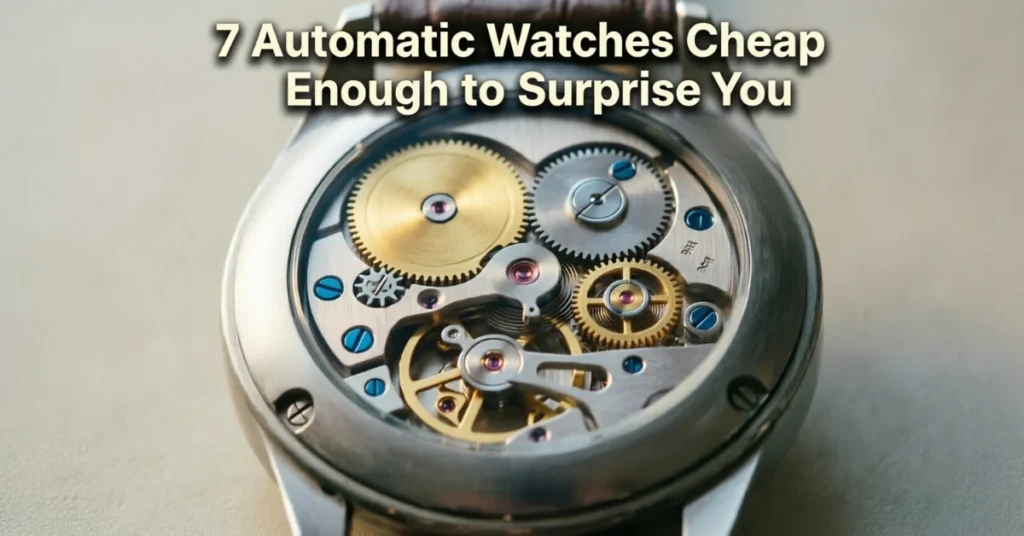
Most people assume a self-winding watch has to cost a small fortune. It doesn’t. Automatic watches cheap enough to wear every day, spill coffee near, and never worry about, are more available in 2026 than at any point in the last few decades. Hold one up to the light and you can watch a tiny rotor spin, winding a mainspring using nothing but the motion of your own wrist. No battery. No charging cable. Just gears doing what gears have done since the 1770s.
That’s the part people miss when they picture “automatic” and think Rolex. The category has quietly split in two. There’s the boutique tier with five-figure price tags, and then there’s a much larger, much more interesting tier where a genuine mechanical movement sits inside a $150 case. This guide sticks to that second group.
What Actually Makes a Watch “Automatic”
An automatic watch is a mechanical timepiece that winds itself through the natural movement of your arm. Inside the case is a semicircular weight, the rotor, that swings freely as you walk, type, or gesture through a conversation. That motion feeds energy into the mainspring, which powers the gear train and, eventually, the hands.
It’s a different animal from a quartz watch, which relies on a battery and a vibrating crystal for accuracy. Quartz will beat an automatic on precision every time. What automatic movements give you instead is mechanical texture: a smooth sweeping second hand, visible engineering through a display caseback, and the odd satisfaction of owning something that runs on motion rather than electricity. Anyone who’s held both side by side tends to notice the difference immediately, even without knowing the technical reason why.
Why Automatic Watches Cheap Options Have Gotten So Good
Ten years ago, a decent automatic under $300 meant compromise. You got the movement, sure, but the crystal scratched easily and the bracelet felt hollow. That’s changed. Sapphire crystal has crept down into sub-$300 territory. Stainless steel cases are now standard rather than a premium add-on. And Japanese movement makers, particularly Seiko’s in-house division, have refined calibres that hack, hand-wind, and hold reasonable accuracy without the Swiss price tag attached.
Brand positioning explains a lot of the remaining price gap. A company without boutique storefronts and a marketing budget built around exclusivity can pass real savings to the buyer. That’s the entire business model behind Seiko 5, Orient, and Citizen’s entry lines, and it’s why searches for automatic watches cheap enough for a first purchase keep landing on the same handful of names.
Seven Worth Actually Considering
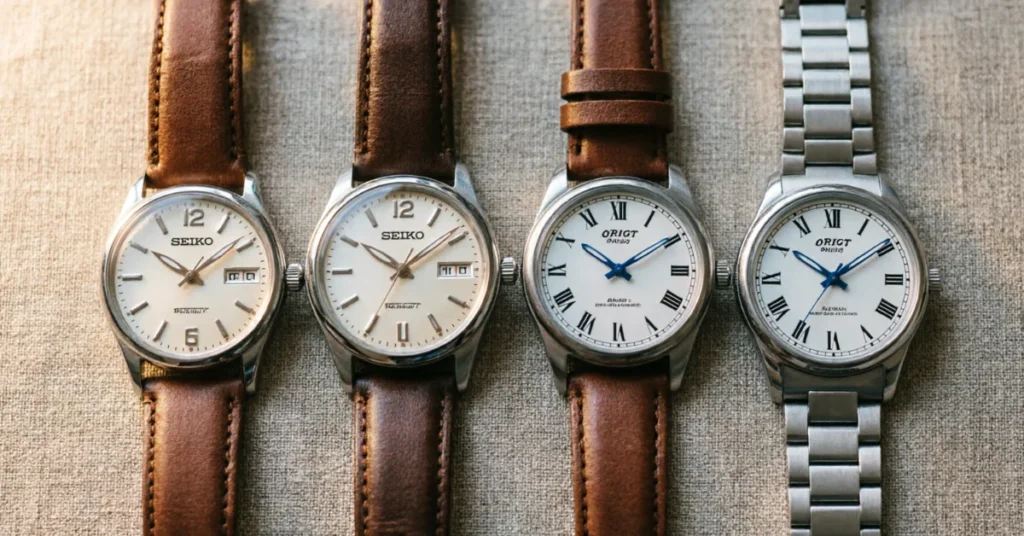
Seiko 5 Sports (SRPD line). Powered by the 4R36 calibre, this watch hacks, hand-winds, and adds day-date functionality with 100m water resistance. It sits in the $200–$350 range depending on the dial variant, and it’s the single most recommended entry point in beginner watch forums for a reason: it does exactly what it promises.
Orient Bambino. A dress watch with an in-house movement, curved crystal, and vintage-leaning Arabic numerals. Multiple generations and dozens of dial colors exist, and most versions land between $150 and $250. It reads far more expensive than its price tag suggests.
Vostok Amphibia. Built in Russia since 1967, this diver uses water pressure to tighten its own case seal at depth, an unusual engineering trick that’s held up across decades of real-world abuse. With 200m water resistance and a screw-down crown, it frequently sells for close to $100, making it one of the most character-rich mechanical watches at any price point nearby.
Citizen NJ series. Citizen’s answer to the Seiko 5, with cleaner dial design and proven movement heritage from a manufacturer that isn’t part of the Seiko-Orient duopoly. A solid pick for anyone who wants Japanese reliability from a third name.
Orient Kamasu. A dive-oriented automatic with sapphire crystal and a screw-down crown, usually priced in the $250–$300 band. It’s the watch most often cited when people ask specifically for a beginner dive automatic that won’t feel disposable in five years.
Ratio automatics. These pair NH35 Seiko-based movements with 200m water resistance on the dive references and sapphire crystal, undercutting most competitors on specifications per dollar. If you’re comparing purely on value, Ratio belongs near the top of the conversation.
Hamilton Khaki Field. A step up in price, usually $500 and above, but worth including because it shows where the “cheap” tier ends and the mid-range Swiss segment begins. It’s a useful benchmark for anyone deciding how much extra polish they actually want to pay for.
Quick Comparison Table
| Watch | Price Range | Movement | Water Resistance | Best For |
|---|---|---|---|---|
| Seiko 5 Sports (SRPD) | $200–$350 | Seiko 4R36 | 100m | First automatic, everyday wear |
| Orient Bambino | $150–$250 | Orient in-house | 30m | Dress watch, office wear |
| Vostok Amphibia | ~$100 | Vostok in-house | 200m | Budget diver, character piece |
| Citizen NJ series | $200–$300 | Citizen in-house | 100m | Alternative to the Seiko/Orient pair |
| Orient Kamasu | $250–$300 | Orient F6922 | 200m | Beginner dive watch |
| Ratio automatics | $200–$350 | NH35 (Seiko-based) | 200m | Best specs per dollar |
| Hamilton Khaki Field | $500+ | ETA/Swiss calibre | 50m | Step-up buyer, field watch look |
Case size matters as much as price. Watches under 38mm suit smaller wrists and read as more classic; the 40–42mm range, common on the Seiko 5 and Orient Kamasu, fits most average wrists comfortably. Anything past 44mm starts to look oversized on wrists under 6.5 inches, regardless of how good the movement inside is.
Movement choice is worth a closer look too. The NH35 hacks and hand-winds, meaning you can stop the second hand to set the time precisely and top up the mainspring by hand when needed. The older Miyota 8215 does neither, but it runs at the same 21,600 vibrations per hour and tends to have a marginally smoother sweep. The 4R36 sits in between, adding day-date functionality on top of hacking and hand-winding. None of the three is objectively “better.” It comes down to whether you want manual control over accuracy or you’re fine letting the watch run on its own.
Where to Actually Buy One
An authorized dealer is the safest route, since the watch ships with a full manufacturer’s warranty and documented service history. Amazon works fine for the mainstream names like Seiko and Citizen, though it’s worth checking that the listing is fulfilled by an authorized seller rather than a third party. Microbrands such as Ratio typically sell only through their own websites, so signing up for their email list is often the only way to catch a specific model before it sells out. Forums like r/watchexchange carry genuine deals from other collectors, but stick to PayPal Goods & Services for any private-party purchase, and treat listings with stock photos and prices that seem too good as a warning sign rather than a bargain.
Buying pre-owned is another route worth considering, and one that’s often overlooked. A Seiko 5 from the late 1960s can still run reliably today because parts remain widely available, which means a decades-old automatic in good condition can actually cost less than a new one while offering the same core mechanical experience. Just budget for a service if the watch hasn’t been touched in years.
Automatic Watches Cheap Enough for Daily Wear vs. Fashion Watches
Here’s the trade-off nobody tells you about upfront. A fashion watch with a battery loses its shine within a few years and usually ends up in a drawer. A well-cared-for automatic, by contrast, is often just approaching its first service interval around that same point. Quartz wins on raw accuracy, typically drifting only seconds a month against an automatic’s tolerance of roughly plus or minus twenty seconds a day. For everyday wear, that gap rarely matters. You’ll sync it to your phone once a week and move on with your day.
The other trade-off is upkeep. Automatics need occasional servicing, roughly every three to five years for movements in this price range, and a basic service at an independent watchmaker typically runs $80 to $150 for a watch in this category. They’ll also stop running if left unworn for more than a day or two without a watch winder. Neither is a dealbreaker. It’s just part of owning something mechanical instead of disposable.
One small habit helps here. If you’re not wearing the watch daily, a 20-turn hand-wind once a week keeps the mainspring topped up and the movement’s oil distributed evenly, so it starts right up the next time you put it on instead of needing to be reset from scratch.
What the Research Shows
Analysts have been tracking this pattern for a while now. According to Statista, the global watch market generated <cite index=”11-1″>roughly $135.63 billion in revenue in 2026</cite>, and mechanical movements continue holding a meaningful slice of that figure even as smartwatches dominate headlines. Industry data also points to automatic movements accounting for the majority of mechanical watch shipments worldwide, a pattern that lines up with what retailers are reporting: demand for accessible automatics has grown steadily since 2024, driven largely by younger buyers who want a “real” watch without a four-figure entry price.
Retailers selling authorized inventory from Seiko, Orient, and Citizen describe the same trend from the sales floor. Buyers walk in expecting to spend on a fashion quartz watch and walk out with an automatic instead, once they realize the price difference is often under $100.
A Few Things to Check Before You Buy
- Movement origin. NH35, 4R36, and F6222 are common, well-serviced calibres. If a listing doesn’t name the movement, that’s worth asking about directly.
- Water resistance rating. 30m is splash-proof only. 100m or higher covers swimming and most daily accidents.
- Warranty and authorized dealer status. Grey-market listings can carry voided warranties even when the watch itself is genuine.
- Power reserve. Anything under 38 hours means a watch left off overnight on a Friday could be dead by Monday.
- Crystal material. Mineral crystal scratches. Sapphire, increasingly common even at this price tier, doesn’t.
Who Should Actually Buy One
If you’ve only ever owned quartz or smartwatches, an automatic under $300 is a reasonable, low-risk way to find out if mechanical watches are your thing. Collectors already know this segment well and often keep one in rotation as a “beater,” a watch you don’t mind knocking around outdoors. And if you’re shopping for a graduation or Father’s Day gift, this price bracket hits a sweet spot: solid enough to feel like a real gift, affordable enough that it doesn’t feel like a financial commitment.
Most of the models in this guide are marketed toward men by default, but the category isn’t limited to that. Orient Bambino and several Seiko 5 references come in 34mm to 36mm cases that suit smaller wrists well, and brands including Tissot and Frederique Constant carry dedicated women’s automatic lines that stay in a similar budget-friendly range once you move past the flagship pieces.
It’s fair to say the search for automatic watches cheap enough to justify an impulse buy has never been easier to satisfy, and the quality gap between this tier and genuine luxury has narrowed more than most shoppers expect.
The Bottom Line
You don’t need a five-figure budget to own something with genuine mechanical engineering on your wrist. The automatic watches cheap enough for daily rotation right now, from Seiko’s SRPD line to the humble Vostok Amphibia, prove that the entry point to real horology has dropped further than most casual shoppers realize. Start with the movement, check the water resistance, and buy from a dealer who backs the warranty. The rest is just picking a dial you’ll actually enjoy looking at.

FAQs
Are cheap automatic watches actually reliable?
Yes, when they come from an established maker. Seiko, Orient, and Citizen movements are widely serviced and often run for decades with basic maintenance.
How accurate is a budget automatic watch?
Expect roughly plus or minus 20 seconds a day. That’s fine for daily wear, though it’s noticeably less precise than a quartz movement.
Do automatic watches need batteries?
No. They wind themselves through wrist motion, with most models also allowing manual winding via the crown when needed.
What’s the cheapest genuinely good automatic watch?
The Vostok Amphibia and entry-level Seiko 5 models both regularly sell in the $100–$200 range and hold up well with basic care.
How often does an automatic watch need servicing?
Roughly every three to five years for movements in this price bracket, similar to routine maintenance on any mechanical device.