

Search for cheap watches automatic online right now and you’ll land in a market that barely resembles what it looked like a decade ago. A $200 mechanical watch used to mean a flimsy crown, a wobbly case, and a movement that gave out within a year. That reputation is outdated. Today, sub-$300 automatics come with in-house calibres, sapphire crystals, and finishing that would have cost triple the price not long ago.
This guide skips the fluff and gets into what actually matters: what your money buys, which models earn their reputation, and how to avoid the traps that catch first-time buyers.
What $150–$300 Actually Buys You in Cheap Watches Automatic
At this price point, you’re mostly looking at Japanese-made movements from Seiko, Citizen, or Orient. The Seiko 5 Sports line, for example, ships with a 24-jewel automatic movement and 100-metre water resistance for roughly $200 to $350. That’s a genuine mechanical watch, not a dressed-up quartz piece pretending otherwise.
Stainless steel cases are the standard now across the entire category. Sapphire crystal, once reserved for watches costing $1,000 or more, has crept down into sub-$300 territory on several brands. You’ll still find mineral crystal on the cheapest models, and that’s a fair trade-off if scratch resistance matters less to you than getting a mechanical movement into your budget.
What you generally won’t get at this price: in-house Swiss movements, COSC certification, or exotic case materials like titanium. Those features live one tier up, usually starting around $400 to $600.
Power reserve is worth checking before you commit, and it’s a spec most buyers skip past. This is simply how long the watch keeps running once you take it off. Anything under 38 to 40 hours feels thin in practice. Take the watch off Friday night and it can sit dead by Sunday afternoon, forcing you to reset the time before wearing it again. Several budget picks now push past 50 hours, so it’s worth comparing this number across models rather than assuming they’re all similar.
How an Automatic Movement Actually Works
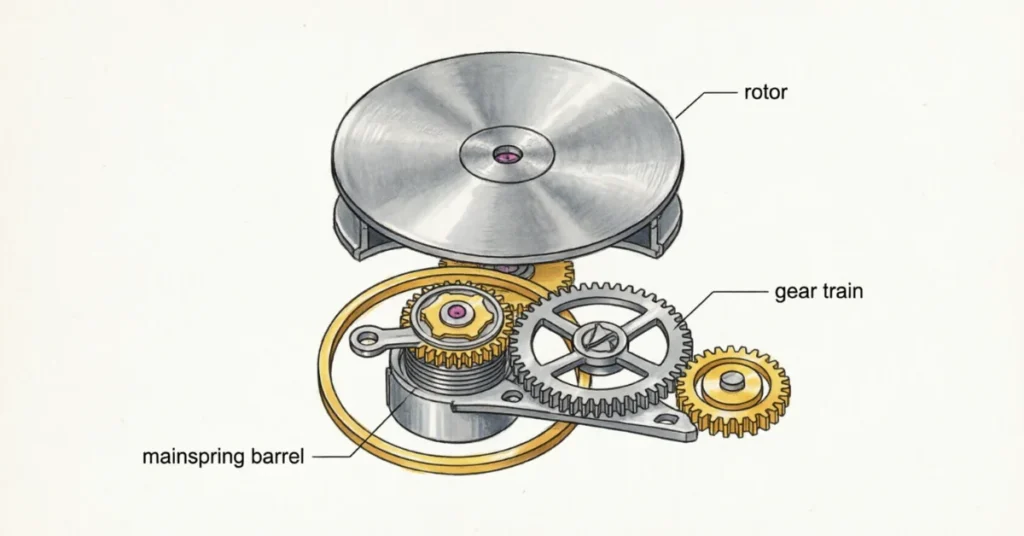
An automatic watch winds itself using the motion of your wrist. Inside sits a semi-circular weight called a rotor. As you move, the rotor spins on its pivot, and that motion feeds a mainspring through a chain of small gears. Wear the watch for eight to ten hours a day and it stays fully powered without you ever touching the crown.
This isn’t new engineering. Swiss watchmaker Abraham-Louis Perrelet experimented with self-winding pocket watches in the 1770s, and the concept became genuinely practical for wristwatches in the late 1920s. Most modern movements can also be wound by hand, which matters if the watch sits in a drawer for a few days and needs a jump start.
Compare that to a quartz watch, which relies on a battery and an electronic oscillator instead of a rotor and gears. Quartz wins on raw accuracy. Automatics win on the fact that nothing ever needs replacing at a jewelry counter every two years.
The Best Budget Picks Worth a Look Right Now
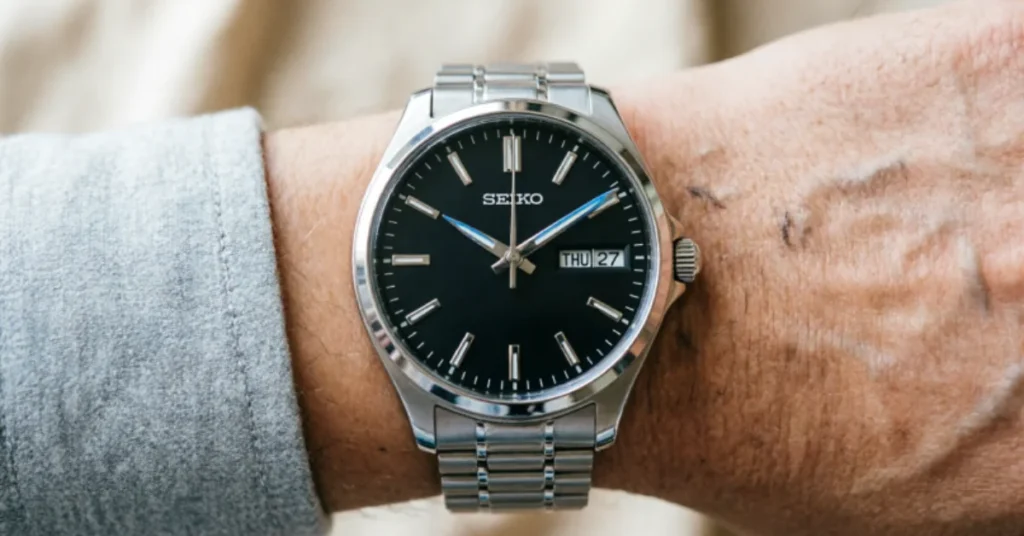
A handful of models keep showing up across enthusiast forums and retailer bestseller lists for good reason:
- Seiko 5 Sports (SRPD series): the reference point for entry-level automatics, built around Seiko’s proven 4R36 movement with day-date function and 100m water resistance.
- Orient Bambino: a dress watch with an in-house movement, domed crystal, and a look that punches well above its under-$250 price.
- Vostok Amphibia: a Russian dive watch built since 1967, known for a case design that actually tightens its seal under water pressure. Often available for around $100.
- Citizen NJ series: clean dial design and Citizen’s own movement heritage, a solid alternative if you’d rather avoid the Seiko-Orient duopoly.
- Ratio watches: built around the NH35 movement (a Seiko 4R35 derivative), typically paired with 200m water resistance and finishing that outpaces the price tag.
None of these are exotic. That’s the point. They’re proven, serviceable, and easy to find parts for years down the line.
Swiss Movement vs. Japanese Movement: Where the Money Goes
The biggest single driver of cost in any automatic watch is where the movement comes from. COSC-certified Swiss calibres carry a premium because of the certification process itself, along with decades of brand positioning. Japanese movements from Seiko’s own manufacturing arm, along with ETA-based Swiss calibres used under license, offer comparable reliability at a noticeably lower cost.
Brand infrastructure plays a role too. A company without boutique retail stores and heavy marketing budgets can pass real savings to the buyer. That’s part of why a brand like Orient can offer an in-house automatic movement for under $250, while a Swiss boutique brand charges four times that for a comparable spec sheet.
Neither option is objectively “better.” A Seiko-based NH35 movement and an ETA-based Swiss calibre both hack, hand-wind, and keep reasonable time. The difference mostly comes down to heritage, resale value, and whether the name on the dial matters to you.
NH35 vs. Miyota 8215: The Comparison Most Guides Skip
Within the Japanese movement tier itself, there’s a real split worth understanding before you buy. The Seiko-based NH35 supports hacking, which means the second hand stops when you pull out the crown, letting you set the time to the second. It also hand-winds, so you can top it up manually instead of waiting on wrist motion alone.
The Citizen-owned Miyota 8215 does neither of those things. Pull the crown and the second hand keeps sweeping. What it offers instead is a smoother, higher-beat sweep that some wearers find more pleasant to watch. Neither movement is more “reliable” than the other in daily use. The choice comes down to whether hacking and hand-winding matter to you, or whether a smoother sweep wins out.
What the Research Shows
Industry figures put the worldwide watch market at over $135 billion in revenue for 2026, with steady annual growth projected through the next several years. Mass-market and mechanical segments continue to hold a meaningful share of that figure, even as smartwatches expand their footprint.
That growth isn’t happening at the luxury end alone. Retailers and independent watchmakers report rising interest specifically in the sub-$300 mechanical bracket, driven by buyers who want a genuine mechanical movement without a four-figure commitment. The pattern lines up with what forum discussions and retailer bestseller lists already show: budget automatics aren’t a niche curiosity anymore. They’re a real, growing category with their own loyal following.
Where to Buy Cheap Watches Automatic Without Getting Burned
Authorized dealers matter more than people expect. A watch bought through an authorized retailer comes with a full manufacturer’s warranty and documentation. Grey market listings and undisclosed pre-owned inventory can carry voided warranties, even when the watch itself is genuine.
A few practical habits protect you:
- Buy from brand-direct websites or dealers listed on the manufacturer’s official retailer page.
- Check return policies before buying, especially online where you can’t try the watch on first.
- Be wary of listings priced far below everyone else’s. That’s rarely a coincidence.
- If buying secondhand, use payment methods with buyer protection, and ask for timestamped photos of the actual watch, not stock images.
Enthusiast forums and watch-specific marketplaces can turn up good deals, but treat unverified private sellers with the same caution you’d use buying anything else secondhand and expensive.
Common Mistakes First-Time Buyers Make
A few habits trip up almost everyone buying their first mechanical piece:
Assuming accuracy will match a quartz watch. It won’t, and that’s fine. A well-regulated automatic typically runs within 10 to 25 seconds a day. That’s a feature of the mechanism, not a defect.
Ignoring service costs down the line. An automatic watch benefits from servicing every four to seven years. It’s not expensive at this price bracket, but it’s a real cost that quartz owners never think about.
Buying based on listing photos alone. Case thickness, lug-to-lug width, and dial texture rarely translate well in a small product photo. Check the actual specs before assuming a watch will sit comfortably on your wrist.
Overlooking water resistance ratings. A 30-metre rating tolerates splashes, not swimming. If you want a beater you can actually wear in a pool, look for 100m or higher.
Every one of these mistakes is avoidable with five extra minutes of reading before checkout, which is really the whole point of a guide like this one.
Basic Care That Actually Extends the Watch’s Life
A short routine keeps a budget automatic running well past what its price tag suggests. If you own more than one watch and rotate between them, give the one you’re not wearing a 20-turn hand-wind once a week rather than letting it sit fully unwound for long stretches. This keeps the lubrication moving through the movement instead of settling in one spot.
Dive-style automatics need one extra step after ocean wear. Rinse the case and bracelet under fresh water once you’re done swimming, since dried salt works its way into the gaskets over time and shortens their life. Neither habit costs anything, and both matter more than people expect for a watch that’s meant to last decades.
A Quick Note on Wrist Size, Big or Small
Most budget automatic watches get designed with a 40mm-plus case, which sits fine on an average or larger wrist but overwhelms a smaller one. If your wrist measures under 6.5 inches, look specifically for models in the 36mm to 38mm range instead of assuming you have to size down within a single brand’s lineup. Orient’s smaller Bambino variants and several Seiko 5 dress references fit this bracket well, and they carry the same movement quality as their larger siblings. Case thickness matters just as much as diameter here. A thick automatic can look oversized on a slim wrist even when the diameter itself is reasonable, so check the full spec sheet rather than diameter alone before buying.
The opposite problem shows up just as often. If your wrist runs past 7.5 inches, a 38mm dress watch can look almost like a bracelet charm rather than a proper timepiece. Divers and field watches in the 42mm to 44mm range, such as the Vostok Amphibia or Citizen NJ series, wear more naturally at that size and won’t look undersized once strapped on. Lug-to-lug measurement matters here too. A wide case with short lugs can still wear smaller than the diameter suggests, so it’s worth checking that figure alongside the case width before ruling a model in or out.
Conclusion
Cheap watches automatic have quietly become one of the most genuinely competitive segments in the entire watch industry. You don’t need a four-figure budget to own a real mechanical movement with proper finishing and a brand name that’s earned decades of trust. Pick a model with a track record, buy from a source that stands behind its warranty, and you’ll end up with a watch that outlasts most of what sits next to it in a jewelry case.
FAQs
Are cheap automatic watches actually reliable?
Yes, provided you stick with well-known names like Seiko, Orient, or Citizen. Their movements have decades of production history and widely available replacement parts.
Why are automatic watches less accurate than quartz?
Automatics rely on a mechanical balance wheel instead of a quartz crystal oscillator, so small variations of 10 to 25 seconds a day are normal rather than a fault.
Do budget automatic watches need servicing?
Most benefit from a service roughly every four to seven years to keep the movement lubricated and running within spec, similar to maintenance on any mechanical device.
What’s the real difference between Swiss and Japanese movements at this price?
Both use proven mechanical designs. The gap in price usually reflects certification costs, brand positioning, and retail infrastructure rather than a meaningful difference in day-to-day reliability.
Is it worth paying more than $300 for an automatic watch?
Only if you want features unavailable at the lower tier, such as in-house Swiss movements, COSC certification, or premium case materials like titanium.